
Hydrocotyle Asiatica Q & 30: Homeopathic Uses, Side Effects

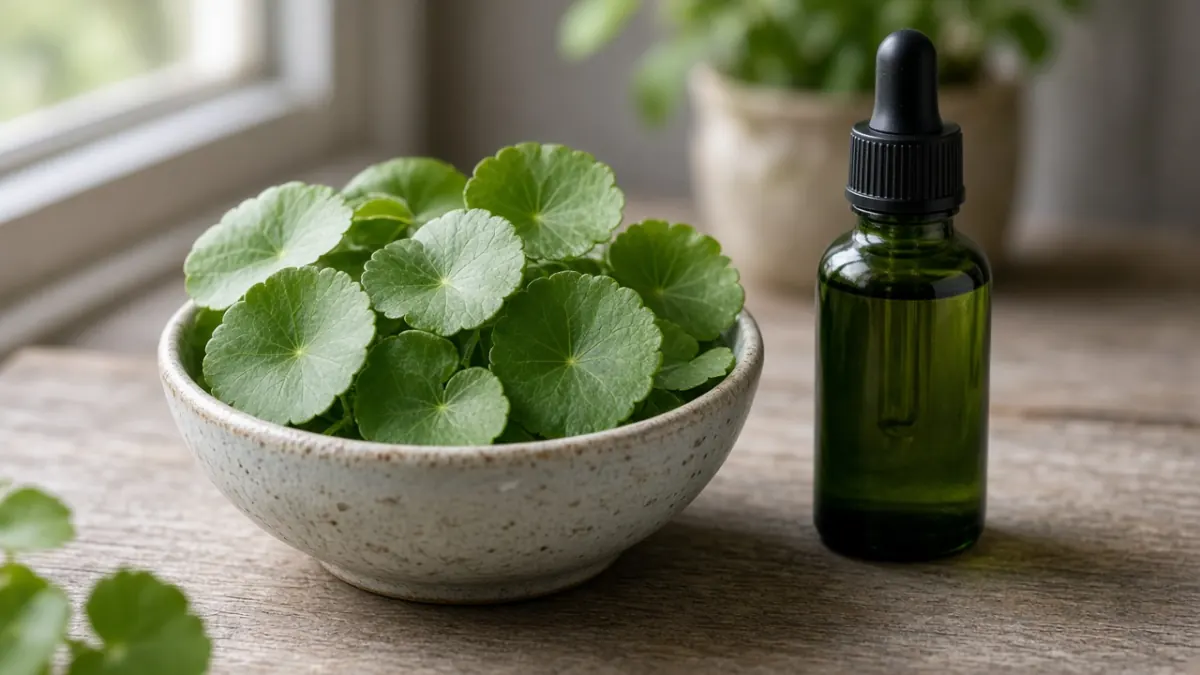
Hydrocotyle asiatica is the homeopathic name for the plant now called Centella asiatica, better known as gotu kola or Indian pennywort. Homeopaths classically prescribe it for skin that thickens and sheds scales — psoriasis, dry eczema and lupus without ulceration; some also extend it, beyond the classical picture, to pigmentary conditions such as leucoderma. It is sold as mother tincture (Q) and as 6C, 30C and 200C potencies.
What Is Hydrocotyle Asiatica in Homeopathy?
Hydrocotyle asiatica is a homeopathic medicine prepared from the whole fresh plant of Indian pennywort, and its recorded action is almost entirely on the skin and the female genital organs.
The plant itself is a small, prostrate, creeping herb of damp, shaded ground across India and much of tropical Asia: slender rooting stems trail along the soil and send up long-stalked, rounded to kidney-shaped leaves with gently scalloped edges, from which tiny pink-white flowers appear in short clusters. Gotu kola is the common name most people search for; the whole fresh plant — leaves, stem and root — is harvested to make the mother-tincture extract used in homeopathy.
The accepted botanical name today is Centella asiatica (L.) Urban; "Hydrocotyle asiatica L." is Linnaeus's 1753 name, surviving as the drug name in homeopathic pharmacies. A bottle labelled Hydrocotyle asiatica Q and one labelled Centella asiatica hold the same plant. Other names: gotu kola, Asiatic or Indian pennywort, spadeleaf, coinwort and, in Ayurveda, mandukaparni or brahmi-buti. Note that "Brahmi" alone is ambiguous in most of India — it commonly refers to Bacopa monnieri, a different, unrelated memory-and-nerve-tonic herb — so a product simply labelled "Brahmi" should not be assumed to be this remedy; mandukaparni is the safer, unambiguous name to look for. Hydrocotyle asiatica is often typed hydrocotyl, hydrocotile or hidrocot — same remedy.
Clarke put its sphere plainly: skin and the female generative organs are the chief seats of action, with liver, nerves and mucous membranes secondary. Boericke's idea was interstitial inflammation and cellular proliferation — tissue that thickens and hardens instead of healing flat.
Why Q Is Not a Potency
The mother tincture (Q or Ø) is a hydro-alcoholic extract of the whole plant, made to a defined drug strength under the Homoeopathic Pharmacopoeia of India. It still holds real plant material and a lot of alcohol. Potencies are made from it by serial dilution with succussion, and above about 12C no measurable plant material remains. That difference drives everything below.
Hydrocotyle Asiatica at a Glance
| Item | Detail |
|---|---|
| Source | Whole fresh plant of Centella asiatica (Apiaceae), historically Hydrocotyle asiatica L. |
| Also called | Gotu kola, Indian pennywort, spadeleaf, coinwort, mandukaparni, brahmi-buti |
| Forms sold | Mother tincture (Q), dilutions 6C / 30C / 200C / 1M, globules, LM |
| Main classical uses | Psoriasis with thick scaling, dry eczema, lupus without ulceration, connective-tissue/scar changes (inferred), pruritus vulvae, leucorrhoea |
| Classical dose (Boericke) | First to sixth potency |
| Typical Q dose | 5–10 drops in half a cup of water, 2–3 times daily, after food |
| Time to judge response | 4–6 weeks for skin, not days |
| Safety in brief | Potencies above about 12C (30C and higher) carry no measurable material dose; the mother tincture and low potencies (3C–6C) are a real herbal dose and need a time limit |
Hydrocotyle Asiatica Uses for Skin
One thread runs through every skin indication: skin that thickens, hardens and sheds scales.
Psoriasis with Thick, Scaly Plaques
Hydrocotyle is classically indicated for psoriasis where the skin is markedly thickened and scaling heavily. Boericke's keynote is "great thickening of the epidermoid layer and exfoliation of scales" — the outer skin layer piles up and flakes off. He names psoriasis gyrata: plaques spreading in rings and curving bands rather than plain patches, on trunk, limbs, palms and soles. It is a local tissue indication, usually paired with a constitutional remedy. See our guide to psoriasis and homeopathy.
Leucoderma and Vitiligo: Not a Classical Indication
Leucoderma and vitiligo do not appear as indications for Hydrocotyle asiatica in Boericke, Clarke or Hering — none of the three classical sources this article draws on records a pigment-loss picture for this remedy. Some contemporary homeopaths use it here anyway, by extension from its other documented skin actions (thickening, hardening and altered texture of tissue) rather than from any proving or clinical report specific to depigmentation. Treat that as an off-label extension, not a sourced classical picture, and expect repigmentation of an established patch to be slow in any system of medicine. Our page on vitiligo and homeopathy sets out the realistic approach.
The remedy suits dry, rough, scaly eruptions rather than weeping ones, with intolerable itching. Boericke singles out itching of the soles, an unusual and useful pointer. Clarke records a prover whose itching eased while rubbing and returned the moment rubbing stopped. Where eruptions ooze or crust, other remedies fit better — see eczema and homeopathy | Localised skin thickening and scaling; commonest form sold | 5–10 drops in half a cup of water | 2–3 times daily, after food | Bounded course under 6 weeks |
| 3C to 6C | Boericke's range: chronic scaling, pruritus vulvae, leucorrhoea | 4 globules or 5 drops | 2–3 times daily for 3–4 weeks | Fine for short self-limited use |
| 30C | Common retail potency, same skin picture | 4 globules or 5 drops | Once or twice daily, stop on improvement | Review at 3–4 weeks |
| 200C | A low potency helped, then stalled | 4 globules, single dose | Days to weeks apart | Prescriber only |
| 1M and above | No classical basis here | Single dose | Rarely repeated | Prescriber only |
Hydrocotyle asiatica 30 uses. In practice, 30C is what most people are handed over the counter for scaly eruptions, dry patches and chronic vulval itching. It holds no molecules of the plant, so it cannot irritate stomach or liver, and it is the safest way to trial the remedy. Give it two to four weeks, then stop if nothing has moved.
Hydrocotyle asiatica 200 uses. Same indications, on the infrequent-dose principle: one dose, wait and watch, repeat only if progress stalls. There is no classical warrant for it here, so leave it — and 1M — to a prescriber. Potency choice is a convention of practice, not dose-response science: no trial has compared 6C with 30C with 200C of Hydrocotyle.
Hydrocotyle Asiatica Q (Mother Tincture): Dosage and External Use
The mother tincture is the form most people buy and the one needing most care, because it delivers real plant material in strong alcohol.
Homeopaths typically advise 5 to 10 drops in half a cup of water, two to three times daily, after food to reduce stomach irritation. Ignore the 30–60 drop figures circulating online — those are herbal fluid-extract doses for a different preparation. Always dilute, never take it neat, and review the course at four to six weeks rather than running it open-endedly.
There is no standardised topical dilution for Hydrocotyle asiatica Q in any pharmacopoeia or monograph — so treat any precise drop-in-water figure you see for external use as unsourced. Practitioners typically advise a well-diluted solution applied to a small area with gauze; confirm the exact strength and frequency with your prescriber rather than following an unverified drop count. Patch-test first: allergic contact dermatitis is the best-documented skin reaction to this plant. Never apply it to broken skin, ulcers or raw eczema.
How to Take Hydrocotyle Asiatica
Take drops or globules on a clean mouth, with a 20 to 30 minute gap from food, coffee, tea, strong mint or tobacco. Let globules dissolve under the tongue, and store below 30°C away from strong smells. For children, use a potency rather than the undiluted mother tincture, and only at a homeopath's direction — this means any appropriate diluted potency such as 6C or 30C, not specifically a high one; 1M and above stay prescriber-only regardless of age. Judge the prescription at four to six weeks — no change by then usually means the wrong remedy, not too small a dose.
Hydrocotyle Asiatica Side Effects: Mother Tincture vs Potencies
The honest answer depends entirely on which form you are holding. The cutoff used below matches the no-material-dose point described earlier (above about 12C): low potencies such as 3C and 6C still carry a small residual dose of plant material and should be treated with the same caution as the tincture, not assumed side-effect-free the way 30C and higher are.
| Attribute | Mother tincture (Q) and low potencies (3C–6C) | Potencies above 12C (30C and higher) |
|---|---|---|
| Plant material | Yes, plus (for Q) a high-alcohol vehicle | None measurable |
| Common effects | Nausea, acidity, loose stools (often the alcohol base in Q); drowsiness | None commonly reported |
| Skin | Allergic contact dermatitis, mainly on topical use of Q | Not reported |
| Liver | Real concern with Q — see below | Not applicable |
| Occasional | Headache, dizziness | Brief aggravation lasting a day or two |
| Course length | Capped near six weeks | Reviewed at 3–4 weeks, stopped on improvement |
The liver point matters and almost no page mentions it. That risk belongs to the plant — so to the mother tincture and to gotu kola capsules, not to a 30C or higher. Stop the Q at once if jaundice, dark urine, pale stools, unusual tiredness or right-sided rib pain appear.
Who Should Avoid Hydrocotyle Asiatica
These cautions apply to the mother tincture and to herbal gotu kola.
- Pregnancy and breastfeeding. Do not use the tincture; safety is not established and the alcohol alone rules it out.
- Children. No mother tincture; potencies only, at a homeopath's direction.
- Liver disease, past drug-induced liver injury, other liver-loading medicines, or regular drinking. Avoid the tincture entirely.
- Sedatives, sleeping tablets or anti-anxiety medicines. Gotu kola can add to drowsiness.
- Allergy to the carrot and celery family (Apiaceae). Centella belongs to it; cross-reaction is a recognised contraindication.
- Disulfiram or metronidazole, or recovery from alcohol dependence. The alcohol base rules the tincture out.
- Memorial Sloan Kettering notes a laboratory signal that gotu kola may affect CYP450 enzymes; tell your doctor if you take long-term medication.
Never stop a prescribed medicine for diabetes, blood pressure, thyroid or epilepsy in order to take a homeopathic remedy.
Homeopathic Hydrocotyle vs Herbal Centella and Gotu Kola Supplements
Same plant, two different preparations — and mixing up their evidence is the commonest error on this topic. Herbal gotu kola (standardised extracts at 60–120 mg a day, or dried-leaf capsules at 600–1800 mg a day) contains measurable asiaticoside, madecassoside, asiatic acid and madecassic acid, and that is where the wound-healing and venous-insufficiency research sits. A 30C or 200C contains none of those molecules, so none of that research transfers to it. If you searched "hydrocotyle 500 mg", you found a herbal capsule dose: homeopathic products are labelled Q, 6C, 30, 200 or 1M, never in milligrams.
Comparable Remedies: Which One When
| Remedy | Chosen instead of Hydrocotyle when |
|---|---|
| Arsenicum album | Dry scaly skin with burning relieved by warmth, restlessness and anxiety |
| Graphites | Cracked skin oozing sticky honey-like fluid, especially in folds |
| Sulphur | Hot, intensely itchy skin, worse from bathing and at night in bed |
| Sepia | Ring-shaped patches with hormonal aggravation and marked exhaustion |
| Berberis aquifolium | Dull, blotchy skin and pigmentation rather than thick scaling |
Clarke also relates Hydrocotyle to Hura, Thlaspi, Fraxinus, Mitchella and Apis; Boericke adds Elaeis and Aurum.
When to See a Doctor
Homeopathy is not the right first step for any of these.
- Any pale or discoloured patch with loss of sensation, or thickened nerves — this needs leprosy screening.
- A mole or lesion changing shape, colour or size, bleeding, or not healing.
- Spreading redness with fever, or an ulcer with pus.
- Yellow eyes or skin, dark urine, pale stools or right-sided rib pain — stop the tincture and get liver function tested.
- Any genital ulcer, or discharge with pain or fever — gonorrhoea and syphilis need antibiotics.
- Psoriasis with swollen, painful joints, which may be psoriatic arthritis.
What the Evidence Actually Shows
Keep two evidence streams apart. For the crude plant and its standardised extracts there is genuine but modest human research: a 2013 review of eight trials found possible benefit in chronic venous insufficiency, though the trials were poorly reported, and a 2017 meta-analysis of eleven randomised trials found no significant cognitive benefit over placebo. For potentised dilutions there are no controlled trials at all; the indications above come from provings and nineteenth-century clinical reports, and concluded, after reviewing 57 systematic reviews covering 176 individual studies, that no condition has reliable evidence of homeopathy being effective. We prescribe on classical indications and observed response.
This article is educational, reviewed by the practising homeopaths at WeClinic Homeopathy, and is not a prescription. Confirm any dose with a qualified BHMS or MD (Hom) practitioner who has seen your case.
Frequently Asked Questions
What is Hydrocotyle asiatica used for in homeopathy?
Is Hydrocotyle asiatica the same as gotu kola and Centella asiatica?
What is the difference between Hydrocotyle asiatica Q and 30?
How many drops of Hydrocotyle asiatica Q should I take?
What are the side effects of Hydrocotyle asiatica Q?
Does Hydrocotyle asiatica 30 have side effects?
Which potency of Hydrocotyle asiatica is best for psoriasis?
Is Hydrocotyle asiatica good for vitiligo or white patches?
How long does Hydrocotyle asiatica take to work?
Is hydrocotyle 500 mg the same as homeopathic Hydrocotyle asiatica?
Can Hydrocotyle asiatica be taken daily, and for how long?
Have questions about your symptoms? Talk to a WeClinic™ homeopathic doctor, free.
Call Now - Free Consultation