
Aconitum Napellus 30: Uses, Dose, Side Effects

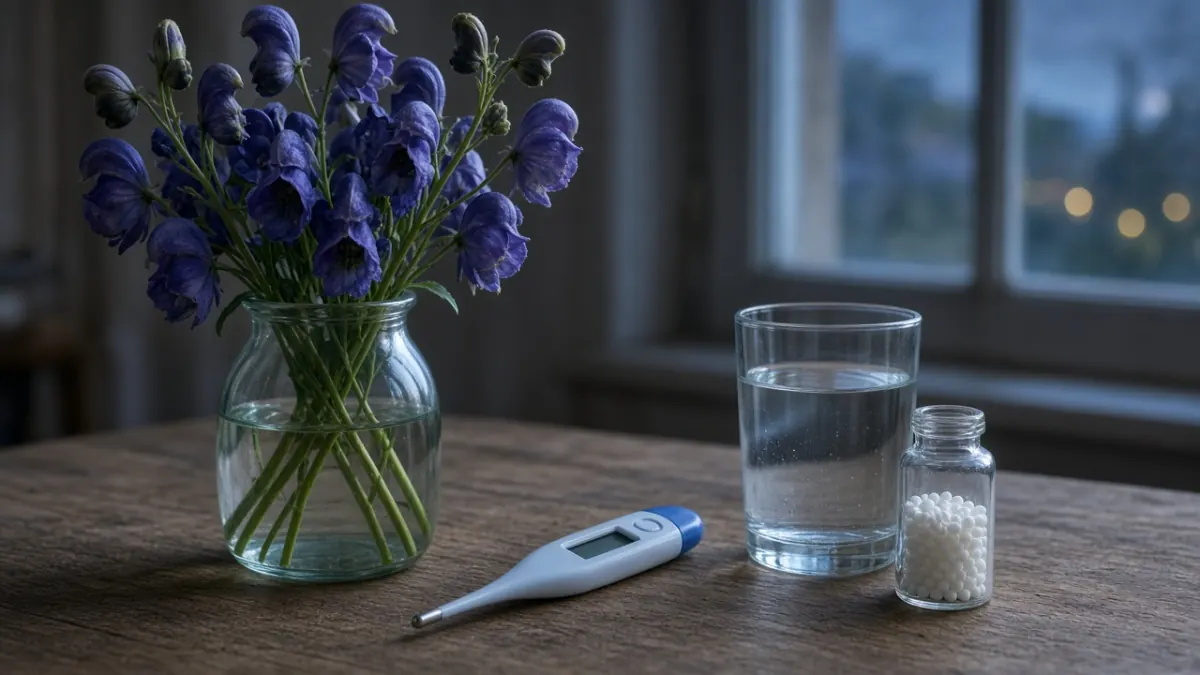
Short answer: Homeopathic Aconitum napellus (Aconite) is made from monkshood or wolfsbane, Aconitum napellus, and is sold in India mostly as 30C or 200C pellets. Classical materia medica uses it for the first hours of a sudden, violent illness after a fright or exposure to cold dry wind: abrupt fever, restlessness, fear, thirst, hot dry skin. The raw plant contains aconitine, a deadly cardiotoxic and neurotoxic poison, so the plant, its root, and the mother tincture (Q) are never home remedies. No good clinical trial shows that Aconite 30 treats fever, panic, or colds.
This article is for searches like aconitum napellus 30, aconite 200 uses, aconitum napellus homeopathic medicine, aconite for fever, aconite for panic attack, aconite for sudden cold, aconitum napellus side effects, aconite q and the same queries typed in Hindi, Bengali, Tamil, Telugu or Malayalam. YMYL: the plant is a poison, and "panic" with chest pain can be a heart attack.
Author: Dr. Dheeraj Sharma, BHMS. Based on: Boericke's Materia Medica with Repertory (Aconitum napellus), paraphrased, for the classical picture; and the standard toxicology of aconitine, which holds sodium channels open in nerve and heart muscle.
Key takeaways
- User intent: "Which Aconite potency for fever, panic, or a sudden cold, and is it safe?" Finished 30C pellets are a high dilution. The plant and the tincture are a different, lethal thing.
- Picture that matters: sudden onset within hours of a fright or cold dry wind, with fear and restlessness, thirst, and a hot dry skin. Slow-building illness is not this picture.
- Hard rule: never touch, crush, brew, or swallow monkshood, its root, or a home-made "tincture". Do not take Q without a clinician.
- Emergency rule: fever in a baby under 3 months, breathing trouble, or chest pain, palpitations, or arm tingling with "panic" is an emergency. Call 108 or 112. Do not reach for a pellet.
Aconitum Napellus at a glance
| Item | Detail |
|---|---|
| Names | Aconitum napellus, Aconite, monkshood, wolfsbane. Related Indian aconites (Aconitum ferox, vatsanabha) are Ayurvedic raw materials, not this medicine |
| Plant | Aconitum napellus (family Ranunculaceae), a perennial of cool, mountain regions with hooded blue-purple flowers |
| Part used | The fresh plant, per the pharmacopoeia; the root tuber carries the most alkaloid |
| Toxic principle | Aconitine (with mesaconitine, hypaconitine). Present in the raw plant and in low-strength preparations |
| Forms sold in India | Pellets (6C, 30C, 200C, 1M), liquid dilutions, and mother tincture (Q) at some pharmacies |
| Classical sphere | Sudden fever and chill; fright, shock and panic; croup and colds in the first hours; restlessness and fear of death |
| Usual adult dose (30C, as commonly labelled) | About 4-5 pellets, or the drops on the label, for a few doses in the first hours of a sudden illness. Read the bottle; labels vary |
| Evidence snapshot | Classical keynotes. No good clinical trials for fever, panic, croup, or colds |
| Safety | 30C and above contain no measurable aconitine. Never take the plant, powder, or a home-made tincture |
What the plant is (and is not)
Monkshood has been known as a poison for centuries, used on arrow tips and in poisonings, and gardeners are advised to wear gloves because aconitine can be absorbed through the skin. Aconitine keeps sodium channels in nerves and heart muscle open, so poisoning begins with tingling and numbness of the mouth and limbs, then vomiting, sweating, weakness, and dangerous heart-rhythm disturbances. Deaths have followed even small amounts of raw root.
Homeopathic potencies are made by diluting the plant tincture 1 to 100, again and again. A 30C has been diluted that way thirty times. Past roughly 12C, chemistry expects not one molecule of the original compound to remain, so 30C and 200C pellets carry no measurable aconitine. The mother tincture (Q) is the plant extract itself and contains the alkaloids. Herbal "aconite" or Ayurvedic raw vatsanabha, even processed, is a separate drug with its own risks.
What Boericke and classical materia medica say
Paraphrased, not quoted:
Onset. The key note is suddenness: a violent, abrupt beginning, often within hours of exposure to cold dry wind or after a fright or shock. It is described as a remedy of the first stage, before the illness has settled in.
Mind. Fear, anxiety, and restlessness, tossing and unable to settle. Fear of death, of crowds, or of crossing the road is described. The classical picture includes numbness and tingling.
Fever. Sudden chill and then high fever with a hot, dry skin, thirst for cold water, a red face that may turn pale on sitting up, and a fast, strong pulse. Worse at night, especially around midnight, and in a warm room.
Respiratory. Early sneezing, a dry hot nose, and a hoarse, barking cough that comes on after a cold wind (classical "croup" picture).
Compared with others. Homeopaths often compare Belladonna (sudden fever with a flushed, throbbing head, without the fear) and Gelsemium (slow, heavy, drowsy flu). Aconite is for the frightened, restless, abrupt picture.
Uses, matched to the search
Fever: aconite for sudden fever
Aconite is classically given in the first hours of a sudden fever with chill and thirst. No trial shows it shortens a fever. Fever is a symptom, not a diagnosis: in monsoon season in Kanpur it can be dengue, malaria, typhoid, or a urinary infection, and a pellet is not a test. See viral fever and homeopathy. A fever lasting more than three days, or one at or above about 40 °C (104 °F), needs a doctor and blood tests.
Panic and fright: aconite for panic attacks
The classical use is for acute fear after a shock, with a racing heart and a feeling of impending death. That same picture is the textbook description of a heart attack, especially with chest pressure, sweating, or tingling in the left arm. A first "panic attack" with chest symptoms must be treated as cardiac until a doctor says otherwise. Recurrent panic has effective treatments (talk therapy, medicines); do not stop prescribed medicines. See anxiety care at WeClinic.
Sudden cold after cold wind
A cold is self-limiting and usually settles in about a week. No trial shows Aconite shortens it. If a child's cough turns barking and noisy, see the red flags below; that can be croup.
What people add, and what does not belong
Arthritis, neuritis, nerve pain, toothache, "boosting immunity", and ointment use are listed on pharmacy pages, but there is no trial support, and skin contact with aconite is not harmless. Heart disease, high blood pressure, and sepsis are not reasons to buy this bottle.
Fact check against older pharmacy pages
Claims you will see online, and what is true:
| Claim | Fact check |
|---|---|
| "Mother tincture, 1-3 drops every 3-4 hours for pain or fever" | Q contains aconitine. It is prescriber-only and is not a home dose |
| "Make your own tincture from the leaves, flowers, and roots" | Never. Handling the plant and root can poison you, and the root is the most toxic part |
| "Stimulates the immune system, boosts immunity" | No evidence. A 30C pellet contains no measurable plant material |
| "Treats arthritis, neuritis, headache, sore throat, anxiety" | A classical keynote list, not a trial result. Each needs its own assessment |
| "Typical dose for children is 12C three times a day" | No schedule is established. Babies under 3 months with fever need a doctor |
| "Homeopathic is safe in any form" | True only for finished high dilutions. The potency on the label decides it |
Dosage by form
| Form | What's in it | What to do |
|---|---|---|
| 30C pellets | No measurable aconitine | The usual home potency. About 4-5 pellets (or the label dose) under the tongue, a few times in the first hours of a sudden illness. If nothing changes, stop and get checked |
| 200C pellets | No measurable aconitine | Usually a prescriber's choice for acute shock or fear, one dose or a few. No trial compares 30 and 200 |
| 1M and above | No measurable aconitine | Prescriber only |
| 6C and lower, X potencies, liquid low dilutions | More of the original than 30C | Only if a prescriber advised and gave the label dose |
| Mother tincture (Q) | The plant extract with aconitine | Not for self-care. Do not take it without a clinician |
| Raw plant, root, powder, home extracts | Aconitine | Never. Emergency if swallowed or if the mouth tingles after contact |
Read more in the potency guide and the mother tincture guide.
Practical points. Let pellets dissolve under the tongue. Many homeopaths ask you to avoid food, coffee, and mint for about 15 minutes; that is a convention, not a tested rule. For children, follow the paediatrician's or homeopath's instruction and the label.
Side effects and risks
| Risk | Who it hits |
|---|---|
| Tingling and numbness, nausea, vomiting, sweating, weakness, slow or irregular heartbeat, breathing failure, death | Anyone who swallows the plant, root, powder, or tincture |
| Skin tingling or numbness after touching the plant | Gardeners and handlers without gloves |
| Sugar in pellets, alcohol in liquid dilutions | Diabetes, alcohol avoidance, young children. Check the label |
| Temporary worsening | Some people report symptoms feeling stronger for a day. Stop and review if it persists |
| Missed diagnosis | Fever, chest pain, or panic treated only with pellets while a cause goes unfound |
No poisoning is documented from finished 30C pellets in the way it is from the plant. No drug interactions are established for them. Safety data in pregnancy and breastfeeding are lacking, so never take raw material and ask your doctor about pellets. More in homeopathy side effects.
When to see a doctor
- Chest pain or pressure, pain spreading to the arm, jaw, or back, sweating, breathlessness, palpitations, or fainting, even if it feels like "panic": 108 or 112 now
- Fever in a baby under 3 months, a seizure, or a child who is drowsy, limp, or hard to wake
- Noisy breathing at rest, a barking cough with a harsh sound on breathing in, blue lips, or drooling
- Fever with stiff neck, severe headache, confusion, repeated vomiting, or a rash that does not fade when pressed
- Fever beyond three days, or about 40 °C (104 °F) or more, or fever in dengue and malaria season
- Any swallowed plant, root, powder, or tincture, or a tingling mouth after contact: 108 or 112, and take the bottle or plant
WeClinic, Panki, Kanpur — 10 AM–9 PM, closed Monday. Call +91 7905136461. Bring the bottle and say the potency on the label. Author: Dr. Dheeraj Sharma.
Frequently Asked Questions
What is Aconitum napellus used for in homeopathy?
What is Aconitum napellus 30 used for, and how much should I take?
What is the difference between Aconite 30 and Aconite 200?
Is aconite good for fever, panic, or a sudden cold?
Is Aconitum napellus poisonous? What about aconite Q?
What are the side effects of Aconitum napellus?
Can children, babies, or pregnant women take Aconitum napellus?
Is monkshood the same as vatsanabha or aconite in Ayurveda?
Have questions about your symptoms? Talk to a WeClinic™ homeopathic doctor, free.
Call Now - Free Consultation