
Homeopathy Potency Guide: 6X, 30, 200, 1M & Q

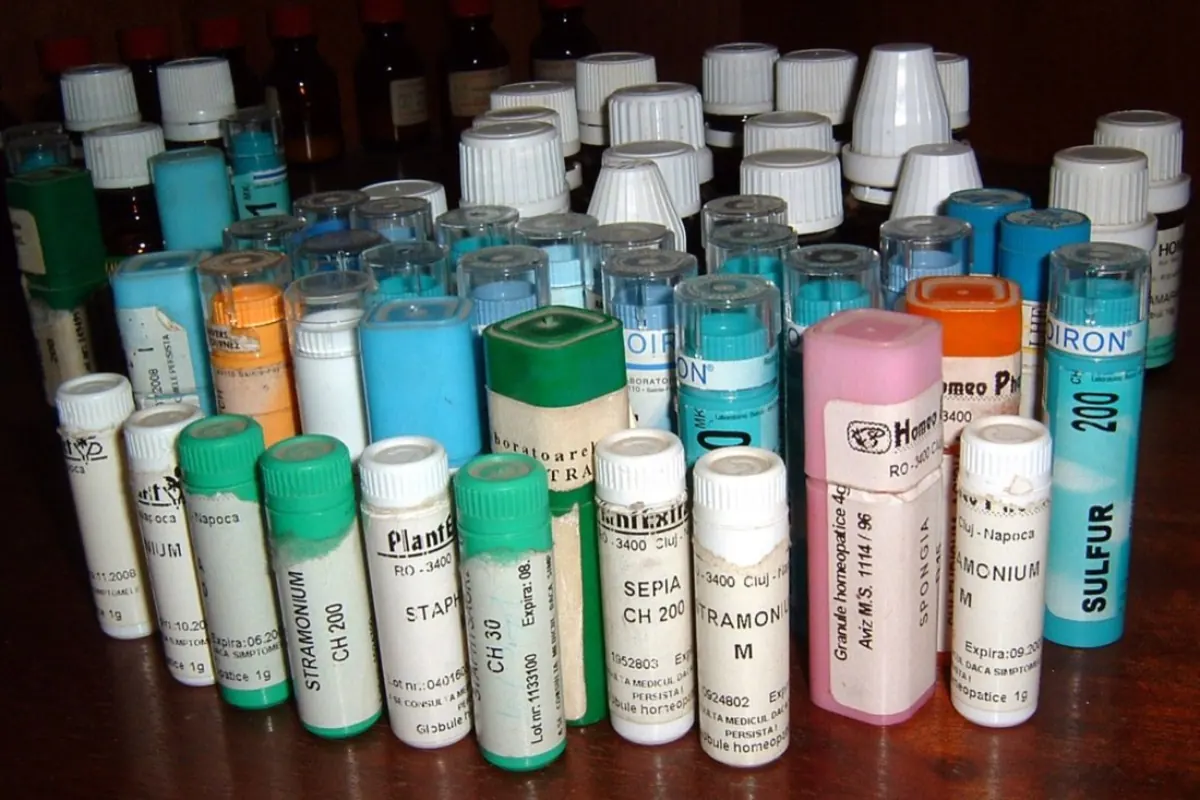
The number on your bottle counts dilution steps. It is not a dose. A bigger number means the medicine was diluted more, not that it is stronger. 6X means diluted 1 part in 10, six times over. 30 means 1 part in 100, thirty times over. And Q on an Indian label almost always means mother tincture — the undiluted extract, and the one form that can carry a real drug dose.
The number on your bottle is not a dose
Two things get mixed up on almost every homeopathy page.
Potency is how the liquid was made — the 6X, the 30, the 200.
Dose is what you swallow and how often — the drops, the pills, the timing.
The label prints the first and says little about the second. That gap is why you are confused.
Put plainly: the number of dilution steps is what the potency number records. D3 means a 1-in-10 dilution done three times over, and the liquid is shaken after every step.
What each letter on the label means
| On the label | What it is | One step |
|---|---|---|
| X or D | Decimal scale | 1 part in 10 |
| C or CH | Centesimal scale (H is for Hahnemann) | 1 part in 100 |
| A bare number, like "30" | The same as C | 1 part in 100 |
| M | 1,000 centesimal steps, so 1M = 1000C | 1 part in 100 |
| K or CK | Korsakov's single-glass method | 1 part in 100 |
| Ø, MT or TM | Mother tincture — not diluted at all | none |
| Q | Two opposite meanings. See the Q section. | — |
Two X steps equal one C step. So 12X and 6C are the same dilution — the numbers look nothing alike, the liquid is identical. M, 10M, 50M and CM are trade shorthand for 1,000, 10,000, 50,000 and 100,000 centesimal steps, which is convention rather than a defined standard.
Ø, MT and TM are the official marks for a mother tincture. That same regulator names all three.
Why an Indian bottle often says just "30"
Nothing is missing from your label. SBL, Schwabe India, Reckeweg and B. Jain all print "30", "30C" and "30CH" for the same thing. Indian labels are not consistent, though — Reckeweg sells Blatta orientalis marked "1X (Q)", two systems on one carton.
The arithmetic, done properly
Most pages give the ratio and stop. Here are the real numbers.
| Potency | Dilution | In plain words |
|---|---|---|
| 6X | 10⁻⁶ | one part per million |
| 12X | 10⁻¹² | one part per trillion |
| 6C | 10⁻¹² | exactly the same as 12X |
| 30 (30C) | 10⁻⁶⁰ | nothing of the substance left |
| 200 (200C) | 10⁻⁴⁰⁰ | nothing of the substance left |
| 1M (1000C) | 10⁻²⁰⁰⁰ | nothing of the substance left |
12X is a million times more dilute than 6X, not slightly deeper
Other sites call 12X "a step up" from 6X. Do the sum. 6X is one part per million; 12X is one part per trillion — a million-fold gap, not a doubling.
This matters most on the tissue-salt shelf, where Calcarea Fluorica and the other biochemic tissue salts are sold as 6X and 12X.
Where the last molecule disappears
One mole of any substance holds a fixed number of molecules: 6.02214076 × 10²³, a figure fixed exactly by definition.
- 12C and 24X are both 10⁻²⁴ — the same number on two scales.
- Start with one mole. At 23X about 6 molecules are left.
- At 24X about 0.6 of a molecule is left, which means none.
So the last molecule runs out between 23X and 24X — right at 12C. The classical "Avogadro limit" checks out. This is arithmetic, not opinion.
So what is actually in a 30, a 200 and a 1M
Nothing of the original substance.
To expect a single molecule in a 30C, you would need about 1.7 × 10³⁵ kg of it — roughly 28 billion Earths, or 83,000 Suns. A 200 is 10⁻⁴⁰⁰; a 1M is 10⁻²⁰⁰⁰.
Many homeopathic products are so dilute that no molecules of the original substance remain. Chemically, a 30 or a 200 is sugar, water and alcohol.
Is 200 stronger than 30?
No. Not the way 500 mg of paracetamol is stronger than 250 mg. There is less of the substance in a 200, not more, and past 12C there is none in either bottle.
People search this as "30 vs 200" for almost every remedy — Acid Phos 30 vs 200, Hepar Sulph 30 vs 200, Lycopodium 30 vs 200. The answer is the same each time, because it is a fact about the scale, not about the plant or mineral in the bottle.
Homeopathic doctrine claims something else. Higher potencies are held to act more deeply and last longer, so they are given less often. Lower ones are repeated more often. James Tyler Kent wrote it himself in 1900: "By giving higher and higher potencies the remedies seemed to operate more and more interiorly."
He wrote seemed. That is an observation from practice, a century old.
Nobody has measured how long a homeopathic dose acts. No trial has shown that a 200 does anything different from a 30. So the strange part is real: the bigger number means more dilute, and it is repeated less, not more.
Boericke's Hepar sulph line shows direction, not size
William Boericke's dose line for Hepar sulphuris, in the 1922 Pocket Manual, settles it:
"First to 200th. The higher potencies may abort suppuration, the lower promote it. If it is necessary to hasten it, give 2x."
Same remedy. Opposite intended effects.
Think of a boil. To bring it to a head, the low potency is classically chosen; to stop it forming, the high one is. So the scale encodes direction, not brute force — and that has never been tested either.
Q is the most confusing label in Indian homeopathy
Read this even if you skip the rest.
In classical and European usage, Q means the fifty-millesimal potency — the LM. The name comes from the Latin quinquaginta milia, fifty thousand, and traces back to the homeopath Jost Künzli von Fimmelsberg. Rudolf Flury preferred to write it LM. Both marks are still used.
On an Indian pharmacy shelf, Q means the opposite. It means mother tincture. B. Jain Pharmaceuticals lists its own mother tincture range as Abroma Augusta Q, Abrotanum Q, Acalypha Indica Q, and so on.
Same letter. Opposite ends of the whole dilution range.
One likely reason is that Ø is awkward to print, but we could not verify that. The outcome is what matters.
How far apart the two Qs really are
A mother tincture is crude extract in alcohol — real substance, in weighable amounts. An LM/Q is not. 1 × 10⁻¹⁴⁷.
So "take 10 drops of Q in water" means nothing measurable with an LM. With a mother tincture it means a real dose of plant extract in alcohol. If the plant is toxic in crude form, that is the whole story.
How to tell which Q you are holding
Signs it is an Indian mother tincture:
- The words "mother tincture", or the symbol Ø, MT or TM
- An alcohol percentage on the label
- A 30 ml or 100 ml amber dropper bottle, with a strong plant or alcohol smell
Signs it is a classical LM/Q potency:
- Degrees in Roman numerals, I to XXX
- The letters LM, or notation like 0/1 or 0/3
- Sold as medicated globules, not bulk liquid
If you cannot tell, do not guess — take the bottle to a pharmacy or a clinic. Our guide to homeopathic mother tinctures covers the Ø forms.
The real risk is at the mother tincture end, not the 200 end
Most homeopathy pages have this backwards. They warn that 200 and 1M are "powerful" and treat Q and 1X as gentle. The reverse is true. Some products have been found to hold measurable amounts of active ingredient. Because homeopathic medicines are sometimes made from known poisons, a measurable amount of one can cause real harm.
The same warning applies to heavy metals in products that are not highly diluted.
In plain words: a 200 cannot poison you, because there is nothing in it. A mother tincture or a 1X can. See our page on homeopathy side effects.
The one table you can actually use
The whole system on one screen. Read the caption below.
| Form on the label | How it is made | How often it is conventionally repeated | Self-prescribing |
|---|---|---|---|
| Ø / MT / TM / Q (India) | Crude extract in alcohol. Not diluted. | Diluted in water each time | No. Real substance, real risk. |
| 1X to 3X | 1 in 10, one to three times | Often | No. Measurable substance can remain. |
| 6X and 12X | 1 in 10, six or twelve times | Daily courses over weeks | Short courses. Tell your doctor. |
| 30 (30C) | 1 in 100, thirty times | Less often. Stop at improvement. | Better with a prescriber. |
| 200 (200C) | 1 in 100, two hundred times | Rarely. Often a single dose. | No. Prescriber only. |
| 1M and above | 1 in 100, a thousand times or more | Rarely | No. Prescriber only. |
| LM / Q (classical) | Far more dilute than a 200 | Hahnemann gave these daily | No. Prescriber only. |
Those last two columns are prescribing convention, from classical texts and homeopathic training — not measured dose-response science. No trial has compared these schedules. And in India, 200, 1M and CM are sold over the counter. Easy to buy is not the same as safe to take.
! jpg)
Modern sites call this "plussing" and rarely say where it came from.
The remedy is dissolved in water. Before every dose the bottle is shaken — "potentized anew with perhaps 8, 10, 12 succussions" — then a teaspoon is taken. His intervals:
- Chronic illness — daily, or every second day
- Acute illness — every two to six hours
- Very urgent cases — every hour, or more often
One bottle lasts seven to fifteen days, then is remade at a higher potency. He shakes before each dose, so no two doses are the same potency. And in his final edition he dosed daily, not once a year.
How to take it: what counts as one dose
A dose is what you swallow, not the number on the label.
Globules and pills. The medicine coats the outside of the sugar pill, so four pills are not "twice as much" as two. Indian packs commonly suggest 4 to 5 globules for adults and 3 to 4 for children, left on the tongue to dissolve. That is seller guidance, not a measured dose.
Liquid dilutions. The common Indian format. Drops go on the tongue, or in a spoon of clean water.
Mother tincture (Q on an Indian label). Always diluted in water, never neat. This is the one form where the amount truly matters.
The 30-minute empty-mouth rule. The usual instruction is nothing to eat or drink for about 30 minutes either side of a dose. We could not find that rule in any pharmacopoeia, regulator document or classical text. The 30 minutes is practitioner convention.
Why we will not print a drop-count chart
India's own research council refuses to give one. In the Standard Treatment Guidelines from, Ministry of Ayush, April 2024, every remedy table leaves Dose form, Dose, Time and Duration blank behind an asterisk. The footnote reads:
"*Varies as per the need of the case depending upon … age, chronicity of complaints, severity (acute or chronic), stage and site of disease, nature of medicine, etc."
It appears twelve times, because dose and repetition depend on the whole symptom picture.
So when a site gives "3 to 5 drops, three times a day" for every remedy it sells, that number came from nowhere.
How often can you repeat it
The convention is short. Low potencies often, high potencies rarely or once, and stop when you are clearly better.
Then look at Boericke on Lycopodium: "Both the lower and the highest potencies are credited with excellent results." The man who wrote the book would not rank them.
"** Kent warned that "the very susceptible ones are terribly damaged by the repetition of the dose." Both are classical opinion. Neither has been tested.
A 200 taken daily for months, with nobody reviewing it, is not classical practice by anyone's account.
The LM/Q potencies break the rule everyone quotes
Here is what kills the folk rule that more dilute means take it less often. Q30 is about 1.1 × 10⁻¹⁴⁷ and a 30C is 10⁻⁶⁰, so an LM/Q is far more dilute than a 200 — and Hahnemann prescribed LM/Q daily.
The 1:50,000 ratio is derived openly in the classical text: "As one globule represents 1/500th of a drop of the centesimal dilution we arrive at 500 x 100 = 50,000th potency."
So the most dilute preparations in the system are the ones he gave most often. Dilution and frequency are linked by habit, not by any rule.
When to stop taking it
- Stop when you are clearly better. Improvement is a signal to stop, not to push on.
- Stop if nothing has changed after a fair trial. Repeating a remedy that is doing nothing will not make it work.
- Stop and get medical care if the problem is worsening, or was serious to begin with.
- Never stop a prescribed medicine to take a homeopathic one.
Storing it, and the camphor rule
Aphorism 270 says to keep medicated globules in a tightly closed bottle, away from heat and light. The footnote to aphorism 272 says they "retain their medicinal power for many years if protected from sunlight and heat." Cool, dark and closed — that is the whole rule.
Camphor needs care. The classical Indian edition of the Organon does list "Camphor, the smell of which suppresses nearly all medicines" in its regimen section. Keeping camphor and strong balms away from your medicines is tradition, not a tested fact.
The remedies people search for, in Boericke's own words
Quoted exactly from the Pocket Manual of Homoeopathic Materia Medica, 8th edition, 1922. The book is free — check them yourself.
| Remedy | Boericke's own Dose line |
|---|---|
| Phosphoricum acidum (Acid phos) | "First potency." |
| Calcarea fluorica | "Third to twelfth trituration. Needs some time before manifesting its effects." |
| Cina | "First to third attenuation. For nervous irritable children, thirtieth and two-hundredth preferable." |
| Ruta graveolens | "First to sixth potency." |
| Argentum nitricum | "Third to thirtieth potency." |
| Tellurium | "Sixth potency and higher. Takes long time to develop its action." |
| Lycopodium | "Both the lower and the highest potencies are credited with excellent results." |
| Blatta orientalis | "Lowest potencies during an attack. After the spasm, for the remaining cough, use the higher." |
Look at the first row. The Indian internet argues over Acid Phos 30 versus 200. Boericke wrote "First potency" — below both. Note also that he gives one dose line per remedy, not one for 30 and another for 200.
Clarke agreed with him on Blatta in 1900: "In the acute attack it acts better in low potencies; the higher being given in the more chronic stages." Clarke records how it is made — "Trituration of live insect" — so the Blatta Q sold in India has no classical dose guidance behind it. Asthma can kill if treatment is delayed. That one needs a doctor.
Some remedies have no dose line at all — nosodes like Wiesbaden are not in the Pocket Manual. The absence of one is not permission to invent it.
Boericke asked readers to disregard those lines
Almost nobody has read his preface.
"The dosage recommended needs some apology. It is, of course, suggestive only; more often to be wholly disregarded."
That is Boericke himself, in 1901. He printed dose lines only because students kept asking for somewhere to start. That does not make them worthless — it makes them a starting point.
Things other homeopathy sites say that are not true
**"Coffee, onion, garlic and mint cancel the remedy. Treat it as tradition.
"Always start low and work up." Boericke's Hepar sulph line disproves it. The scale has a direction, not a ladder.
"It is regulated, so it must work." Homeopathic medicines in India are regulated drugs under the Drugs and Cosmetics Act, 1940. Regulating quality is not proof of effect.
What is actually known about whether any of this works
There is no reliable clinical-trial evidence that homeopathy is effective for any health condition. That includes every potency on this page.
The largest independent review of the field assessed 57 systematic reviews containing 176 studies across 61 conditions. Its conclusion was blunt: there is no reliable evidence from research in humans that homeopathy is effective for the health conditions considered.
Other major reviews say the same: there is little evidence supporting homeopathy as an effective treatment for any specific health condition. Reviews of individual conditions land in the same place — no firm conclusion can be drawn about either effectiveness or safety.
We prescribe on classical indications and clinical experience, alongside conventional care and never instead of it. We do not promise cures. Our advice is simple: tell your doctor you are using homeopathy, and keep taking what they prescribed.
When the potency question does not matter
Some situations need a hospital, not a bottle. Get help now for:
- Chest pain, or pain spreading to the arm or jaw
- Breathlessness, or an asthma attack not settling with the usual inhaler
- High fever in an infant, or a baby who is floppy, drowsy or not feeding
- Bleeding that will not stop, or blood in vomit or stool
- Sudden weakness, a drooping face or slurred speech
- A spreading skin infection, with fever or a red streak
- Severe dehydration — sunken eyes, no urine, very little going in
- Any symptom getting steadily worse
Choosing a potency is also the wrong question for diabetes, tuberculosis, cancer, heart disease and pregnancy. Homeopathy should not be used to treat health conditions that are chronic, serious, or could become serious.
Bring the bottle in
If you cannot tell whether your Q is a mother tincture or an LM, bring the bottle. If you have taken a 200 daily for months with no review, bring that too. We will read the label with you.
WeClinic™ Homeopathy has 20+ government-registered homeopathic doctors. Come to the Panki clinic in Kanpur, or consult by video from anywhere in India, with medicines delivered to your door.
- Call or WhatsApp: +91 7905136461
- Book a video or phone visit: online homeopathy consultation
- Panki clinic: 3/84, F Block, Panki, Kanpur, Uttar Pradesh 208020. Open 10:00 AM to 9:00 PM daily, closed Monday. Find us
- Meet our doctors, or read about homeopathy in Kanpur and choosing a homeopathic doctor
Packages run from about Rs 1,600 to Rs 5,000 by condition, and medicines can be ordered from our online store. We work alongside your doctor, not instead of them. Bring your prescriptions and reports.
Frequently Asked Questions
Is homeopathy 200 stronger than 30?
What does the number 30 on a homeopathy bottle mean?
What is the difference between 6X and 6C in homeopathy?
Is Calcarea Fluorica 12X stronger than 6X?
What does Q mean on a homeopathy bottle?
Is Q the same thing as mother tincture?
How many drops of a 30 potency should I take?
How many pills make one dose in homeopathy?
Can Lycopodium 200 be taken daily?
Does Acid Phos 200 work differently from Acid Phos 30?
Which potency is safe for a child?
What does CH mean on Indian homeopathy bottles?
Is there any medicine left in a 200 potency?
Can I switch to a higher potency if the lower one did not work?
Do coffee, onion and garlic cancel out homeopathic medicine?
Can I take two homeopathic medicines at the same time?
Have questions about your symptoms? Talk to a WeClinic™ homeopathic doctor, free.
Call Now - Free Consultation