
Calcarea Fluorica 6X & 12X: Uses, Dosage, Side Effects

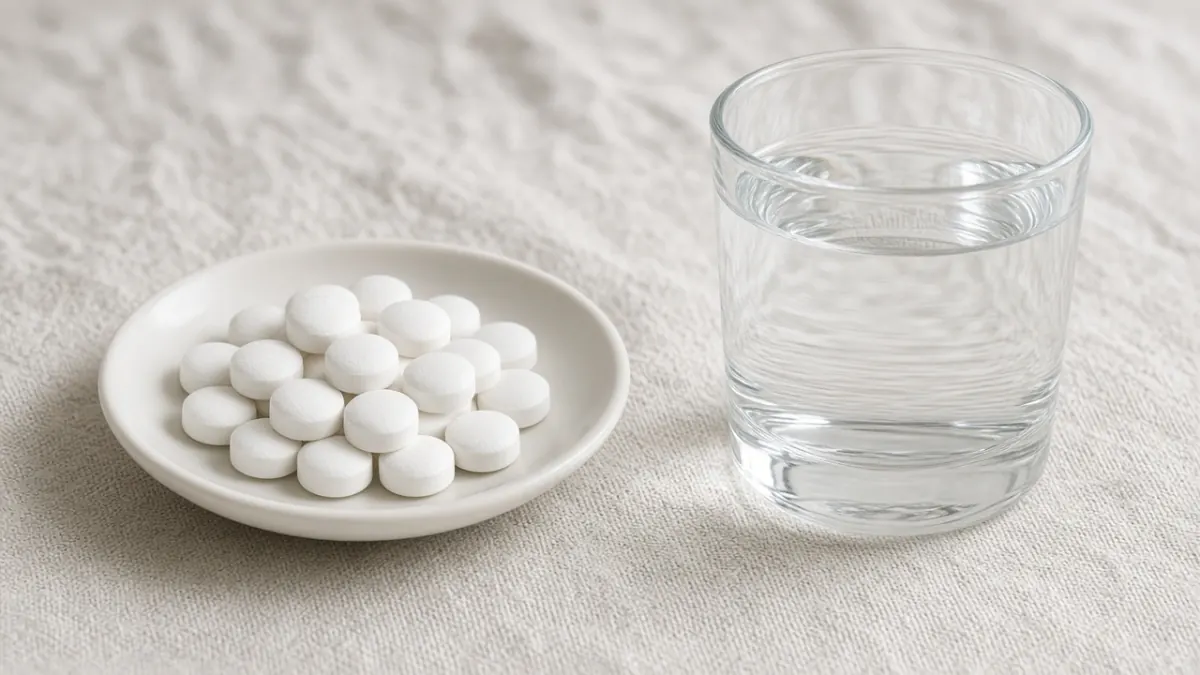
Calcarea Fluorica is the homeopathic and biochemic preparation of calcium fluoride (fluorspar), and is Schüssler's tissue salt No. 1 — the elasticity salt. It is classically used for tissue that has lost elasticity or become stony hard: varicose veins, bleeding piles, hardened glands, bone outgrowths, cracked skin and weak tooth enamel. It is sold mainly as 6X and 12X biochemic tablets, and the usual adult dose is around 4 tablets three to four times daily, dissolved under the tongue.
On side effects, briefly: Calcarea Fluorica 6X and 12X are low potencies that do contain a real but extremely small amount of calcium fluoride — around a microgram or less per tablet. At that dose the fluoride warnings circulating online do not apply. The one genuine caution nobody mentions is the lactose base of every biochemic tablet, which matters if you are lactose intolerant. The detail is below.
What Is Calcarea Fluorica?
Calcarea Fluorica is prepared from fluorspar — naturally occurring calcium fluoride, CaF₂. Clarke describes its place in the body precisely: it "is found in the surface of bones, the enamel of teeth, in elastic fibres and in the cells of the epidermis." That list is the remedy. Wherever the body needs tissue to be both firm and elastic — vein walls, ligaments, bone surface, enamel, skin — this is the salt associated with it.
It is tissue salt No. 1 in Schüssler's biochemic system of twelve, where it carries the trade byname "Elasticity."
Patients and pharmacies write the name many ways, and all of them mean this remedy: Calc Fluor, Calc Fluor 6X, Calcarea Fluor, Calcarea Fluorata, Calcarea Fluoricum, Calcium Fluoratum, Calcium Fluoride, and the abbreviation CF6X. Common misspellings include calcarea flour, calcarea floorica, calcarea flourica, calcaria flour and cal flour. They all refer to the same preparation.
One clarification worth making immediately: homeopathic Calcarea Fluorica is not a calcium supplement and not a fluoride supplement. A 6X tablet contains a fraction of a microgram of calcium fluoride. It is not intended to correct a dietary mineral deficiency in the nutritional sense, and it should not be confused with fluoride toothpaste, fluoridated water or calcium tablets.
Calcarea Fluorica at a Glance
| Attribute | Detail |
|---|---|
| Source | Fluorspar — calcium fluoride, CaF₂ |
| Tissue salt number | No. 1 of Schüssler's twelve; byname "Elasticity" |
| Also written | Calc Fluor, Calcarea Fluorata, Calcium Fluoratum, Calcium Fluoricum, CF6X |
| How it is made | Trituration with lactose — the mineral is insoluble, so it is ground, not dissolved |
| Mother tincture (Q) | Does not exist — see below |
| Forms sold | Biochemic tablets 3X, 6X, 12X; liquid dilutions 30, 200, 1M |
| Most common form | 6X and 12X biochemic tablets |
| Classical sphere | Elastic tissue, bone surface, tooth enamel, epidermis |
| Defining keynote | Induration of stony hardness; loss of tissue elasticity |
| Boericke's dose | "Third to twelfth trituration. A 'chronic' remedy… Should not be repeated too frequently." |
| Modalities | Worse during rest and on first movement, worse changes of weather; better warmth and continued motion |
| Real-world caution | Lactose base in every biochemic tablet |
Calcarea Fluorica Side Effects
This is the question most people arrive with, and most pages answer it either with "no side effects are known" — which is not useful — or by repeating alarming warnings that do not survive a dose calculation. Here is the honest position.
The dilution arithmetic that decides the answer
Homeopathic potencies come on two scales, and confusing them is the source of most of the misinformation about this remedy.
- X (decimal) scale — each step dilutes 1 part in 10. So 6X is 10⁻⁶, one part per million. 12X is 10⁻¹², one part per trillion.
- C (centesimal) scale — each step dilutes 1 part in 100. The point beyond which no molecule of the original substance remains sits at roughly 12C, which is equivalent to about 24X.
The consequence matters: 6X and 12X are below that threshold, so they genuinely do contain calcium fluoride — a real, weighable, if tiny, quantity, typically declared at around half a microgram per tablet. Potencies of 30 and 200 on the centesimal scale are far beyond it and contain no molecules of the original mineral at all.
Almost every page on this remedy gets this wrong in one direction or the other — either claiming 12X is "so dilute it is nothing" (it isn't nothing, it's a trillionth), or treating the tablets as though they deliver a pharmacological fluoride dose (they don't, by many orders of magnitude).
| Form | What can happen | How common |
|---|---|---|
| 6X, 12X biochemic tablets | Lactose intolerance symptoms from the tablet base; temporary intensification of existing symptoms early on | Lactose issues in those already intolerant; otherwise uncommon |
| 30, 200, 1M dilutions | No material substance present; occasionally a brief sharpening of existing symptoms | Rare |
| Any form | Sugar/lactose load relevant to diabetics and the lactose intolerant | — |
Calcarea Fluorica 6X side effects. The tablet contains about a microgram or less of calcium fluoride in a lactose base. The realistic side effect is not from the mineral but from the base: bloating, wind or loose stools in someone who is lactose intolerant, taking several tablets a day. Homeopathic tradition also describes a temporary intensification of existing symptoms shortly after starting, treated as a reason to space out the dose rather than to continue pushing.
Calcarea Fluorica 12X side effects. Identical in kind, with a thousand-fold smaller quantity of the mineral. The same lactose consideration applies, because the tablet base is the same.
Calcarea Fluorica 30, 200 and 1M side effects. These are centesimal dilutions past the point where any molecule of calcium fluoride remains, so there is no pharmacological side effect to report. What is described is the temporary aggravation above, and Boericke's own caution is about repetition rather than toxicity: "Should not be repeated too frequently."
Three warnings you will find online that are not supported
These appear across many pages on this remedy — including, previously, this one. We have checked each against the classical literature, product labelling and the dose arithmetic, and none of them holds up.
"It causes fluoride toxicity, dental fluorosis or skeletal fluorosis." This is a genuine description of chronic elemental fluoride overexposure, transplanted onto a 6X or 12X preparation without anyone doing the sum. At roughly half a microgram of calcium fluoride per tablet, even six tablets a day amounts to a small fraction of the fluoride in a single glass of fluoridated drinking water. Fluorosis arises from milligram-level intake sustained over years. There are no case reports linking biochemic Calc Fluor tablets to fluorosis.
"It increases the risk of kidney stones." We could find no clinical case report, pharmacovigilance signal, pharmacopoeial warning or classical reference supporting this. It is also mechanically implausible: kidney stones are predominantly calcium oxalate or phosphate, and the calcium delivered here is at sub-microgram level.
"It worsens hyperthyroidism." Not only unsupported but the reverse of the classical position — Boericke lists goitre among the remedy's indications. Calc Fluor is traditionally used for thyroid enlargement, not held to be contraindicated in thyroid disease. That said, any thyroid swelling needs proper medical assessment; see the red flags below.
What is genuinely worth knowing instead: the lactose base. Every biochemic tablet is made on lactose, and a course of this remedy means taking several tablets several times a day for weeks. If you are lactose intolerant, tell your homeopath — lactose-free preparations and liquid potencies exist.
How Calcarea Fluorica Is Made — and Why There Is No Mother Tincture
Calcium fluoride is essentially insoluble — in water and in alcohol alike. That single fact governs how the remedy is made, and it disposes of a claim found on several websites.
A mother tincture (Q) is an alcoholic extract: plant or soluble material macerated in alcohol until its constituents pass into solution. An insoluble mineral cannot produce one. Instead, fluorspar is ground and triturated with lactose in successive one-in-ten steps to produce 3X, 6X and 12X. Only once the trituration has been carried far enough does the attenuation become dispersible in liquid, allowing onward preparation of the 30, 200 and 1M dilutions sold as drops.
Clarke's monograph header states the preparation in three words: Calcium Fluoride. Fluor spar. Trituration. Boericke's dose instruction likewise specifies "third to twelfth trituration" — not dilution, not tincture.
So there is no Calcarea Fluorica mother tincture, and no Calc Fluor Q. If you see one offered for sale or described online, the description is wrong. This page previously carried that error itself, describing the mineral being macerated in alcohol for several weeks; it has been corrected.
Calcarea Fluorica Potency Guide: 3X, 6X, 12X, 30 and 200
Boericke's dose instruction for this remedy is unusually specific, and no competing page quotes it in full:
"Third to twelfth trituration. A 'chronic' remedy. Needs some time before manifesting its effects. Should not be repeated too frequently."
Three things follow from that sentence. His stated range is 3X to 12X — the biochemic range, not the high potencies. He classes it as a chronic remedy, meaning it is not expected to act quickly. And he cautions against frequent repetition.
| Potency | Typically chosen for | Usual adult dose | Repetition | Supervision |
|---|---|---|---|---|
| 3X | Marked structural change where a very low potency is preferred | 4 tablets | 3–4 times daily | Advisable |
| 6X | The standard biochemic choice — elastic-tissue and bone-surface complaints | 4 tablets | 3–4 times daily | Sensible for short courses |
| 12X | The other common tissue-salt strength; often preferred for longer courses | 4 tablets | 3–4 times daily | Sensible for short courses |
| 30 (30C) | Constitutional prescribing on the full symptom picture | 3–4 pellets | 1–2 times daily, tapering | Prescriber-directed |
| 200 (200C) | Recurrent chronic picture | 3–4 pellets | Single dose, infrequently repeated | Prescriber only |
| 1M | Deep constitutional prescribing | Single dose | Rarely repeated | Experienced prescriber only |
Calcarea Fluorica 6X uses. This is the form most people are holding and the one Boericke's instruction covers. It is the standard biochemic tablet for the elasticity indications: varicose and enlarged veins, bleeding piles, hardened glands, bone outgrowths, cracked skin and weak enamel. Taken as a course over weeks, not as a one-off dose.
Calcarea Fluorica 12X uses. The same indications at a thousand-fold lower concentration. Many practitioners prefer 12X for longer courses; the choice between 6X and 12X is a matter of prescribing convention rather than a difference in what the remedy treats.
Calcarea Fluorica 30, 200 and 1M. These centesimal dilutions sit outside Boericke's stated range and belong with a prescriber working from the whole constitutional picture, not from a single complaint. They are not the tissue-salt form, and there is no classical basis for routine daily self-dosing at these strengths.
How to Take Calcarea Fluorica
- Dissolve, don't swallow. Biochemic tablets are meant to dissolve under the tongue rather than be swallowed with water.
- Adult dose: about 4 tablets, 3–4 times daily. Children take roughly half that; infants a quarter. Conventions vary slightly between manufacturers, so check your pack and confirm with your homeopath.
- Keep it clear of food and strong flavours. The usual convention is a gap of around 30 minutes either side of food, coffee or mint.
- Expect it to be slow. Boericke calls it a chronic remedy that "needs some time before manifesting its effects." This is not a remedy that acts in a day.
- Don't over-repeat. Boericke's explicit caution. More frequent dosing is not better here.
- Set a review point. Agree one with your homeopath — for a chronic tissue complaint this is typically measured in weeks to a few months — rather than continuing indefinitely without reassessment. Courses of several months are commonly described in homeopathic practice, but that is convention rather than trial evidence.
If you are lactose intolerant, raise it before starting, since a full course means a substantial number of lactose-based tablets.
What Calcarea Fluorica Is Classically Used For
These indications come from the classical materia medica — chiefly Boericke and Clarke — and from Schüssler's biochemic system. They describe when a homeopath selects the remedy, not a guaranteed outcome. Boericke's opening summary is the remedy in one line: "A powerful tissue remedy for hard, stony glands, varicose and enlarged veins, and malnutrition of bones."
Varicose and enlarged veins. Boericke is emphatic here: "Chief remedy for vascular tumors with dilated blood-vessels, and for varicose or enlarged veins." This is the elasticity indication at its clearest — vein walls that have stretched and lost tone. See our guide to varicose veins.
Bleeding piles and anal fissure. Boericke's rectal rubric covers "Fissure of the anus, and intensely sore crack near the lower end of the bowel. Bleeding hæmorrhoids," and internal piles with pain low down in the sacrum and constipation. He notes it is worse in pregnancy. Relevant to both piles and anal fissure prescribing.
Hardened glands and breast lumps. The keynote across both authors is induration of stony hardness. Boericke lists "Knots, kernels, hardened glands in the female breast," and Clarke gives "indurated glands (of neck; of breast, &c.) of stony hardness." Any breast lump requires medical evaluation before any homeopathic prescribing — this is not a self-treatment situation.
Bone outgrowths and exostoses. Clarke records that it "has been principally used for dispersing bony growths; ulcerations of bone; and for fistula." Boericke adds "Exostoses on fingers" and "Osseous tumors." This is the classical basis for its use in bone spurs, alongside remedies such as Hecla Lava.
Chronic low back pain. Boericke describes "Chronic lumbago; aggravated on beginning to move, and ameliorated on continued motion" — a pattern worth recognising in back pain prescribing, and one Clarke notes succeeded after Rhus toxicodendron had failed.
Teeth and enamel. Clarke gives "deficient enamel of teeth" directly. Boericke's dental rubric is about looseness rather than enamel: teeth becoming "loose in their sockets," and toothache when food touches the tooth. Note that this is a symptom-picture indication, not a substitute for dental care.
Cracked skin and scar tissue. Boericke: "Chaps and cracks. Fissures or cracks in the palms of the hands, or hard skin," along with "Scar tissue; adhesions after operations" and "Indurations of stony hardness."
Ganglion and hydrocele. Boericke lists "Ganglia or encysted tumors at the back of the wrist" and "Hydrocele; indurations of the testicles."
Chronic throat with tonsil plugs. A distinctive rubric: "Follicular sore throat; plugs of mucus are continually forming in the crypts of the tonsils," better from warm drinks and worse from cold. Relevant within tonsillitis prescribing.
Cataract — with an important qualification. Boericke's actual wording is that "many cases of cataract have undoubtedly been influenced favorably by it." He does not say cured. Many pages upgrade this into a cure claim; the source does not support it, and established cataract is treated surgically.
Goitre. Boericke lists it as a single word, with no elaboration. Thyroid swelling needs assessment before any prescribing — see our thyroid guide.
Two things the classical texts do not say. The word keloid appears in neither Boericke's nor Clarke's entry for this remedy, and neither mentions stretch marks. Both are modern extensions reasoned by analogy from "scar tissue" and "indurations of stony hardness." That reasoning is defensible, and homeopaths do prescribe on it — but it should be presented as a modern extension, not quoted as classical authority. Most pages blur that line.
Keynotes and Modalities
| Feature | Detail |
|---|---|
| Central keynote | Induration of stony hardness; tissue that has lost elasticity |
| Worse | During rest, on beginning to move, changes of weather, damp, cold drinks |
| Better | Warmth and warm applications, continued motion, rubbing, warm drinks |
| Mental picture | Great depression; groundless fears of financial ruin; indecision, anxiety about money |
| Tissue affinity | Bone surface, tooth enamel, elastic fibres, epidermis |
One apparent contradiction in Boericke deserves explaining, because no competing page does. He gives "worse during rest" and "aggravated on beginning to move." Both are in the text, and they resolve into a single recognisable pattern — the Rhus toxicodendron pattern: stiff and uncomfortable after resting, worst in the first few movements, then easing as movement continues.
Calc Fluor Compared With the Other Calcium Salts
| Remedy | When it fits instead |
|---|---|
| Calcarea phosphorica | Bone growth and repair, delayed dentition, slow-healing fractures, thin anaemic children — nutrition of bone rather than hardness of tissue |
| Calcarea carbonica | Flabby, chilly, sweaty constitutions, slow development, easy fatigue — a whole-constitution remedy rather than a tissue one |
| Silicea | Suppuration that will not resolve, expelling foreign bodies, poor scar formation with discharge, weak nails and hair |
| Conium | Glandular induration, particularly after injury, with dizziness on turning the head |
Calc Fluor is selected over these when the defining feature is hardness or lost elasticity of tissue — stony glands, stretched vein walls, bony outgrowths, cracked hard skin.
When to See a Doctor
Several of this remedy's classical indications describe findings that must be medically assessed before any homeopathic treatment. Do not self-treat, and seek proper evaluation for:
- Any breast lump, change in breast shape, skin dimpling or nipple discharge — this needs clinical assessment without delay
- Any new or growing swelling or gland, particularly if hard, fixed or painless
- Thyroid swelling or goitre, with or without weight, heartbeat or temperature changes
- Rectal bleeding, especially with a change in bowel habit or unexplained weight loss
- Vision loss or clouding — cataract is a surgical condition
- A bone lump, or bone pain that is worsening or wakes you at night
- Leg swelling with pain, redness or warmth, which may indicate a clot rather than simple varicose veins
Homeopathy is not a substitute for diagnosis and must not delay investigation of any of the above.
What the Evidence Says
Plainly: there is no reliable clinical-trial evidence that Calcarea Fluorica is effective for any of the conditions above, and the same is true of homeopathy generally — reviewed the field and found no health condition for which homeopathy is reliably effective.
Everything in the classical section of this page is drawn from 19th-century provings and clinical observation — Boericke, Clarke and Schüssler — not from trials. The dosing conventions are pharmacy and prescribing practice, not dose-response science. The course lengths commonly quoted for tissue salts are convention repeated between practitioners rather than measured outcomes.
We prescribe on those classical indications and on clinical experience, alongside conventional care rather than instead of it, and we would rather say so plainly than imply more than the record supports.
Frequently Asked Questions
What is Calcarea Fluorica used for?
What are the side effects of Calcarea Fluorica 6X?
What are the side effects of Calcarea Fluorica 12X?
Does Calcarea Fluorica cause fluoride toxicity or fluorosis?
Does Calcarea Fluorica cause kidney stones or affect the thyroid?
Is there a Calcarea Fluorica mother tincture (Q)?
Is Calcarea Fluorica 6X or 12X better?
How many tablets of Calcarea Fluorica 6X should I take?
How long does Calcarea Fluorica take to work?
Can Calcarea Fluorica be taken daily long term?
Is Calcarea Fluorica safe for children and in pregnancy?
What is the difference between Calcarea Fluorica and Calcarea Phosphorica?
What are the benefits of Calcarea Fluorica 6X?
Have questions about your symptoms? Talk to a WeClinic™ homeopathic doctor, free.
Call Now - Free Consultation