
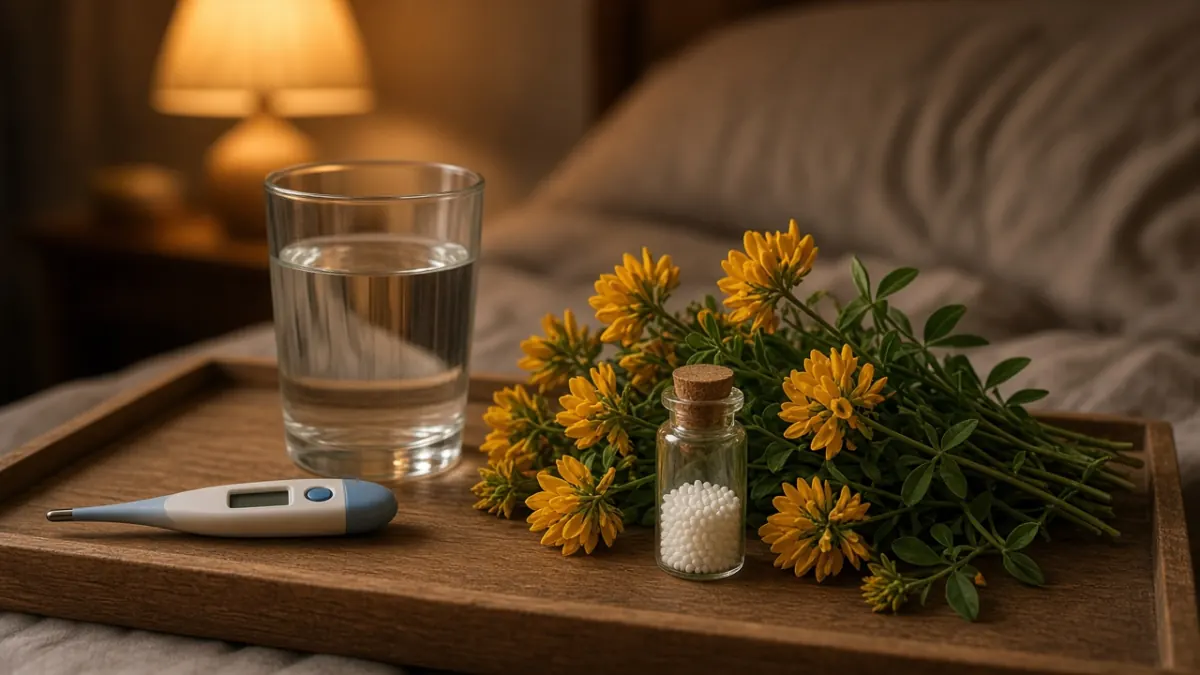
Short answer: Baptisia tinctoria (wild indigo) is a homeopathic remedy made from the fresh root of a North American pea-family plant. Classical materia medica links it to a sudden, dull, "besotted" septic-type fever: dusky face, foul breath, stool and sweat, a bruised aching body and a dark swollen sore throat. It is not a treatment for typhoid, sepsis, dengue, malaria or tonsillitis, and no good clinical trial shows homeopathic Baptisia changes the course of any infection. A 30C pellet holds no measurable plant material; Q (mother tincture) is an alcoholic herbal extract that can cause vomiting and diarrhoea. Fever with confusion is an emergency.
This article is for searches like baptisia tinctoria, baptisia tinctoria 30 uses, baptisia q, baptisia for typhoid fever, baptisia septic fever, baptisia tinctoria side effects and wild indigo homeopathy, and the same typed in Hindi (बैप्टिसिया टिंक्टोरिया 30 के उपयोग), Bengali (ব্যাপ্টিসিয়া টিংক্টোরিয়া ৩০ এর ব্যবহার), Tamil (பாப்டிசியா டிங்க்டோரியா 30 பயன்கள்), Telugu (బాప్టిసియా టింక్టోరియా 30 ఉపయోగాలు) and Malayalam (ബാപ്റ്റീസിയ ടിങ്ക്ടോറിയ 30 ഉപയോഗങ്ങൾ). It is not a protocol for typhoid, sepsis, dengue or a tonsil abscess. Author: Dr. Dheeraj Sharma, BHMS. Based on: Boericke's Materia Medica (paraphrased).
| Item | Detail |
|---|---|
| Names | Baptisia tinctoria, wild indigo, yellow wild indigo, horsefly weed; written Bapt. |
| Botanical family | Fabaceae (pea family), eastern North America |
| Part used | Fresh root (root bark in some older texts) |
| Forms sold in India | Mother tincture Q; dilutions 6C, 30C, 200C; 1M from some makers |
| Classical sphere | Abrupt septic-type fever with a besotted mind, foul discharges, dark swollen throat, bruised aching body |
| Dose as commonly labelled | 30C pellets: often "3–5 pellets, 2–3 times a day" or "as directed". Q: pack wording varies; treat as prescriber-only |
| Evidence snapshot | No good clinical trial of homeopathic Baptisia for typhoid, sepsis, fever, tonsillitis or any infection |
| Safety in one line | Q can cause nausea, vomiting and diarrhoea and is best avoided in pregnancy; 30C has no measurable root, so its main risk is delay |
The plant. Baptisia tinctoria is a bushy perennial with yellow pea-type flowers and a woody root. Pages describing blue or purple flowers on a six-foot plant are describing a related species, blue wild indigo (Baptisia australis). It is also not Indigofera tinctoria, the true indigo dye plant.
What is in the root. Phytochemical reports list quinolizidine alkaloids (cytisine, called baptitoxine in older books), isoflavonoids and plant polysaccharides. Cytisine acts on nicotine receptors; plants rich in it, laburnum being the classic example, cause vomiting, sweating, tremor and, in large amounts, convulsions. A Q bottle label does not tell you how much alkaloid is in it.
Lab findings are not a pellet. Cell and test-tube work on wild indigo extracts is often quoted as "antibacterial" or "immune-boosting". That is not evidence for a 30C pellet, and not evidence for a person.
Q vs 30C vs the herb. Q is an alcoholic extract of the fresh root, so it behaves more like a herbal tincture than like high-dilution homeopathy. Past about 12C nothing of the original root is left, so 30C, 200C and 1M carry no alkaloid; see the homeopathy mother tincture guide for the difference. Wild indigo root capsules and teas sold abroad are a third thing: crude herb, with older herbal texts describing nausea and purging in larger amounts. Some European herbal cold products combine wild indigo with echinacea and thuja; any trials there test that combination in measurable doses, not a 30C pellet, and cannot be credited to Baptisia alone.
Paraphrasing Boericke; wording differs between books.
Baptisia for typhoid fever or septic fever. The classical picture is a dull, confused patient with foul stool and sweat. Evidence: none for homeopathic Baptisia. Typhoid is a Salmonella Typhi infection confirmed by blood culture (a Widal test alone can mislead) and treated with antibiotics chosen for local resistance, which is a real problem in South Asia. Gut bleeding or perforation can occur in the second to third week. Sepsis is dangerous organ failure from infection and needs hospital care in hours. Fever beyond three days, belly pain, black stool or any confusion means tests first.
Baptisia for sore throat with dark swollen tonsils. The classical throat is dark red, swollen and not very painful. Evidence: none. Most sore throats are viral; a minority are group A streptococcus, which in children can lead to rheumatic fever, so a high-fever sore throat in a child needs a swab and a doctor. Dark red tonsils cannot tell viral from bacterial. Drooling, a muffled voice or one-sided swelling suggests an abscess. See the throat infection post.
Baptisia for flu-like aching and dullness. Used classically when a viral fever brings stupor, a sore bruised body and a foul taste, rather than the heavy trembling of Gelsemium. Evidence: no trial. During the monsoon, a "viral fever" that lasts beyond three days needs dengue, malaria and typhoid tests; see the viral fever post.
Baptisia for foul, loose stool. Classical for offensive, dysenteric stool with fever. Evidence: none. Oral rehydration and a stool test come first; blood in the stool, a sunken look or no urine for eight hours needs a doctor.
What it is not for. Not an immunity booster, a mood or sleep remedy, an arthritis or Crohn's remedy, or a treatment for malaria, measles, mumps, chickenpox, diphtheria or scarlet fever. Those are lines from generic herbal pages, not from the materia medica.
| Remedy | Classical picture | How it differs from Baptisia |
|---|---|---|
| Baptisia | Abrupt, besotted, confused; foul discharges; dark throat | — |
| Gelsemium | Heavy drooping lids, trembling, thirstless flu weakness | Drowsy but not "poisoned"; discharges are not foul |
| Arsenicum album | Burning, restless, anxious, chilly, sips of water | Anxiety and restlessness, not stupor |
| Bryonia | Stays still; pain worse on motion; very thirsty | Dry and irritable rather than besotted |
| Claim you will see online | Honest fact |
|---|---|
| "Baptisia kills the bacteria that cause typhoid, diphtheria or scarlet fever" | No. Those infections need diagnosis and antibiotics; homeopathic Baptisia has no antibacterial action and no trial shows benefit. |
| "Wild indigo grows six feet tall with blue or purple flowers" | That is blue wild indigo, B. australis. B. tinctoria has yellow flowers. |
| "Contains baptisin and baptitoxine with antibacterial and antiviral action" | Baptitoxine is an older name for cytisine, a nicotine-like alkaloid that is toxic in large amounts, not a proven germ-killer. Lab findings on extracts do not transfer to 30C. |
| "Boosts immunity, relieves stress, improves mood and sleep" | No trials, and not in the classical picture. |
| "5–10 drops every 1–2 hours for fever; children 2–5 drops" | An unsourced schedule. Frequent dosing of an alkaloid-containing extract is not advice we can stand behind. |
| "Generally safe, safe in pregnancy" | Not established. Q is a herbal extract in alcohol; avoid it in pregnancy. |
Label-style wording only; this is not a prescription.
| Form | What it is | Label wording often seen | Who decides |
|---|---|---|---|
| 30C pellets | High dilution, no measurable root | "3–5 pellets, 2–3 times a day" or "as directed" | Self-care only for a mild, short complaint after red flags are excluded |
| 200C / 1M | High dilution, no measurable root | Single dose or "as directed by physician" | Registered homeopath |
| Q (mother tincture) | Alcoholic root extract with alkaloids | No standard; packs differ | Prescriber only; do not self-dose |
| Herbal root, capsules, tea | Crude plant material | No homeopathic dose exists | Not recommended without a clinician |
| Children | — | Q not advised; 30C only if a doctor has seen the child | Paediatrician first |
30C and above. No measurable plant material, so no drug-type side effects. The risks are delay and the pellet base (sugar or lactose). A "besotted" patient given pellets and left at home is the real harm.
Q. Expected effects of the herb are nausea, vomiting, diarrhoea and stomach cramps. Large amounts of alkaloid-rich plants can add sweating, tremor and a fast heartbeat; this is expected from the alkaloid class and is not well documented for Baptisia Q. Vomiting after Q is the herb, not a healing "aggravation".
Herbal root. Older herbal texts call large amounts an emetic and purgative.
Who should avoid Q: pregnancy, breastfeeding, children, liver disease, anyone avoiding alcohol, and anyone with a known allergy to the pea family (cross-reactivity is poorly studied).
Interactions. No good interaction studies exist, so the honest answer is unknown, not "none". Tell your doctor about any Q you take. Never stop a prescribed medicine for Baptisia. See homeopathy side effects.
Call emergency services (108 / 112 in India) for trouble breathing, a seizure, collapse, unresponsiveness or severe confusion.
WeClinic, Panki, Kanpur — 10 AM–9 PM, closed Monday. Call +91 7905136461. Bring the bottle and say the potency on the label. Author: Dr. Dheeraj Sharma.
Have questions about your symptoms? Talk to a WeClinic™ homeopathic doctor, free.
Call Now - Free Consultation