
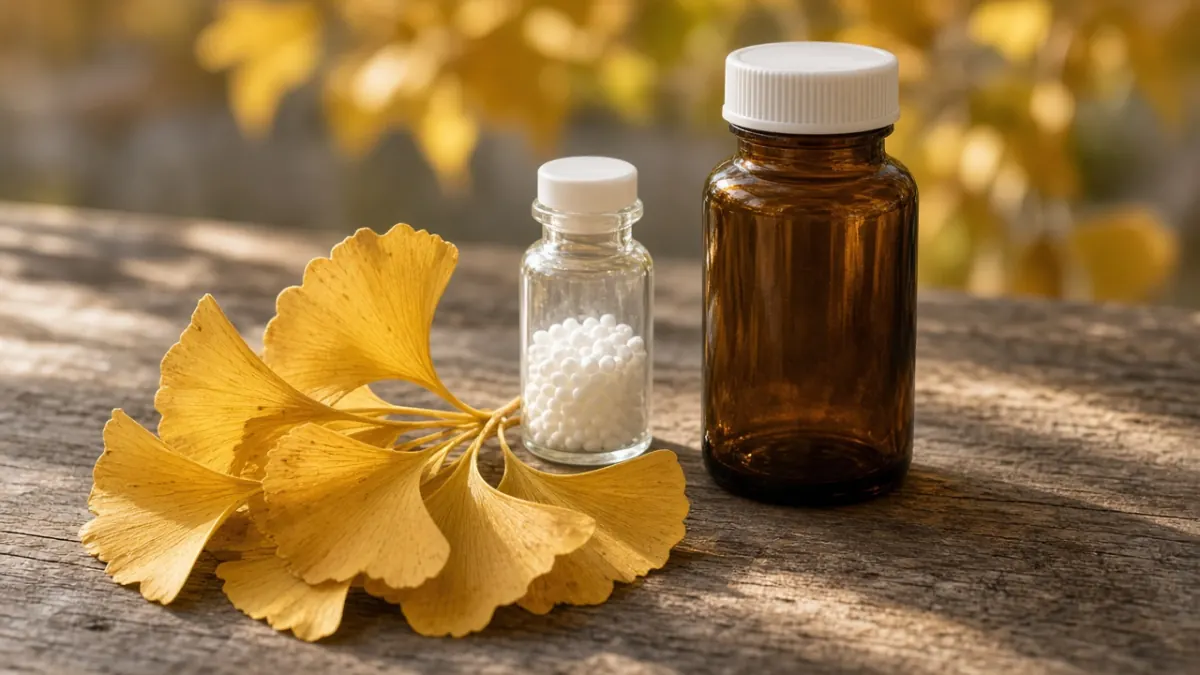
Short answer: In homeopathy, Ginkgo biloba usually means the mother tincture (Q), or 30C and 200C pellets, made from the leaves of the maidenhair tree (Ginkgo biloba). It is sold in India for forgetfulness, ringing in the ears, dizziness, and poor circulation, but it is a modern addition rather than a core classical remedy, and nearly all the research is on herbal leaf extract (EGb 761), a different product. Large trials of the herbal extract found no reduction in dementia in older adults, and results for memory and tinnitus are mixed. Herbal ginkgo can add to bleeding risk with blood thinners, and the seeds are toxic. No good clinical trial shows that Q or a 30C pellet treats dementia, tinnitus, or poor circulation.
This article is for searches like ginkgo biloba, ginkgo biloba mother tincture uses, ginkgo biloba homeopathic medicine, ginkgo biloba q, ginkgo for memory, ginkgo for tinnitus, ginkgo for circulation, ginkgo biloba side effects and the same queries typed in Hindi (जिंकगो बिलोबा), Bengali, Tamil, Telugu or Malayalam. YMYL: sudden hearing loss or sudden confusion is an emergency, and herbal ginkgo interacts with blood thinners.
Author: Dr. Dheeraj Sharma, BHMS. Based on: published trials and reviews of ginkgo leaf extract, standard herbal pharmacology (ginkgolic acids, ginkgotoxin), and usual homeopathic label descriptions, paraphrased. Ginkgo is not a core remedy in classical texts such as Boericke's Materia Medica.
| Item | Detail |
|---|---|
| Names and plant | Ginkgo biloba, Ginkgo; maidenhair tree. The only living species of its family, native to China, grown widely. Hindi: जिंकगो बिलोबा |
| Part used | Leaves for Q and herbal extract; seeds are used in East Asian cooking and are toxic in quantity |
| Active constituents (herbal) | Flavonoid glycosides and terpene lactones (ginkgolides, bilobalide); the seed carries ginkgotoxin |
| Forms sold in India | Mother tincture (Q), pellets (30C, 200C), herbal capsules, tablets, and tea |
| Classical sphere | Not a core classical remedy. Modern use for forgetfulness, tinnitus, dizziness, poor circulation, largely borrowed from the herb |
| Usual adult dose (as commonly labelled) | Q: many labels print about 5-10 drops in water, two or three times a day, or as directed. 30C: about 4-5 pellets up to three times a day for a short spell. Read the bottle; labels vary |
| Evidence snapshot | Herbal extract: large prevention trials negative, other results mixed. Q and 30C: no good trials |
| Safety | 30C and above contain no measurable leaf material. Q and herbal extract are active; seeds are toxic |
Ginkgo biloba is a very old tree species with fan-shaped leaves. The herbal leaf extract (such as EGb 761) is standardised to a fixed share of flavonoid glycosides and terpene lactones, with irritant ginkgolic acids kept very low. That standardisation is what the trials tested.
Q is an alcohol extract of the leaf. It is not standardised, so the amount of active compounds varies by maker and nobody can say it matches a studied capsule. A homeopathic 30C is the preparation diluted 1 to 100, thirty times over. Past roughly 12C, chemistry expects not a single molecule of the original material to remain, so 30C and 200C pellets carry no measurable plant compounds. See the mother tincture guide for what the letter on the bottle means.
The seeds and fleshy fruit coat are different again. The seed contains ginkgotoxin, which interferes with vitamin B6 and can trigger seizures when many are eaten, especially in children. The fruit pulp can irritate skin and cause a contact rash.
Ginkgo does not have the classical keynote picture that older remedies have, so there is little to paraphrase from Boericke. Modern homeopathic sources and Q labels list forgetfulness, poor concentration, ringing in the ears, dizziness, and cold hands and feet, largely following the herb's reputation. In East Asian tradition the seeds were used for cough and urinary complaints, and the standardised leaf extract was developed in Europe in the 20th century.
That is why the evidence below is about the herbal extract. It is a guide to what ginkgo does or does not do in people, not proof for Q or 30C.
Two large trials in older adults, the GEM trial in the US and GuidAge in France, tested herbal extract taken for several years and did not find fewer cases of dementia. In people already living with dementia, some trials of 240 mg a day report small gains in thinking or behaviour and others report none, and reviews call the evidence inconsistent. In healthy adults, trials have mostly found no memory gain. There are no good trials of Q or 30C for memory.
Forgetfulness has treatable causes: B12 deficiency, thyroid disease, depression, poor sleep or sleep apnoea, hearing loss, alcohol, and some medicines. See B12 deficiency and homeopathy. Homeopaths classically compare Anacardium orientale for weak memory with anxiety. Ginkgo is not a substitute for a dementia assessment.
Emergency, call 108 or 112: sudden confusion or memory loss, slurred speech, facial droop, one-sided weakness, severe headache, or vision loss, which can be a stroke or another acute illness.
Reviews have found no convincing benefit of ginkgo for ringing in the ears. Q and pellets have no trials. Most tinnitus follows hearing loss, noise, earwax, or medicines, and many cases settle or become tolerable with proper care. See tinnitus and homeopathy. Sudden hearing loss in one ear, ringing in one ear only, a pulse-like beat, or tinnitus with vertigo needs an ENT check the same day.
Trials in people with leg pain on walking (claudication) report small gains in pain-free walking distance, but the benefit is modest and uncertain. No trial shows that ginkgo lowers the risk of stroke or heart attack. Leg pain on walking that eases at rest points to artery disease and needs assessment, with attention to smoking, diabetes, blood pressure, and cholesterol. A suddenly cold, pale, painful limb, or chest pain, is an emergency.
Evidence is limited and low in quality. Positional vertigo often has a different, treatable cause, and sudden vertigo with other symptoms can be a stroke. See vertigo and homeopathy.
Anxiety, depression, ADHD, PMS, arthritis, Crohn's disease, "immune boosting", and cancer prevention appear on pharmacy pages. There is no good evidence for ginkgo in these, and each needs its own assessment.
| Claim you will see online | Fact check |
|---|---|
| "Ginkgo mother tincture improves memory in Alzheimer's and dementia" | Q has no trials. Herbal extract trials are mixed, and two large prevention trials were negative |
| "Reduces the risk of stroke and heart attack" | No trial shows this, and herbal ginkgo adds bleeding risk with blood thinners |
| "Balances brain chemicals, antioxidant, neuroprotective" | Lab and animal properties do not equal benefit in people, and "balances brain chemicals" is marketing |
| "Gentle and safe to take daily for long periods" | Not for everyone: bleeding risk, epilepsy, planned surgery, and pregnancy are cautions. Seeds are toxic |
| "Treats ADHD, anxiety, PMS, arthritis, Crohn's disease" | No good evidence. These need a proper diagnosis |
| "120-240 mg a day for brain, heart, eyes, tinnitus, vertigo, and PMS" | One copied range from herbal trials, not condition-specific and not a homeopathic dose |
| Form | What's in it | What to do |
|---|---|---|
| 30C pellets | No measurable leaf material | The common homeopathic potency. About 4-5 pellets (or the label dose) under the tongue, up to three times a day for a short course |
| 200C and above | No measurable leaf material | Prescriber only |
| Mother tincture (Q) | Unstandardised alcohol leaf extract | Treat it as a herb. Many labels print drops in water two or three times a day; ask a clinician first if you take blood thinners or have epilepsy |
| Herbal capsules, tablets (standardised) | Studied ginkgo extract | Not homeopathy. Follow the label; trials mostly used 120-240 mg a day, which is a research range, not advice for you. Ask your doctor |
| Tea, raw leaf | Variable | No reliable dose. Not a way to prevent dementia |
| Seeds, nuts, fruit pulp | Ginkgotoxin, ginkgolic acids | Never in quantity, and not for children. Seek help after a seizure |
Practical points. Let pellets dissolve under the tongue. Many homeopaths ask you to keep the mouth free of food, coffee, and mint for about 15 minutes; that is a convention, not a tested rule. Herbal ginkgo is often tried for weeks or months, but if there is no clear change you should reassess, not increase. Read more in the potency guide.
| Risk | Who it hits |
|---|---|
| Headache, upset stomach, dizziness, palpitations, rash | Some people taking herbal extract or Q |
| Bleeding: bruising, nosebleeds, and rare serious bleeding reported | People on warfarin, aspirin, clopidogrel, newer anticoagulants, or anti-inflammatory pain medicines, and anyone facing surgery. Large trials show no clear rise, so the risk is uncertain but real enough to ask first |
| Seizures | Eating ginkgo seeds, and case reports with supplements. Avoid in epilepsy unless your doctor agrees |
| Changed blood levels of some medicines | Ginkgo can affect liver enzymes. Ask a pharmacist if you take regular medicines |
| Skin allergy | Contact with fruit pulp; people sensitive to poison ivy, mango rind, or cashew shell may react |
| Sugar in pellets, alcohol in Q | Diabetes, alcohol avoidance, children. Check the label |
| Missed diagnosis | Memory loss, hearing loss, or leg pain treated with a bottle while the cause goes unfound |
Surgery advice commonly asks people to stop herbal supplements such as ginkgo about two weeks before an operation; follow your surgeon's instruction and do not stop prescribed medicines yourself. Avoid herbal ginkgo and Q in pregnancy and breastfeeding; there is little safety data, and bleeding near delivery is a concern. Ask your doctor before pellets. No dose is established for children, and babies need a doctor first.
WeClinic, Panki, Kanpur — 10 AM–9 PM, closed Monday. Call +91 7905136461. Bring the bottle and say the potency on the label. Author: Dr. Dheeraj Sharma.
Have questions about your symptoms? Talk to a WeClinic™ homeopathic doctor, free.
Call Now - Free Consultation