
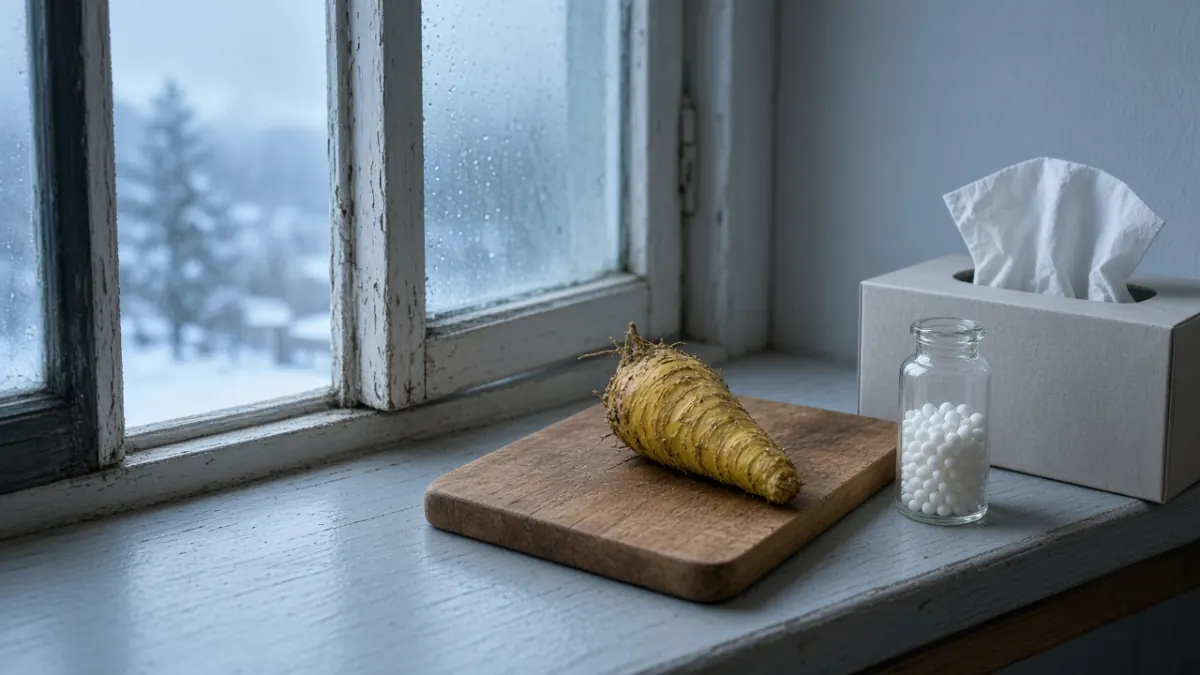
Short answer: Homeopathic Rumex crispus is made from the fresh root of Rumex crispus (curly dock, yellow dock) and is sold in India mostly as 30C or 200C pellets and as a mother tincture (Q). Classical materia medica uses it for a dry, tickling cough set off from one spot at the pit of the throat and made worse by cold air and by uncovering, and old texts also list early-morning loose stools. Herbal dock root is a different product: it contains laxative anthraquinones and oxalates, and oxalates matter if you form kidney stones. No good clinical trial shows that a 30C pellet treats a cough, diarrhoea, or any other condition.
This article is for searches like rumex crispus, rumex crispus 30 uses, rumex crispus q, rumex for dry tickling cough, rumex crispus homeopathic medicine, rumex side effects and the same queries typed in Hindi (रूमेक्स क्रिस्पस 30), Bengali, Tamil, Telugu or Malayalam. YMYL: a cough that lasts weeks can be TB, asthma, reflux, or a medicine side effect, and herbal dock has real kidney and bowel cautions.
Author: Dr. Dheeraj Sharma, BHMS. Based on: Boericke's Materia Medica with Repertory (Rumex crispus), paraphrased, for the classical picture; and general herbal pharmacology of dock root (anthraquinones, oxalates).
| Item | Detail |
|---|---|
| Names and plant | Rumex crispus, Rumex; curly dock, yellow dock. A tall perennial weed (family Polygonaceae) with curled leaf edges and a yellow-brown taproot, native to Europe and western Asia and now widespread |
| Part used | The fresh root (Boericke) |
| Herbal constituents | Anthraquinones (emodin, chrysophanol; laxative), tannins, and oxalates |
| Forms sold in India | Pellets (6C, 30C, 200C, 1M), liquid dilutions, and mother tincture (Q) |
| Classical sphere | Dry tickling cough from the throat pit, worse from cold air; early-morning diarrhoea; itching on uncovering |
| Usual adult dose (30C, as commonly labelled) | About 4-5 pellets, or the drops on the label, up to three times a day for a short spell. Read the bottle; labels vary |
| Evidence snapshot | Classical keynotes. No good clinical trial of homeopathic Rumex for cough, diarrhoea, skin, or liver |
| Safety | 30C and above contain no measurable root material. Herbal dock and Q can loosen the bowels and add oxalate |
Curly dock is a common roadside weed. Its root has a long herbal history as a gentle-to-strong laxative, which is why the plant is also called "yellow dock". The laxative action comes from anthraquinones of the same family as senna. The leaves and root also carry oxalates, which bind calcium and add to the risk of kidney stones.
A homeopathic 30C is the root preparation diluted 1 to 100, thirty times over. Past roughly 12C, chemistry expects not a single molecule of the original material to remain, so 30C, 200C, and 1M pellets contain no measurable anthraquinone or oxalate. Low dilutions and the mother tincture (Q), an alcohol extract of the fresh root, can still carry active plant material. Q is therefore closer to a herbal product than to a 30C pellet. See the mother tincture guide for what the letter on the bottle means.
Paraphrased, not quoted:
Cough. Dry, hacking, tickling, and fatiguing, set off from a spot at the pit of the throat, just above the breastbone. Worse when breathing cold air, when going from warm to cold, and when any part of the body is uncovered. Worse at night, so sleep is broken. The person pulls up the bedclothes or covers the mouth and breathes through a cloth to avoid cold air.
Throat. A tickling, sometimes rawness, from the throat pit; talking, or pressing at that spot, may provoke a fit of coughing.
Digestion. Loose stools in the early morning, sending the person out of bed in a hurry, often alongside the cough.
Skin. Itching, especially when the skin is uncovered to cool air, for instance on undressing at night.
General. Sensitive to cold air, chilly, and worse at night. Mentions of anaemia or "liver" in later herbal writing are not part of this core picture.
This is the use people look up most. The classical fit is a dry cough triggered from the throat pit, worse in cold air and when uncovered. There is no trial showing that Rumex 30 changes the length or severity of a cough. Many coughs follow a viral infection and ease within two to three weeks. Other common causes include post-nasal drip, reflux, asthma, smoking, and allergy. A dry tickly cough is also a recognised side effect of ACE inhibitors (such as enalapril or ramipril); if that fits, speak to the prescribing doctor and never stop the tablet yourself. For throat-related coughs, see throat infection and homeopathy. Homeopaths also compare Drosera when the cough comes in long spasms.
Emergency, call 108 or 112: cough with breathlessness, wheeze, chest pain, blue lips, or coughing blood. A cough lasting more than 2 weeks needs a chest X-ray and sputum test, because TB is common in India. A cough beyond 3 weeks is "chronic" and always needs a workup.
Old texts pair the cough with loose stools on waking. There is no trial for this. Morning loose stools are common in IBS, infection, lactose intolerance, thyroid disease, and bowel inflammation; see IBS and homeopathy. Blood or black stool, fever, signs of dehydration, weight loss, or diarrhoea lasting beyond 2 weeks need a doctor first, and babies and older adults dehydrate quickly.
Some old texts note itching that appears when the skin meets cool air. Itching can come from dry skin, scabies, allergy, thyroid or liver disease, and more. Pellets are not a diagnosis; see homeopathy for itching for the approach.
"Liver cleanser", anaemia, constipation, eczema, arthritis, and "detox" come from herbal dock marketing, not from the homeopathic cough picture. Each needs its own assessment: liver tests, a blood count and iron studies, or a skin examination. A 30C pellet contains no iron and no laxative.
| Claim you will see online | Fact check |
|---|---|
| "Rumex crispus cleanses the liver and helps you detox" | No evidence. Liver trouble is found by blood tests and a scan, not a tincture |
| "Rich in iron, good for anaemia" | Dock has little iron compared with a prescribed supplement. Anaemia needs a blood count and a cause (periods, piles, worms, diet). A 30C has no iron |
| "Anthraquinones make it a laxative" | True of the herbal root. It does not describe a 30C pellet, and repeated laxative use can drain potassium |
| "Oxalates have liver-cleansing properties" | Backwards: oxalates raise kidney stone risk, so stones are a reason to avoid dock |
| "Mother tincture 2 tablespoons, tea 1-2 cups, powder 1-2 g a day" | Made-up schedules. Two tablespoons is about 30 mL of an alcohol extract, a large herb and alcohol load |
| "Safe and effective when used correctly" | No trial shows effect, and herbal dock and Q have real bowel and kidney cautions |
| Form | What's in it | What to do |
|---|---|---|
| 30C pellets | No measurable root material | The common home potency. About 4-5 pellets (or the label dose) under the tongue, up to three times a day for a short course |
| 200C pellets | No measurable root material | Usually chosen by a prescriber who matched the full picture, taken once or a few times, not daily at home |
| 1M and above | No measurable root material | Prescriber only |
| 6C and lower, liquid low dilutions | More of the original than 30C | Take only if a prescriber advised and gave the label dose |
| Mother tincture (Q) | The alcohol extract of the fresh root | Prescriber-led. Do not self-dose a made-up amount, and avoid it with kidney stones, in pregnancy, or with diuretics or digoxin |
| Herbal dock root, tea, capsules, powder | Anthraquinones and oxalates | Not a homeopathic product. Use only on a clinician's advice |
30 vs 200: no trial compares them for this remedy. 30C is the usual over-the-counter choice; 200C is usually a prescriber's. Read more in the potency guide. Let pellets dissolve under the tongue. Many homeopaths ask you to keep the mouth free of food, coffee, and mint for about 15 minutes; that is a convention, not a tested rule. If a cough has not changed after two or three doses, stop and rethink. For children, follow the paediatrician's or homeopath's instruction and the label; babies under two need a doctor first.
| Risk | Who it hits |
|---|---|
| Cramps, nausea, loose stools; potassium loss with repeated use | Anyone taking herbal dock, Q, or low dilutions in laxative-type amounts |
| Oxalate load, raising stone risk | People who form kidney stones, or with kidney disease |
| Possible allergy to plants of the dock family | Uncommon; people who react to sorrel or rhubarb |
| Sugar in pellets, alcohol in liquid dilutions and Q | Diabetes, alcohol avoidance, young children. Check the label |
| Temporary worsening | Some people report symptoms feeling stronger for a day. Stop and review if it persists |
| Missed diagnosis | A cough that is TB, asthma, or a drug effect treated with pellets for weeks |
No harm from finished 30C pellets is documented in the way it is for the herb. A herbal dock laxative effect can lower potassium, which matters for people taking digoxin or diuretics; for pellets no interaction is established. Avoid herbal dock and Q in pregnancy and breastfeeding, and ask your doctor before pellets.
WeClinic, Panki, Kanpur — 10 AM–9 PM, closed Monday. Call +91 7905136461. Bring the bottle and say the potency on the label. Author: Dr. Dheeraj Sharma.
Have questions about your symptoms? Talk to a WeClinic™ homeopathic doctor, free.
Call Now - Free Consultation