
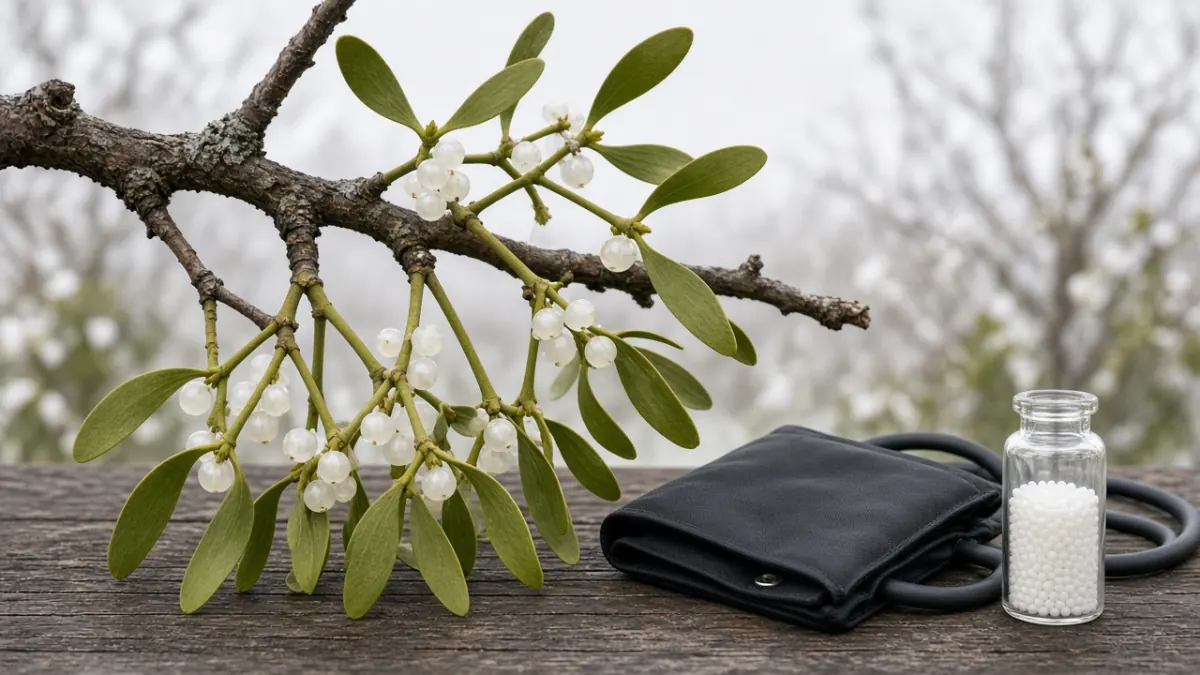
Short answer: Homeopathic Viscum album is made from European mistletoe (Viscum album L.) and is sold in India mostly as 30C or 200C pellets, with a mother tincture (Q) at some pharmacies. Classical materia medica uses it for rheumatic and neuralgic pains, and older texts describe a high-tension, dizzy picture. Mistletoe extract injections such as Iscador or Helixor are a different product, studied as complementary cancer care with low-quality, inconsistent evidence. They are not homeopathic Viscum album 30 and not a replacement for oncology. The raw plant, berries and tea contain viscotoxins and lectins and are toxic. No good clinical trial shows that Viscum album 30 treats cancer, high blood pressure or epilepsy.
This article is for searches like viscum album, viscum album 30 uses, viscum album q, viscum album for blood pressure, viscum album for cancer, mistletoe homeopathy, viscum album side effects and the same queries typed in Hindi (विस्कम एल्बम), Bengali, Tamil, Telugu or Malayalam. YMYL: mistletoe-for-cancer claims are everywhere online, and a lump or a cancer diagnosis needs an oncologist.
Author: Dr. Dheeraj Sharma, BHMS. Based on: Boericke's Materia Medica with Repertory (Viscum album) for the classical picture, and general toxicology and systematic-review knowledge on mistletoe (paraphrased).
| Item | Detail |
|---|---|
| Names | Viscum album, mistletoe, European mistletoe, Viscum album L. |
| Plant | An evergreen shrub that grows as a semi-parasite on host trees such as apple, poplar, oak and pine; white sticky berries. Other parasitic plants sold as "mistletoe" in India are different species |
| Part used | Fresh leafy twigs for the homeopathic tincture (pharmacopoeias differ) |
| Toxic principle | Viscotoxins (small peptides) and mistletoe lectins (proteins), found in leaves, stems and berries |
| Forms sold in India | Pellets and dilutions (6C, 30C, 200C, 1M), mother tincture (Q), some combination drops. Injectable extracts (Iscador, Helixor) are separate physician-supervised products with limited availability here |
| Classical sphere | Rheumatic and neuralgic pains; an old-book picture of high tension, vertigo and nervous twitching |
| Usual adult dose (30C, as commonly labelled) | About 4-5 pellets, or the drops on the label, up to three times a day for a short spell. Read the bottle; labels vary |
| Evidence snapshot | Classical keynotes. No good trials of 30C for blood pressure, cancer, seizures, diabetes or pain. Injected extracts: low-quality, inconsistent evidence as add-on care |
| Safety | 30C and above contain no measurable mistletoe. Raw plant, teas, Q and injections are active or toxic |
European mistletoe grows in clumps on trees. Its leaves, stems and berries carry viscotoxins, which are toxic to cells, and lectins, which are proteins that interfere with protein-making in cells. Eaten, they mostly cause vomiting, diarrhoea and stomach pain. Reports after teas or larger amounts also mention a slow heart rate, drowsiness, confusion and seizures. A child tasting one berry is often mild, but that is not a safety margin to rely on.
A homeopathic 30C is the plant preparation diluted 1 to 100, thirty times over. Beyond roughly 12C, chemistry expects no molecule of the original material to remain. So a 30C pellet carries no measurable viscotoxin or lectin, and it is not an extract.
That is why mistletoe injections and 30C pellets cannot borrow each other's evidence. An injected extract (Iscador, Helixor and similar) contains measurable plant material and is given by a physician. A pellet does not. Likewise, a mother tincture (Q) is an alcohol extract of the fresh plant and may still carry plant compounds, and capsules or teas vary in strength because they are not standardised. Ask what a "Q" is in the mother tincture guide.
Paraphrased, not quoted. Texts differ in detail, and some of this is tradition, not evidence.
Pains. Shooting, tearing or wandering pains in the limbs and joints, stiffness, and sciatic-type pains. Worse in cold, damp weather and in winter in most descriptions.
Nerves. Older books list twitching, nervous excitability and fits. That is history, not an instruction to use it for a seizure disorder.
Circulation. European herbal tradition and some old homeopathic texts link mistletoe to a high-tension pulse, flushes, dizziness and a slow pulse. This is a traditional "picture", not a diagnosis of hypertension.
Women's sphere. Some older texts also mention uterine bleeding and menstrual complaints. Abnormal bleeding needs an examination first.
The classical fit is wandering joint or limb pain with stiffness that is worse in the cold and damp, or a sciatic-type shooting pain. Homeopaths may compare it with other remedies for these pictures. No good trial shows that a 30C pellet relieves joint pain or sciatica. The cause comes first: see arthritis and homeopathy and sciatica and homeopathy. A hot, swollen joint with fever, or back and leg pain with numbness between the legs or loss of bladder or bowel control, is a same-day emergency.
This is the search that carries the most risk. Old European herbal texts link mistletoe with high blood pressure, and online pages repeat it. No good clinical trial shows that a homeopathic 30C pellet lowers blood pressure. Hypertension is silent until it causes a stroke, heart attack or kidney damage, so it needs measured readings and, where advised, prescribed medicines. Do not stop or skip tablets. If you want to take pellets as well, tell your doctor and keep checking your readings. Read more in homeopathy for blood pressure.
Emergency, call 108 or 112: a reading of 180/120 or more, especially with severe headache, chest pain, breathlessness, vision change, confusion, slurred speech or weakness on one side.
Here the two products are mixed up the most. Injected mistletoe extracts, such as the anthroposophic Iscador and Helixor, are used in parts of Europe as complementary care next to standard cancer treatment. Reviews of the trials rate them small, often unblinded, at high risk of bias, and inconsistent on both survival and quality of life. Some report better quality-of-life scores, and that signal is weak. They are not a cancer cure, they are not homeopathic Viscum album 30, and they do not replace surgery, chemotherapy, radiotherapy or targeted therapy.
If you have cancer and are thinking about any mistletoe product, tell your oncology team first, and do not delay or skip scheduled treatment. A new lump, unexplained weight loss, blood in cough, stool or urine, a sore that will not heal, or a hoarse voice that lasts weeks needs a doctor, not pellets.
Epilepsy, seizures, diabetes, anxiety, insomnia, missed periods, infertility, "immunity" and heart rhythm problems come up on pharmacy pages. None of those is a reason to buy this bottle. Raw mistletoe poisoning is itself linked to seizures, so it is the wrong thing to reach for in a seizure disorder. Each of these needs its own assessment.
| Claim | Fact check |
|---|---|
| "Viscum album lowers high blood pressure; a pilot study proves 10 drops three times a day works" | No good controlled trial shows this for homeopathic 30C, and I know of no reliable study behind that dose. Treat the claim as unverified and keep measuring your pressure |
| "Mistletoe fights or cures cancer; Viscum album 30 for cancer" | Injected extracts have been studied as add-on care, with low-quality, inconsistent evidence. A 30C pellet contains no extract. Neither replaces oncology |
| "Treats epilepsy, seizures and twitching" | Raw mistletoe poisoning is linked to seizures in reports. Do not use it for seizures and do not stop antiseizure medicines |
| "Improves diabetes, circulation and immunity" | No good human trial for 30C. Monitor blood sugar as your doctor advises |
| "Mistletoe tea or herbal capsules are a natural, safe alternative" | Natural does not mean safe. Leaves and berries contain viscotoxins and lectins, and strength varies between products |
| "Homeopathic means no side effects" | True only to the extent that a 30C has no measurable material. Q, teas and injections have documented effects |
| Form | What's in it | What to do |
|---|---|---|
| 30C pellets | No measurable mistletoe | The usual home potency. Label wording is commonly about 4-5 pellets, or the drops stated, up to three times a day for a short spell |
| 200C pellets | No measurable mistletoe | Usually chosen by a prescriber who has matched the full picture, taken once or a few times, not daily at home |
| 1M and above | No measurable mistletoe | Prescriber only |
| 6C and lower, liquid low dilutions | More of the original than 30C | Only if a prescriber advised, at the label dose |
| Mother tincture (Q) | An alcohol extract of the fresh plant | Not for self-care. Prescriber only, if used at all |
| Injectable extracts (Iscador, Helixor, others) | Measurable plant extract | Prescription products given under physician supervision. Dose is set by the product and the physician, not by a C potency. Availability and licensing in India are limited |
| Raw berries, leaves, teas, powders, home extracts | Viscotoxins and lectins | Never swallow. Emergency if ingested |
30 vs 200: no trial compares them for this remedy. 30C is the usual over-the-counter choice, and 200C is usually a prescriber's choice. See the potency guide.
Practical points. Let pellets dissolve under the tongue. Many homeopaths ask for a mouth free of food, coffee and mint for about 15 minutes, but that is a convention, not a tested rule. If pain has not changed after two or three doses, stop and rethink. For children, follow the paediatrician's or homeopath's advice and the label; babies under two need a doctor first.
| Form | Risk |
|---|---|
| 30C and above (pellets) | No poison effect is documented. Pellets contain sugar and liquid dilutions contain alcohol, which matters in diabetes, alcohol avoidance and young children. Some people report symptoms feeling stronger for a day |
| Mother tincture, low dilutions | May carry plant compounds in an unstandardised amount. Stomach upset is possible |
| Raw berries, leaves, teas | Vomiting, diarrhoea, stomach pain. Reports also mention slow heart rate, drowsiness, confusion and seizures. Children and larger amounts are the main concern |
| Injected extracts | Redness, swelling or pain at the injection site, fever, chills and flu-like symptoms are commonly reported. Allergic reactions, rarely severe, can occur. These products are used under medical supervision |
| Any form used for the wrong reason | A missed diagnosis. A pellet taken instead of blood pressure tablets or cancer care is the real danger |
Who should avoid it. Anyone with a known allergy to mistletoe. In pregnancy and breastfeeding, avoid the raw plant, tea, tincture and injections, and ask your doctor before any 30C because safety data are lacking. No interaction between 30C pellets and medicines is established. For the tincture, teas and extracts, data are thin, so tell your doctor or oncologist about any mistletoe product. More background in homeopathy side effects.
WeClinic, Panki, Kanpur — 10 AM–9 PM, closed Monday. Call +91 7905136461. Bring the bottle and say the potency on the label. Author: Dr. Dheeraj Sharma.
Have questions about your symptoms? Talk to a WeClinic™ homeopathic doctor, free.
Call Now - Free Consultation