
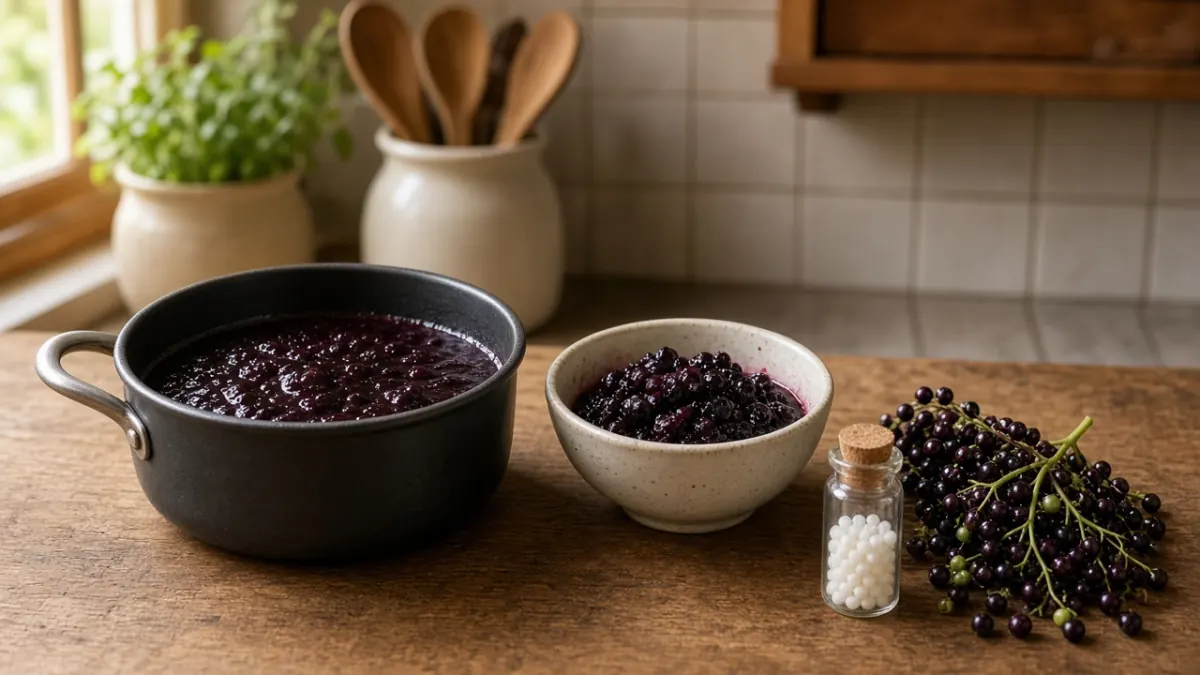
Short answer: Homeopathic Sambucus nigra (elder) is a plant remedy sold in India as dilutions such as 30C and 200C, and as a mother tincture (Q). Boericke's picture is respiratory and mostly about babies: a dry, blocked nose so the infant cannot nurse and snuffles, sudden waking at night as if suffocating, a croupy cough, and sweat that appears on waking while the skin is dry and hot in sleep. It is not the same product as elderberry syrup or gummies, and raw elderberries, leaves, bark and stems are poisonous. No good clinical trials of the homeopathic remedy exist.
This article is for searches like sambucus nigra, sambucus nigra homeopathic medicine uses, sambucus nigra 30 uses, sambucus nigra Q / mother tincture, sambucus nigra side effects, elderberry homeopathy, sambucus for snuffles in babies, sambucus for night sweat. YMYL: three different products share this name, and only one of them is a homeopathic dilution.
Author: Dr. Dheeraj Sharma, BHMS. Based on: Boericke's Materia Medica (Sambucus nigra entry), paraphrased, and public elderberry safety guidance (which plant parts are unsafe raw, and the lack of pregnancy data).
| Query | Honest need | Section |
|---|---|---|
| sambucus nigra 30 uses | Classical respiratory and sweat indications | Uses |
| sambucus nigra Q / mother tincture | A plant extract in alcohol, not the pellet | Dosage |
| sambucus nigra side effects | Raw-plant toxicity, alcohol, missed diagnosis | Safety |
| elderberry homeopathy | Syrup and gummies are a different product | Fact check |
| snuffles in babies / night sweat | When it is a remedy question and when it is not | Uses, doctor |
| sambucus nigra in Hindi, Bengali, Tamil, Telugu, Malayalam | The label name stays Sambucus nigra; read the potency printed beside it | At a glance |
| Item | Detail |
|---|---|
| Botanical name | Sambucus nigra L., family Adoxaceae (older books place it with the honeysuckles) |
| Common names | Elder, black elder, European elder, elderberry |
| Part used in homeopathy | Classically the fresh leaves and flowers for the tincture; the maker's label decides. The berries are what syrups and gummies use |
| Forms sold in India | Dilutions (6C, 30C, 200C, 1M) and mother tincture (Q). Elderberry syrup, gummies and capsules are separate food or supplement products |
| Classical sphere | Respiratory tract of infants and children; sweat; some older texts also list swelling and urinary complaints |
| Usual adult dose of 30C, as commonly labelled | About 4 to 5 pellets, 2 to 3 times a day, as a short course. Labels differ and your practitioner's advice overrides them |
| Usual adult dose of Q, as commonly labelled | Often 5 to 10 drops in a few tablespoons of water, 2 to 3 times a day, adults only. Labels differ |
| Evidence snapshot | Classical indications. No good clinical trials of homeopathic Sambucus nigra |
| Safety | 30C is very low risk. Q is an alcoholic plant extract. Raw plant parts are toxic |
Homeopathic dilution (30C, 200C). Made from the tincture by repeated dilution. At 30C no measurable plant material remains, so the cyanide-forming chemistry of the raw plant is not a dose issue at that potency. The potency guide explains the numbers.
Mother tincture (Q). An alcoholic extract of the plant. It carries the plant's chemistry and the alcohol. See the mother tincture guide for how Q differs from a potency.
Elderberry syrup, gummies, capsules. Food or supplement products, usually from the cooked berry or flower. Cooking matters: raw or unripe berries and the green parts of the plant contain compounds that release cyanide in the gut and cause nausea, vomiting and diarrhoea. Properly made syrups are cooked, which breaks these compounds down.
Boericke treats Sambucus as a remedy of the breathing passages. His short entry circles three pictures, paraphrased here and not quoted.
The infant's nose. Dry coryza. The nose is blocked and dry rather than running, the baby snuffles and cannot suck because it has to breathe through the mouth, and lets go of the breast to gasp.
The night attack. The child wakes suddenly, nearly suffocated, sits up and struggles for air, with a spasmodic, croupy cough. Boericke lists spasmodic croup and suffocative attacks at night. A child who wakes like this needs a doctor, not only a remedy.
The sweat. Sweat that comes on waking while the skin is dry and hot during sleep. This is the opposite of the usual night-sweat pattern, which is why it is a keynote.
Other lines. Some older texts also list puffy swelling and urinary complaints. Those are medical problems, not self-care: see the doctor list below.
No good clinical trial exists of homeopathic Sambucus nigra for infant snuffles, croup, cough or night sweat. What this page calls "uses" is classical indication from old provings and clinical reports, not trial data. Nothing in current chemistry explains what a 30C does, since no measurable plant remains at that dilution.
Elderberry as a food or supplement is a separate question. Some small trials of standardised elderberry extracts suggest at most a modest shortening of cold or flu symptoms, but those trials are small and of mixed quality, and they say nothing about homeopathic pellets. Elderberry is not a substitute for flu vaccination, prescribed antivirals or medical care.
| Claim | Fact check |
|---|---|
| "Boosts immunity" | That is a claim about elderberry extract and syrup (vitamins, plant pigments). A homeopathic dilution is not a source of vitamins, and no trial shows 30C changes immunity |
| "Shortens colds and flu" | Small trials of standardised elderberry extract hint at a modest effect at best. Not shown for homeopathic Sambucus |
| "Treats asthma, bronchitis, croup" | Classical homeopathic indications only. Asthma and croup need medical treatment. Do not stop an inhaler or steroid |
| "Lowers cholesterol and blood pressure" | No reliable human evidence for the remedy. Do not change prescribed heart or blood pressure medicines |
| "Good for skin, wrinkles, arthritis" | Antioxidant marketing for the fruit. No proof for pellets |
| "30 to 40 drops of tincture three times a day" | Not what homeopathic Q labels advise, and an unstudied amount of alcohol and plant extract. Do not copy it |
| "Safe for babies because it is diluted" | 30C has no measurable plant, but the diagnosis still matters. Q is alcoholic, and many syrups contain honey, which should not be given under 12 months |
| "Take it daily for immunity" | No long-term safety data for Q, and no evidence of benefit from pellets for this purpose |
The fit is the nursing infant with a dry, blocked nose who snuffles, cannot suck and has to leave the breast to breathe. Homeopaths discuss a 30C for this picture. First-line care for a blocked infant nose is simple: saline drops, a clear feeding position, and a doctor's review if the baby is under three months, feeding poorly or breathing hard. Pellets do not replace that. If the nose is running yellow-green with fever, that is a different picture.
The classical match is a spasmodic, croupy cough with sudden waking at night and a sense of suffocation. For a barking, croupy cough, homeopaths more often compare Spongia, Aconite and Hepar sulph; see Spongia tosta. If breathing is noisy at rest, the child is breathing fast or pulling in at the ribs, or lips look blue, go to emergency care. For an adult with a blocked nose, see sinusitis, where the cause is usually inflammation of the sinuses.
The keynote is sweat on waking with a dry, hot skin during sleep. Persistent drenching night sweats are a different matter: with a cough lasting more than two weeks, evening fever, or weight loss they need a chest and TB check, not a remedy. Night sweats in menopause or with a thyroid problem have their own assessment.
Immune boosting, cholesterol, blood pressure, wrinkles, arthritis and kidney disease are not the keynote of Sambucus. Elderberry marketing carries those claims over to the homeopathic name. Respiratory care at WeClinic is described on the respiratory diseases page.
| Form | What is in it | What to do |
|---|---|---|
| 30C pellets | No measurable plant | Labels commonly suggest about 4 to 5 pellets, 2 to 3 times a day for a short course in adults. Stop when the complaint settles. Reassess at 48 to 72 hours |
| 200C and above | No measurable plant | A practitioner's choice, usually a single dose. Not a self-care potency |
| Mother tincture (Q) | Alcoholic plant extract | Labels commonly say about 5 to 10 drops in a few tablespoons of water, 2 to 3 times a day, adults only. Short courses. Do not give to infants |
| Elderberry syrup, gummies, capsules | Cooked berry or flower extract | No agreed standard dose. Follow the product label. Check for honey (not under 12 months) and sugar |
| Home-made syrup from raw berries, or tea from leaves and stems | Raw plant toxins | Do not improvise. Buy a labelled, cooked product instead |
There is no safe children's drop dose given on this page. A baby's dose of pellets is set by a clinician after the baby has been examined. Potency names are explained in the guide linked above.
How to take pellets: on a clean mouth, 15 to 30 minutes away from food, drink or strong flavours, dissolved under the tongue. Do not exceed the label unless a clinician says so. Stop if the complaint is not changing by 72 hours and have it examined.
| Risk | Who it hits |
|---|---|
| Nausea, vomiting, diarrhoea, abdominal pain | Anyone eating raw or unripe elderberries, or leaves, stems, bark and roots, including juice pressed with stems |
| Alcohol exposure | Children, pregnancy, liver disease and alcohol recovery with Q or liquid dilutions |
| Allergy: rash, itching, lip swelling, breathlessness | Rare, but any allergic reaction needs medical help |
| Brief worsening of the complaint | Reported in homeopathic practice after a dose. Stop and ask your practitioner |
| Missed diagnosis | The main real risk: croup, asthma, pneumonia or kidney disease treated with pellets alone |
| Sugar and lactose in the carrier | Pellets and tablets. Worth knowing in diabetes or lactose intolerance |
Interactions: none is firmly established for homeopathic Sambucus nigra. For elderberry extract the concerns are theoretical, for example whether stimulating the immune system could matter for autoimmune disease or immune-suppressing medicines. If you take such medicines, ask your doctor before starting an elderberry supplement. See homeopathy side effects for the wider picture.
WeClinic, Panki, Kanpur — 10 AM–9 PM, closed Monday. Packages ~Rs 1,800–5,000. Call +91 7905136461. Bring the bottle and say whether it is 30C, Q or a syrup. Author: Dr. Dheeraj Sharma. We will not swap an inhaler, an antibiotic or hospital care that a child needs for pellets.
Ranking pages for this name mostly describe elderberry the food: immunity, heart, skin and 30 to 40 drop doses. This page keeps the homeopathic picture (blocked infant nose, night suffocation, sweat on waking), keeps the dose by form, and treats raw elderberry as a poison, not a tonic.
Have questions about your symptoms? Talk to a WeClinic™ homeopathic doctor, free.
Call Now - Free Consultation