
Calendula Officinalis Q and 30: Uses, Dose, Side Effects

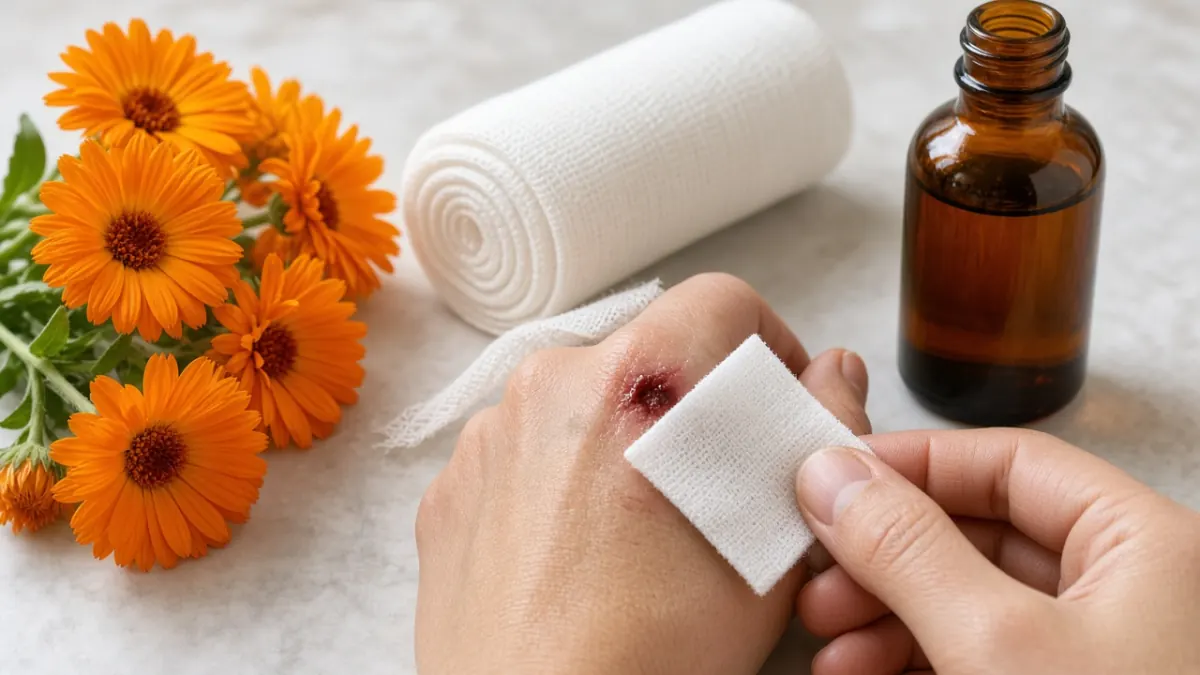
Short answer: Calendula officinalis (pot marigold) is a classical homeopathic remedy used mostly on the skin — as a diluted mother tincture, lotion or ointment — for clean, minor, torn or scraped wounds. Calendula 30 pellets are also sold. No good clinical trial shows that homeopathic Calendula (Q or 30C) heals wounds faster than ordinary wound care. The key safety fact: it is a daisy-family plant, so people allergic to ragweed, chrysanthemum, chamomile or arnica can react, and deep, dirty, bitten, infected, burnt or non-healing wounds need a doctor, not a tincture.
This article is for searches like calendula officinalis homeopathic medicine, calendula q uses, calendula 30, calendula ointment uses, calendula lotion uses, calendula tincture uses, calendula for wounds, calendula side effects, and the same typed in Hindi (कैलेंडुला ऑफिसिनेलिस के फायदे, कैलेंडुला Q के उपयोग), Bengali (ক্যালেন্ডুলা ওষুধের ব্যবহার), Tamil (கலெண்டுலா மருந்தின் பயன்கள்), Telugu (కలెండ్యులా ఉపయోగాలు) and Malayalam (കലെൻഡുല ഉപയോഗങ്ങൾ).
Author: Dr. Dheeraj Sharma, BHMS. Based on: Boericke's Materia Medica and standard homeopathic pharmacy practice (paraphrased).
Key takeaways
- Intent: Calendula is mainly an external remedy. Q tincture, lotion and ointment are far more common than Calendula 30, and the two behave very differently.
- The picture that matters: a clean, superficial, torn or scraped wound, where classical texts also note pain that seems out of proportion to how it looks.
- Hard safety rule: do not use it if you react to daisy-family plants (ragweed, chrysanthemum, chamomile, arnica), dilute any tincture as labelled, and never pour alcohol tincture into a deep wound.
- Emergency rule: deep, dirty, infected or bitten wounds, burns, diabetic foot sores and sores that do not heal need a doctor first. Call 108 / 112 for heavy bleeding or a swelling face with breathlessness.
Calendula officinalis at a glance
| Item | Detail |
|---|---|
| Names | Calendula officinalis; pot marigold; Calendula (Calen.); family Asteraceae (daisy family) |
| Part used | Fresh flowers or flowering tops (mother tincture) |
| Forms sold in India | Mother tincture Q; dilutions 6C, 30C, 200C, 1M; ointment, cream, lotion, gel; herbal oil and tea (not homeopathic) |
| Classical sphere | Torn, lacerated or open wounds with a risk of suppuration; mainly external use |
| Usual adult dose, as commonly labelled | Tincture or lotion: dilute with boiled, cooled water for a wash or dressing. Ointment: thin layer on clean skin, a few times a day. 30C: a few pellets, a few times a day, short course. Follow your pack; this is label wording, not medical advice |
| Evidence snapshot | No good trial of homeopathic Calendula (Q or 30C) for wound healing; small, mixed studies exist for herbal calendula creams |
| Safety | Contact allergy in daisy-family-sensitive people; Q contains alcohol; not a substitute for wound care, tetanus cover or antibiotics |
What Calendula is, and what each form contains
Calendula officinalis is a short, bright orange-yellow flowering herb of Mediterranean origin, grown across India as a winter garden flower. It is not the garland marigold (genda, genus Tagetes), which is a different plant. Its flower heads contain triterpenoids, flavonoids, carotenoids and polysaccharides, and extracts of it are active in laboratory studies. Calendula is not a classically poisonous plant, but daisy-family plants are a recognised cause of plant contact allergy and calendula is one of them.
Q (mother tincture) is an alcoholic extract of the fresh plant. It still contains measurable plant compounds and a lot of alcohol, so treat it as a herbal preparation, not as "just homeopathy". See the mother tincture guide.
30C and above are repeated dilutions. Beyond about 12C a pellet is not expected to contain even one molecule of the original plant (see the potency guide). Any effect cannot be a chemical one.
Ointments, creams and lotions are Calendula tincture in a base or in water; the strength differs by brand. Herbal products (tea, capsules, infused oil) are ordinary plant products made by different rules, and the milligram figures printed on them do not apply to homeopathic pellets. On evidence: a few small studies of herbal calendula ointments exist in skin settings such as radiation skin reactions, leg ulcers and nappy rash. They are few, small and mixed in quality, and they used measurable plant extract. They do not show that a 30C pellet works.
What classical materia medica says
Boericke and the older homeopathic writers place Calendula mainly under wounds: lacerated, torn or ragged wounds, with or without loss of skin, where the aim is clean healing and avoiding excess suppuration. They also describe pain that can seem greater than the wound looks, and use after surgical cuts. The standard instruction is external use of a diluted tincture, with internal use less central. This is classical tradition. It is not trial evidence.
Uses, matched to the search
Calendula for wounds. Classical use: a diluted lotion or a thin ointment on a clean, minor scrape or shallow cut, after the wound has been washed under clean running water. Evidence for the homeopathic form: none from good trials. Red flags: depth, dirt, a bite, a nail or thorn puncture, or signs of infection (see below).
Calendula ointment, lotion and tincture uses. Ointment or cream is the gentlest form for dry, chapped or lightly scraped skin and for nappy-area soothing. Lotion is diluted tincture, used as a wash or on a dressing. Plain Q is the strongest and the one most likely to sting or irritate. Evidence: small trials of herbal creams at best; nothing for homeopathic strengths.
Calendula Q uses. In India Q is bought mostly for external dilution. Some packs also print internal drops, but that is a herbal-strength alcohol extract, not a homeopathic dilution, and external use is the usual classical route. Check your label.
Calendula 30 uses. A 30C pellet is a high dilution with no measurable plant. Practitioners sometimes give it alongside dressings after minor injuries or surgery. No good trial shows it speeds healing.
Burns. Calendula lotion is commonly mentioned for minor sunburn-type burns. Cool the burn under running water for about 20 minutes first and do not use alcohol tincture on it. Larger, blistering or deep burns need a doctor.
Skin conditions. A calendula ointment can be a soothing emollient for mild dry skin or nappy rash, but good evidence that it controls eczema, psoriasis or acne is lacking, and a calendula allergy can itself cause a rash.
Mouth ulcers, piles, vaginal itching. Online lists mention all three. Nothing good shows Calendula treats them, and alcohol tincture should not go inside the vagina or onto raw rectal tissue. A mouth ulcer lasting over three weeks, rectal bleeding or a new vaginal discharge needs an examination.
Wound remedies are matched to the injury type:
| Remedy | Classical injury picture |
|---|---|
| Calendula | Torn, ragged, open, superficial wound; external dressing |
| Arnica | Bruise or blow with unbroken skin |
| Hypericum | Crush injury to nerve-rich parts such as fingertips, with shooting pain |
| Ledum | Puncture wound or insect sting that feels cold; still a tetanus question |
Fact check against older pharmacy pages
| Claim you will see online | What is actually true |
|---|---|
| "Calendula speeds wound healing and prevents infection" | A classical external dressing for clean minor wounds. Not a proven antiseptic; it does not replace washing, tetanus cover or antibiotics |
| "Calendula treats eczema, psoriasis, acne and diaper rash" | At most a soothing base for mild skin. No good trial of homeopathic Calendula, and allergy can worsen a rash |
| "Calendula cures piles, mouth ulcers and vaginal yeast infections" | No good evidence. Bleeding, ulcers over three weeks and discharge need examination |
| "Calendula helps arthritis, gout, IBD, PMS, anxiety or cancer" | Herbal-listicle claims. No trial for homeopathic Calendula in any of these; gout, IBD and cancer need proper treatment |
| "Take 1–2 mL tincture or 500–1,000 mg capsules several times a day" | Herbal supplement figures copied onto homeopathic pages. They are not homeopathic doses and not advice here |
| "It is natural, so it has no side effects" | Contact allergy, alcohol in Q, and delay in proper care are all real |
Dosage by form
Label wording only. Packs differ, so read yours. Nothing here is a prescribed schedule.
| Form | What it is | Commonly labelled use | Note |
|---|---|---|---|
| 30C pellets | No measurable plant | A few pellets under the tongue, a few times a day, short course | Self-care only for minor, short problems |
| 200C / 1M | Higher dilution, still no plant | Single doses, as a prescriber decides | Prescriber only |
| Q for skin | Alcohol plant extract | Dilute in boiled, cooled water before a wash or dressing; do not apply undiluted to raw skin | Check the pack for the ratio |
| Q by mouth | Alcohol plant extract | Some packs print drops in water; many are labelled external only | Not for children, pregnancy, liver disease or alcohol recovery |
| Ointment, cream, lotion | Tincture in a base or water | A thin layer or dressing on clean skin, a few times a day | Patch test first |
| Herbal tea, capsules, oil | Plant product | Per manufacturer, not homeopathic | Avoid by mouth in pregnancy; ask a doctor first |
Side effects and risks
Any skin form. Redness, itching or a spreading rash from contact allergy. Test a small dab on the inner forearm and wait 24 hours before wider use. Stop if it itches, reddens or blisters.
Q tincture. It contains alcohol: it stings on raw skin, can dry it and may delay healing if overused. Keep it away from eyes, ears, the mouth and the vagina unless the pack says otherwise.
By mouth. Alcohol load, possible nausea or stomach upset. Allergic reactions, rarely severe, have been reported with herbal calendula in daisy-family-sensitive people.
30C. No chemical risk. The real risk is delay: using pellets while a wound goes bad.
Who should avoid it: anyone allergic to ragweed, chrysanthemum, chamomile, sunflower, arnica or other daisy-family plants; anyone with a deep, dirty or infected wound.
Pregnancy, breastfeeding and children. Calendula by mouth has a traditional reputation for stimulating menstruation and is best avoided in pregnancy; safety data are lacking. Check any skin use with your obstetrician. Do not give Q by mouth to children. For a baby's nappy rash, patch test first and see a doctor if the rash blisters, oozes or comes with fever.
Interactions. No well-established drug interactions for skin use or 30C. For large oral herbal doses, additive drowsiness or blood-pressure or sugar effects are only theoretical. Never stop a prescribed medicine for Calendula; if you take immunosuppressants, steroids or blood thinners, tell your doctor. For wider cautions, see homeopathy side effects.
When to see a doctor
- Heavy bleeding, or a wound still bleeding after 10 minutes of firm pressure.
- A wound that is deep, gaping, shows fat or bone, or leaves numbness or weakness beyond it.
- Dirty, rusty or soil-contaminated wounds, nail or thorn punctures, and any animal or human bite. Wash for 15 minutes with soap and running water and go for tetanus review and, for dog, cat or monkey bites, rabies post-exposure advice.
- Spreading redness, warmth, swelling, pus, red streaks, increasing pain after 48 hours, or fever.
- Burns larger than the person's palm, any blistering burn on the face, hands, feet, groin or joints, deep or white burns, and any burn in a baby.
- A diabetic foot sore, a leg ulcer with varicose veins or poor circulation, or any sore not clearly healing within two to three weeks.
- A pregnant, breastfeeding or immunosuppressed person, or an infant, with any wound that is not trivial.
- Rectal bleeding, a mouth ulcer over three weeks, or new vaginal discharge.
Call 108 / 112 for severe bleeding, a spreading rash with swollen lips or face, wheeze or faintness after using a calendula product, or a bite from an animal that cannot be observed.
WeClinic, Panki, Kanpur — 10 AM–9 PM, closed Monday. Call +91 7905136461. Bring the bottle and say the potency on the label. Author: Dr. Dheeraj Sharma.
Frequently Asked Questions
What is Calendula officinalis homeopathic medicine used for?
What are Calendula Q uses, and can I put it straight on a wound?
What are Calendula 30 uses?
Calendula ointment, lotion or tincture: which should I use?
Is calendula good for wounds, cuts and burns?
What are the side effects of calendula?
Is calendula safe in pregnancy, breastfeeding and for babies?
Can calendula treat eczema, piles or mouth ulcers?
Have questions about your symptoms? Talk to a WeClinic™ homeopathic doctor, free.
Call Now - Free Consultation