


 Our specialists are online... Call now...




























Key Takeaways
- What it is: Gynecomastia is the benign enlargement of glandular breast tissue in males caused by an imbalance between estrogen and testosterone.
- Who it affects: It is common in adolescent boys during puberty and in men over 50 with declining testosterone, and can occur at other ages too.
- Main causes: Puberty, obesity, ageing, certain medications, anabolic steroid or supplement use, alcohol, and thyroid, liver or kidney conditions can all trigger it.
- Not the same as chest fat: True gynecomastia is firm glandular tissue behind the nipple, while pseudogynecomastia is soft chest fat with no gland growth - a simple pinch test can help tell them apart.
- Homeopathy's role: WeClinic™ Homeopathy uses individualised remedies aimed at the underlying hormonal imbalance, mainly for early, mild or hormonally-driven cases.
- Typical timeframe: Visible change in tenderness and swelling is usually noticed within 8-12 weeks in early, softer-stage cases, though this varies by patient.
- Safety note: Persistent, firm, fibrous or severe gynecomastia is best evaluated for surgery, which remains a well-established option WeClinic™ doctors will recommend honestly when needed.
What Is Gynecomastia?
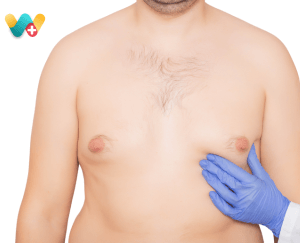
Gynecomastia is a benign hormonal condition marked by the enlargement of glandular breast tissue in males, caused by an imbalance between the hormones estrogen and testosterone. It can affect one or both breasts, and while it is rarely a sign of anything serious, it is one of the most common sources of embarrassment and self-consciousness men and teenage boys experience.
It is important to distinguish true gynecomastia from simple chest fat, and to identify which type you have, since this determines the right course of action. The presentations we commonly see at WeClinic™ Homeopathy in Kanpur include -
- True Gynecomastia - an actual increase in glandular breast tissue behind the nipple.
- Pseudogynecomastia - fat deposition in the chest with no glandular growth.
- Pubertal Gynecomastia - temporary swelling that appears around age 13-14.
- Adult-Onset Gynecomastia - develops later in life, often after age 50.
- Unilateral Gynecomastia - enlargement affecting only one breast.
- Bilateral Gynecomastia - enlargement affecting both breasts.
| Also known as | Man boobs, male breast enlargement, enlarged male breast tissue |
|---|---|
| Commonly affects | Adolescent boys during puberty and men over 50; can occur at any age |
| Main symptoms | Chest swelling, tenderness, a firm lump beneath the nipple, asymmetry |
| Common causes | Hormonal shifts, obesity, medications, steroid use, alcohol, thyroid/liver/kidney conditions |
| How it's told apart from chest fat | Pinch test and clinical breast exam - firm gland tissue vs. soft, diffuse fat |
| Diagnosis | Clinical exam, hormone blood tests, medication review, imaging in select cases |
| Homeopathic approach | Individualised, constitutional remedies aimed at the hormonal imbalance |
| Typical treatment duration | 8-12 weeks for early improvement; full course often 6-12 months |
Gynecomastia vs Pseudogynecomastia: The Pinch Test
The simplest way to tell true gynecomastia apart from pseudogynecomastia at home is the pinch test: gently pinch the tissue directly under and around the nipple between your thumb and finger. If you feel a firm, rubbery, button-like disc of tissue, that points to true glandular gynecomastia. If the tissue feels uniformly soft and compressible, similar to the fat elsewhere on your body, that points to pseudogynecomastia, which is chest fat without glandular growth. This distinction matters because pseudogynecomastia usually responds to weight loss and exercise, while true glandular tissue generally does not shrink with diet or workouts alone and needs a hormonal evaluation. The pinch test is a useful first check, but it cannot replace a clinical breast examination by a doctor, which remains the most reliable way to confirm the diagnosis.
Common Symptoms We Treat
Gynecomastia can present differently from patient to patient. Our doctors regularly evaluate men and teenage boys with the following symptoms -
- Swelling of breast gland tissue - a visible increase in chest size.
- Breast tenderness - sensitivity, especially common in teenagers.
- A firm, rubbery lump - felt directly beneath the nipple-areola area.
- Asymmetry - one breast appearing larger than the other.
- Nipple discharge - uncommon, but needs prompt medical evaluation.
- Emotional distress - avoidance of swimming, gyms or fitted clothing.
What Causes Gynecomastia?
Gynecomastia develops when the ratio of estrogen to testosterone activity shifts in favour of estrogen, whether due to a natural life stage or an outside factor. Common causes include -
- Natural hormonal changes during puberty.
- Declining testosterone levels with age.
- Obesity, which increases estrogen production.
- Certain medications - anti-ulcer drugs, some blood pressure/heart medicines, anti-androgens, select antipsychotics and antidepressants.
- Regular alcohol use.
- Anabolic steroid or unprescribed hormone use.
- Underlying thyroid, liver or kidney conditions.
- Rare hormone-secreting tumours (needs evaluation).
Who Is Most at Risk?
While gynecomastia can occur at almost any age, certain groups are more commonly affected -
- Adolescents: up to a majority of boys experience some pubertal gynecomastia around age 13-14, which usually resolves on its own within 6 months to 2 years.
- Men over 50: falling testosterone combined with steady estrogen levels raises the risk of adult-onset gynecomastia.
- Overweight men: excess fat tissue converts more testosterone into estrogen, increasing risk.
- Medication users: men on certain long-term medications or anabolic steroids are at higher risk.
- Men with liver, kidney or thyroid conditions: these can disturb the body's hormone balance.
Common Diagnostic Approach
To confirm true gynecomastia and rule out other causes, doctors typically recommend -
- Clinical breast examination - to distinguish firm glandular tissue (true gynecomastia) from soft fat (pseudogynecomastia).
- Hormone blood tests - checking testosterone, estrogen and thyroid levels.
- Review of medications and health history - to identify any drug-induced or condition-related cause.
- Imaging (ultrasound or mammography) - recommended in select cases to rule out other breast conditions.
Note: Imaging and detailed hormone panels are usually reserved for unclear, asymmetric or rapidly-progressing cases, and are not required for every patient.
Possible Complications of Untreated Gynecomastia
Untreated gynecomastia is rarely dangerous, but leaving it unaddressed for a long time can lead to a few practical and emotional consequences that are worth knowing about -
- Tissue fibrosis: long-standing glandular swelling can gradually harden into fibrous tissue that responds far less to medicines and typically needs surgery.
- Persistent asymmetry: unilateral or uneven cases left unmonitored can remain visibly asymmetric.
- Ongoing tenderness or discomfort: especially in cases linked to an underlying hormonal or medication cause that hasn't been addressed.
- Psychological impact: prolonged self-consciousness, social withdrawal, avoidance of gyms or intimacy, and reduced self-confidence.
- Missed underlying cause: rarely, gynecomastia is the first visible sign of a thyroid, liver, kidney or hormone-secreting tumour issue, which delays appropriate evaluation if ignored.
Note: Persistent or rapidly growing breast lumps, especially if hard, irregular, fixed to the skin, or accompanied by nipple discharge or skin changes, need prompt medical evaluation to rule out rarer causes.
Lifestyle & Care Tips
- Maintain a healthy body weight through diet and exercise.
- Limit or avoid regular alcohol consumption.
- Never use anabolic steroids or unprescribed hormone supplements.
- Review any new medication with your doctor if breast changes appear.
- Include strength training as part of a balanced fitness routine.
- Get early evaluation instead of hiding the condition out of embarrassment.
How Homeopathy Treats Gynecomastia
It's important to be upfront: for gynecomastia that has persisted for a long time, has become firm and fibrous, or is causing significant physical or psychological distress, surgery (male breast reduction) is a well-established and often the most predictable treatment option, and our doctors will say so honestly rather than delaying necessary care. Where homeopathy fits in best is in early, milder or hormonally-driven cases - particularly pubertal gynecomastia and softer, glandular swelling - where it aims to work on the underlying hormonal imbalance alongside supportive lifestyle guidance.
The Homeopathic Approach - Working on the Underlying Imbalance
Homeopathy doesn't view gynecomastia as an isolated "lump" - it looks at the person's overall hormonal and constitutional picture. Dr. Abhinash Gupta and the men's health team at WeClinic™ Homeopathy, Kanpur take a detailed case history: your age, when the swelling began, whether it's linked to puberty, weight, medication or another health condition, and your general physical makeup. Based on this, an individualised remedy and potency is selected, and you are also told clearly if your case is one that would benefit more from monitoring, medical management or a surgical referral.
Commonly Referenced Homeopathic Remedies for Gynecomastia
Classical homeopathic literature references several remedies for glandular swelling and breast tissue changes in men, each suited to a different presentation, such as -
Commonly referenced for firm, hardened glandular swelling of the breast tissue linked with hormonal imbalance.
Considered for glandular swelling that feels hard or nodular, and is often referenced when obesity contributes to the case.
Referenced for hard, stony glandular tissue and indurations of long standing.
Often considered when glandular overgrowth follows steroid, hormone or vaccine exposure.
Commonly used in overweight patients with soft, enlarged breast tissue and general excess fat deposition.
Considered for cases with hormonal imbalance, sluggish digestion and bloating, where breast tissue feels flabby rather than firm.
Often referenced for pubertal gynecomastia in teenage boys, particularly where physical or mental development also seems delayed.
Used in chronic or recurring presentations, especially where breast enlargement is accompanied by burning or itching sensations.
Important: This information is for educational purposes only. Please do not self-medicate. WeClinic™ doctors prescribe the right remedy and dosage only after a detailed personal case-history consultation, so book your free consultation before starting any treatment.
Benefits of Homeopathic Support for Gynecomastia
- Natural treatment with no known dependency
- Works on the underlying hormonal imbalance
- Completely confidential process, start to finish
- Combined with practical diet & lifestyle guidance
- Suitable alongside monitoring in early, mild cases
Homeopathy vs Allopathy (Surgery) for Gynecomastia
Both approaches have a genuine role depending on how long-standing and how severe the case is -
Allopathy (Surgery)
- Recommended for firm, fibrous or long-standing tissue
- Gives an immediate, predictable cosmetic result
- Involves a surgical procedure & recovery period
- The established option for severe or persistent cases
Homeopathy
- Best suited to early, mild or hormonally-driven cases
- Aims to work on the underlying hormonal imbalance
- Non-invasive, natural remedies
- Combined with monitoring & lifestyle guidance
Frequently Asked Questions About Gynecomastia Homeopathy
Can homeopathy reduce gynecomastia without surgery?
In many early or mild cases, especially where glandular tissue hasn't hardened into fibrous tissue, homeopathy can help by addressing the underlying hormonal imbalance and supporting a gradual reduction in swelling and tenderness. However, in long-standing cases where the breast tissue has become firm and fibrous, or where the enlargement is significant, surgery remains the established, more predictable option, and our doctors will tell you honestly which category your case falls into after a proper evaluation.
Is gynecomastia common in teenage boys?
Yes, pubertal gynecomastia is very common and is reported in a large proportion of adolescent boys, usually appearing around 13-14 years of age due to a temporary imbalance between estrogen and testosterone during puberty. In most cases it resolves on its own within 6 months to 2 years without any treatment, though a doctor's evaluation is still recommended to rule out other causes and to guide the family if it persists.
Is gynecomastia caused by hormones?
Yes, gynecomastia is primarily caused by an imbalance between estrogen and testosterone - either a relative increase in estrogen activity or a decrease in testosterone activity - which stimulates the growth of glandular breast tissue in men. This imbalance can occur naturally during infancy, puberty and older age, or can be triggered by obesity, certain medications, alcohol use or underlying health conditions.
Which is the best homeopathic medicine for gynecomastia?
There is no single best medicine - homeopathy is individualised, and remedies like Conium Maculatum, Phytolacca Decandra, Calcarea Fluorica, Thuja Occidentalis and Calcarea Carbonica are commonly referenced in classical literature for different gynecomastia presentations. The right remedy and potency depend entirely on your specific case, so it should only be prescribed after a proper case-history consultation with a qualified homeopathic doctor, not self-administered.
Does weight loss help with gynecomastia?
Weight loss can help significantly if your chest enlargement is mainly due to fat deposition (pseudogynecomastia) rather than true glandular tissue growth, since excess fat tissue also increases estrogen production in the body. However, if true glandular tissue has developed, weight loss and exercise alone usually will not fully resolve it, and a doctor's evaluation is needed to tell the two apart and plan the right treatment.
When is surgery needed for gynecomastia?
Surgery is generally considered when gynecomastia has persisted for a long time (often over 1-2 years) despite conservative management, when the breast tissue has become firm and fibrous, or when the enlargement is causing significant physical discomfort or psychological distress. Surgery is a well-established, effective option for such persistent or severe cases, and our doctors will refer you appropriately if your case needs it rather than delaying necessary care.
How long does homeopathic treatment take to show results in gynecomastia?
Most patients in the early, softer stages of gynecomastia notice a change in tenderness and swelling within 8-12 weeks of starting treatment, though this varies with age, how long the condition has been present, and whether the tissue has hardened. For lasting improvement, doctors usually recommend completing the full course rather than stopping as soon as symptoms ease.
Is homeopathic treatment for gynecomastia safe for teenagers?
Yes, homeopathic medicines are prepared from natural sources and, when taken in the doctor-prescribed dose, are considered safe for teenagers with no known dependency or major side effects. Since pubertal gynecomastia often resolves naturally, our doctors typically combine reassurance and monitoring with gentle, individualised homeopathic support for the discomfort.
What is the difference between gynecomastia and simple chest fat (pseudogynecomastia)?
True gynecomastia involves an actual increase in glandular breast tissue, which feels like a firm, rubbery disc directly beneath the nipple on examination. Pseudogynecomastia, on the other hand, is caused purely by fat deposition in the chest with no glandular growth, so the tissue feels soft throughout with no distinct firm lump. A clinical breast examination by a doctor is the most reliable way to tell the two apart.
Can steroids or bodybuilding supplements cause gynecomastia?
Yes, anabolic steroids and unregulated bodybuilding supplements are a well-recognised cause of gynecomastia, because the body converts excess synthetic testosterone into estrogen, disturbing the natural hormone balance. This steroid-induced glandular growth can be more resistant to homeopathic or medical management if steroid use continues, so the first step our doctors advise is always stopping the substance under proper guidance before starting any treatment.
Do chest exercises or workouts get rid of gynecomastia?
Chest exercises can strengthen the underlying pectoral muscle and improve overall chest shape, but they do not shrink true glandular breast tissue, since spot-reduction of glandular tissue through exercise is not physiologically possible. Workouts are more helpful for pseudogynecomastia, where general fat loss through exercise and diet can reduce chest fat, whereas true gynecomastia needs hormonal or medical evaluation regardless of fitness level.
Is one-sided (unilateral) gynecomastia a cause for concern?
Unilateral gynecomastia, where only one breast is enlarged, is usually still a benign hormonal condition, but it warrants a more careful clinical evaluation than bilateral cases because it can occasionally point to a localised cause that needs to be ruled out. Our doctors recommend a proper physical examination for any one-sided breast swelling, especially if there is a hard, irregular lump, skin changes or nipple discharge, before starting homeopathic or any other treatment.
Which medications can cause gynecomastia?
Medications linked to gynecomastia include certain anti-ulcer drugs, some blood pressure and heart medications, anti-androgens used for prostate conditions, select antipsychotics and antidepressants, anabolic steroids, and some antiretroviral drugs. If you notice breast changes after starting a new medication, do not stop it on your own - discuss it with the prescribing doctor first, since some of these drugs cannot be abruptly discontinued.
Can gynecomastia affect a person's confidence or mental health?
Yes, gynecomastia can have a real psychological impact, and many patients report avoiding swimming, gyms, tight clothing or intimacy due to self-consciousness about their chest appearance. This emotional distress is a valid part of the condition, not a minor side issue, and our doctors factor it into the treatment discussion alongside the physical evaluation so patients feel heard and supported, not just examined.
Start Your Journey to a Confident Chest, Confidentially
Book a free, confidential consultation with WeClinic™'s experienced homeopathic doctors and get an honest evaluation of your specific case.
Call Now - Book Free Consultation Prefer to visit in person? Book a Clinic Appointment