


 Our specialists are online... Call now...































Key Takeaways
- What it is: A mole (melanocytic nevus) is a common, usually benign skin growth formed by a cluster of pigment-producing cells called melanocytes.
- Who it affects: Nearly everyone has moles - most adults have between 10 and 40, and having them is a normal part of having skin.
- Main causes: Genetics, cumulative sun exposure, hormonal shifts during puberty or pregnancy, and natural ageing all influence how many moles a person develops.
- Safety first: Any mole showing an ABCDE warning sign - Asymmetry, irregular Border, uneven Color, Diameter over 6mm, or Evolving change - needs prompt dermatological evaluation before any cosmetic or complementary approach.
- What homeopathy offers: WeClinic™'s constitutional homeopathic care is offered only for moles a doctor has already confirmed are benign, and aims to support the skin's general tendency to form such growths - it does not physically remove an existing mole.
- Typical timeframe: When pursued for benign, doctor-cleared moles, constitutional care is generally viewed as a gradual, months-long process rather than a quick fix, and visible change is not guaranteed.
- Reviewed by: This page is medically reviewed by Dr. Sonali Verma, Homeopathic Physician at WeClinic™ Homeopathy, Kanpur.
What Are Moles?
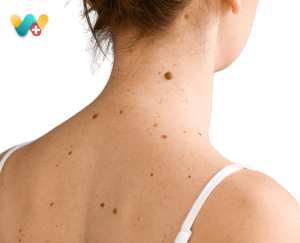
A mole, medically known as a melanocytic nevus, is a common benign skin growth that forms when melanocytes - the pigment-producing cells in the skin - develop in a cluster instead of spreading evenly through the surrounding tissue. Most people have somewhere between 10 and 40 moles by adulthood, usually appearing during childhood, the teenage years, and sometimes during pregnancy.
| Also known as | Melanocytic nevus, nevi (plural), naevus |
|---|---|
| Commonly affects | Nearly everyone; most adults have 10-40 moles, appearing mainly in childhood, adolescence and pregnancy |
| Main symptoms | Small, pigmented, round/oval spot; may be flat or slightly raised; usually painless |
| Common causes | Clustered melanocytes, genetics, sun/UV exposure, hormonal changes, ageing |
| Diagnosis | Visual skin exam, dermoscopy; biopsy or mole mapping if a mole looks atypical |
| Homeopathic approach | Individualised, constitutional care - only for moles already confirmed benign by a doctor |
| Typical treatment duration | Gradual, generally assessed over several months; results vary and are not guaranteed |
| When to seek urgent care | Any mole showing ABCDE warning signs, or a new mole appearing after age 30 |
Understanding which type of mole you have is the first step towards deciding whether it simply needs periodic observation, a dermatologist's opinion, or is a candidate for complementary homeopathic skin care. The types we most commonly discuss with patients at WeClinic™ are:
- Congenital Moles - present on the skin from birth, found in roughly 1 in 100 people.
- Acquired Moles - develop later in childhood, the teenage years or adulthood.
- Atypical (Dysplastic) Moles - larger, irregularly-shaped moles that often run in families.
- Junctional Nevi - flat, evenly pigmented moles at the junction of the skin layers.
- Compound Nevi - slightly raised moles with a mix of flat and dome-shaped features.
- Blue Nevi - blue-grey to blue-black moles with a smooth surface and deeper pigment cells.
Common Mole Characteristics
A typical, benign mole shares a fairly predictable set of features. Our doctors look for the following when assessing whether a mole appears to be within the normal range -
- Round or oval shape - with a clearly defined, even edge.
- Even coloring - a single, consistent shade of brown, black or skin tone.
- Small diameter - generally smaller than a pencil eraser, under 6mm.
- Flat or slightly raised texture - smooth or gently domed surface.
- Stable appearance - largely unchanged in size, shape or colour over years.
- Occasional hair growth - some benign moles grow fine hairs from within them.
What Causes Moles?
Moles develop due to a combination of biological and environmental factors. Common contributors include -
- Clusters of melanocytes (pigment-producing cells) in the skin.
- Genetics & family history of multiple moles.
- Cumulative sun exposure & UV damage over the years.
- Fair skin type that is more prone to pigmentation changes.
- Hormonal changes - puberty, pregnancy & hormone therapy.
- The natural ageing process.
When Should a Mole Be Checked?
This is the single most important section on this page. While the overwhelming majority of moles are completely harmless, a small number can develop into or resemble melanoma, a serious form of skin cancer. Dermatologists worldwide recommend the ABCDE rule as a simple way to remember the warning signs that mean a mole needs prompt professional evaluation -
- A - Asymmetry: one half of the mole does not match the other half in shape.
- B - Border: the edges are irregular, ragged, notched or poorly defined, rather than smooth.
- C - Color: the mole contains multiple shades of brown or black, or patches of red, white or blue, instead of one even tone.
- D - Diameter: the mole is larger than about 6mm across, roughly the size of a pencil eraser.
- E - Evolving: the mole is changing in size, shape, colour or elevation, or has started itching, bleeding, oozing or crusting.
Important safety note: If a mole shows any one of the ABCDE signs above, or is new and appeared after age 30, please book a prompt appointment with a dermatologist or your family doctor to rule out skin cancer. This medical evaluation should always come before considering any cosmetic or homeopathic approach - homeopathic care at WeClinic™ is offered only for moles that a doctor has already assessed and confirmed to be benign and stable, never as a substitute for that evaluation.
Common Diagnostic Approach
When a mole needs a closer look, doctors typically use a combination of the following -
- Visual skin examination - a doctor or dermatologist inspects the mole's shape, border, colour and size.
- Dermoscopy - a magnified, illuminated examination that reveals the mole's pigment pattern in detail.
- Skin biopsy - a small tissue sample is taken and examined in a lab if any feature looks unclear or suspicious.
- Photographic mole mapping - used for people with many moles, to track subtle changes over time.
Note: Most benign moles need nothing more than periodic visual self-checks. Biopsy and mapping are reserved for moles that a doctor identifies as needing closer monitoring or evaluation - this decision should always be made by a qualified dermatologist, not self-diagnosed.
Sun-Care & Self-Exam Tips
- Apply broad-spectrum SPF 30+ sunscreen daily, even on cloudy days.
- Reapply sunscreen every 2 hours outdoors, more often if swimming or sweating.
- Wear protective clothing, wide-brimmed hats & sunglasses in strong sun.
- Avoid peak sun hours (roughly 11am-4pm) and avoid tanning beds.
- Do a self skin-check once a month, ideally after a bath or shower.
- Get a professional dermatological skin check yearly, or more often if you have many moles or a family history of skin cancer.
Moles vs Skin Tags vs Warts: How to Tell Them Apart
Moles, skin tags and warts are three distinct types of skin growths that are often confused with one another. A mole is a pigmented spot formed by a cluster of melanocytes, is usually flat or gently domed, and has a smooth surface. A skin tag is a small, soft, flesh-coloured growth that hangs off the skin on a thin stalk, most often where skin rubs against skin (neck, armpits, groin, under the breasts), and is not related to pigment cells at all. A wart is caused by HPV (human papillomavirus) infection, has a rough, grainy or cauliflower-like surface, and is usually skin-toned rather than pigmented brown or black. If you are unsure which one you have, a doctor can usually tell within seconds on visual examination.
- Mole: pigmented, smooth surface, formed from melanocytes.
- Skin tag: flesh-coloured, soft, hangs on a thin stalk, caused by friction.
- Wart: rough, grainy texture, caused by HPV, can spread to nearby skin.
Moles During Pregnancy & Puberty (Hormonal Moles)
Hormonal changes during puberty and pregnancy commonly cause existing moles to darken slightly, enlarge a little, or new moles to appear, because rising oestrogen and progesterone can stimulate melanocyte activity. This is a well-recognised, usually harmless pattern - many women notice their moles look slightly different by the third trimester of pregnancy and largely return to their earlier appearance afterward. That said, pregnancy is also a time when doctors advise extra vigilance rather than less: any mole that changes dramatically, bleeds, or develops irregular borders during pregnancy or puberty should still be shown to a dermatologist promptly, since normal hormonal darkening and a genuinely concerning change can look similar to the untrained eye.
How Many Moles Is Normal, and Should I Get Mole Mapping?
Most adults have between 10 and 40 moles, and this is considered a normal part of having skin - the number itself is not a cause for concern. Having a very high mole count (over 50-100) or several atypical-looking moles, or a first-degree family history of melanoma, is associated with a somewhat higher lifetime risk of skin cancer and is generally a reason to ask a dermatologist about baseline photographic mole mapping. Mole mapping involves photographing all of a person's moles at a single visit so that any future change can be compared objectively at follow-up visits, rather than relying on memory. Doctors typically recommend this only for higher-risk individuals, not for the general population.
Medical Mole Removal Methods (For Context)
When a mole genuinely needs to be physically removed - whether for medical reasons or purely cosmetic preference - this is handled by a dermatologist or surgeon, not by homeopathy. The three methods most commonly used are surgical excision, laser removal and cauterisation (electrocautery), and each has a different role -
- Surgical excision: the mole and a margin of surrounding tissue are cut out and the tissue is sent for pathology testing. This is the preferred method for any mole that is suspicious or needs a biopsy, since it is the only method that preserves a tissue sample for lab analysis.
- Laser removal: a laser breaks down the mole's pigment without cuts or stitches, generally used only for small, superficial, already-confirmed-benign moles, because it destroys the tissue and leaves nothing to biopsy.
- Cauterisation (electrocautery): heat is used to shave off and seal a benign, raised mole at skin level; it is quick, but carries its own scarring risk and, like laser, is not used when a biopsy is needed.
We mention these methods for educational context only - WeClinic™ does not perform surgical, laser or cautery mole removal. If physical removal of a mole is medically necessary or cosmetically desired, please consult a dermatologist or plastic surgeon; our homeopathic care is a separate, complementary option for the skin's general constitutional tendency once a mole has been cleared as benign.
How Homeopathy Approaches Moles
To be clear from the outset: homeopathy is not a method for physically removing a mole, and it is not appropriate for any mole showing ABCDE warning signs. Physical removal of an unwanted mole is a dermatological or minor surgical procedure. What WeClinic™ offers is a complementary, constitutional approach considered only for moles that a doctor has already examined and confirmed to be benign, stable and not a medical concern - typically patients seeking gentle, natural support for their overall skin health rather than a cosmetic procedure.
The Homeopathic Approach - Supporting Skin Health, Not Replacing Medical Evaluation
Homeopathy looks at a person's overall constitution rather than treating a mole as an isolated spot on the skin. Our doctors at WeClinic™ take a detailed case history - the number and type of moles, their location, your family history of similar skin growths, and your general physical and mental makeup - before considering whether a constitutional remedy may be appropriate as complementary care. This is only ever offered once a doctor has confirmed the mole in question is benign.
Commonly Referenced Homeopathic Remedies
Classical homeopathic literature references several remedies in connection with moles and a constitutional tendency to form skin growths, such as -
Frequently referenced for moles and skin growths, particularly on covered parts of the body, and for a general constitutional tendency toward such growths.
Considered for skin lesions and growths, particularly around the face, eyelids and skin folds, in patients with a matching constitutional picture.
Often referenced for reddish, glistening moles in individuals with a Calcarea constitution - typically those who feel the cold easily and tire quickly.
Traditionally referenced for a constitutional tendency to form moles, cysts and other skin growths, and for general skin health support.
Referenced in classical texts for horny, thickened skin growths and moles with a rough or warty surface.
Commonly referenced for spidery, pricking moles that provoke scratching, in a matching constitutional picture.
Referenced for spidery nevi type moles on skin that tends to feel moist, alongside a sluggish constitutional picture.
At WeClinic™ Homeopathy in Kanpur, Dr. Sonali Verma and our team select from remedies such as these only after a full constitutional case-taking, never as a fixed formula for "moles" as a diagnosis.
Important: This information is educational only and is not a recommendation to self-medicate. Homeopathic remedies for moles should only ever be considered for a mole your doctor has already examined and confirmed as benign - never for a mole showing any ABCDE warning sign. Please do not delay a dermatological opinion on any new, changing or unusual mole while trying home remedies. Book a consultation so our doctors can guide you appropriately, including referring you for a medical skin check first if needed.
What This Approach Can and Cannot Offer
- Natural, constitutional approach with no known major side effects
- No risk of dependency - completely non-addictive
- Addresses the individual's overall skin tendency
- Complements, rather than replaces, dermatological care
- Cannot guarantee removal or disappearance of an existing mole
Homeopathy vs Allopathy for Moles
Both approaches serve very different purposes when it comes to moles -
Allopathy
- Uses surgical excision, laser or cauterisation to physically remove a mole
- Provides a definite cosmetic result for an unwanted mole
- The essential, first-line approach for any suspicious or changing mole
- A localised, one-time procedure with a recovery period
Homeopathy
- Works constitutionally on the body's general tendency to form skin growths
- Does not physically remove an existing mole
- Only appropriate for moles a doctor has already confirmed are benign
- A gradual, complementary approach - never a substitute for medical evaluation
Frequently Asked Questions About Moles Homeopathy
Can homeopathy help with moles?
Homeopathy is not typically used to physically remove or excise a mole - that is a dermatological or surgical procedure. Some classical homeopathic literature references remedies like Thuja Occidentalis, Causticum and Silicea for a person's general constitutional tendency to form moles or skin growths, offered as complementary, cosmetic-adjacent support for moles that a doctor has already confirmed are benign. It should never be used as a substitute for evaluating a mole that shows any concerning changes.
When should a mole be checked by a doctor?
You should have a mole examined by a doctor or dermatologist promptly if it shows any ABCDE warning sign - Asymmetry (one half doesn't match the other), an irregular or blurred Border, uneven Color or multiple shades, a Diameter larger than about 6mm, or is Evolving, meaning it is changing in size, shape or colour, or has started itching, bleeding or crusting. Any new mole appearing after age 30, or one that looks noticeably different from your other moles, is also worth a professional check. This evaluation should always come before considering any cosmetic or homeopathic approach.
Are moles dangerous?
Most moles are harmless (benign) and never cause any health problems throughout a person's life. However, in rare cases a mole can develop into or resemble melanoma, a serious form of skin cancer. This is why doctors recommend knowing your own moles well and watching for the ABCDE warning signs, so that anything unusual can be evaluated promptly rather than ignored.
Is homeopathic treatment for moles safe?
Yes, when prescribed by a qualified homeopathic doctor for a mole that has already been medically assessed as benign, homeopathic remedies are natural, prepared in minimal doses, and generally well tolerated with no known dependency or major side effects. Homeopathy is only appropriate as a complementary, constitutional approach for stable, doctor-cleared moles - never for a mole showing any ABCDE warning signs, which needs medical evaluation first.
How long does homeopathic care take to show results for moles?
This varies significantly from person to person and depends on the type, size and depth of the mole, and visible results are not guaranteed. Some patients pursuing constitutional homeopathic care for benign, cosmetically-bothersome moles notice gradual changes over several months, while others see no visible change in the mole itself, since homeopathy works at a constitutional level rather than as a topical or surgical treatment.
What causes moles to form?
Moles form when melanocytes, the pigment-producing cells in the skin, grow in clusters instead of spreading evenly through the skin. Genetics, cumulative sun exposure and UV damage, hormonal changes such as during puberty or pregnancy, and natural ageing all influence how many moles a person develops and how they may change over a lifetime.
Are all moles normal, or should I be worried about mine?
Most adults have somewhere between 10 and 40 moles, and having moles is a completely normal part of having skin. The vast majority are entirely benign and remain unchanged for years. What matters is knowing your own moles well enough to notice if one starts looking different from the rest, or if a new one develops any ABCDE warning sign - that is the signal to get it checked, not the mere presence of moles itself.
What is the difference between a normal mole and an atypical (dysplastic) mole?
A normal, common mole is usually small, round or oval, evenly coloured and stable in appearance over time. An atypical or dysplastic mole tends to be larger, with an irregular border and uneven, multi-shaded colouring. Dysplastic moles are not cancerous themselves, but people who have several of them are considered to have a somewhat higher lifetime risk of melanoma and are usually advised to have regular dermatological skin checks.
Which homeopathic medicines are commonly referenced for moles?
Classical homeopathic literature references remedies such as Thuja Occidentalis, Causticum, Calcarea Carbonica, Silicea, Antimonium Crudum, Platina and Carbo Vegetabilis for different mole presentations and for the constitutional tendency to develop skin growths. These are case-specific and should only be prescribed by a qualified homeopathic doctor after a detailed consultation, not self-administered, and only ever for moles a doctor has already confirmed are benign.
What is the difference between a mole, a skin tag and a wart?
A mole is a pigmented, usually smooth spot formed by a cluster of melanocytes. A skin tag is a soft, flesh-coloured growth that hangs from a thin stalk, typically in skin-fold areas, and has nothing to do with pigment cells. A wart is caused by HPV infection and has a rough, grainy surface, usually without brown or black pigmentation. A doctor can generally distinguish between the three on a simple visual examination.
Why do new moles appear or existing moles darken during pregnancy or puberty?
Hormonal changes during pregnancy or puberty, particularly rising oestrogen and progesterone, can stimulate melanocyte activity, which commonly causes existing moles to darken or enlarge slightly and occasionally leads to new moles appearing. This pattern is usually harmless and often settles after pregnancy, but any mole that changes dramatically, bleeds or develops irregular borders during this time should still be shown to a dermatologist promptly rather than assumed to be purely hormonal.
What are the medical options if I want an unwanted mole physically removed?
Physical mole removal is a dermatological or surgical procedure, not a homeopathic one, and is typically done by surgical excision, laser removal or cauterisation (electrocautery). Surgical excision removes the mole along with a tissue sample for lab testing and is preferred for any suspicious mole. Laser and cauterisation are generally reserved for small, already-confirmed-benign moles, since neither preserves a tissue sample for biopsy. WeClinic™ does not perform these procedures and can guide you to appropriate medical care if physical removal is needed.
Does a family history of melanoma mean I need mole mapping?
A first-degree family history of melanoma, a very high mole count, or several atypical-looking moles are all reasons a dermatologist may recommend baseline photographic mole mapping, where all your moles are photographed at one visit so future changes can be compared objectively. This is generally advised only for higher-risk individuals rather than the general population, so it is worth discussing your specific family history with a dermatologist to see if it applies to you.
Start Your Journey to Clear, Confident Skin Today
Book a free consultation with WeClinic™'s experienced homeopathic doctors and get guidance made for your specific case.
Call Now - Book Free Consultation Prefer to visit in person? Book a Clinic Appointment