


 Our specialists are online... Call now...






























Key Takeaways
- What it is: A fibroadenoma is a benign (non-cancerous) breast lump made of glandular and fibrous tissue, common in women aged 15 to 35.
- Not cancer: A simple fibroadenoma does not increase your risk of breast cancer, but every new lump must be examined and imaged first to confirm the diagnosis.
- Main cause: Fibroadenomas are linked to increased breast-tissue sensitivity to the hormone oestrogen, which is why they can enlarge during pregnancy or breastfeeding.
- Diagnosis pathway: Doctors confirm a fibroadenoma using a triple assessment - clinical breast exam, ultrasound or mammogram, and biopsy or FNAC when needed.
- Homeopathy's role: Homeopathic care is considered only for small, confirmed, monitored fibroadenomas, aiming to support hormonal balance alongside continued medical follow-up - it is never a substitute for diagnosis.
- Treatment timeframe: A monitored homeopathic course is typically reassessed for change over 3-6 months, since fibroadenomas grow and shrink slowly.
- Safety first: Any new, hard, irregular, fixed or fast-growing breast lump needs urgent medical evaluation before any complementary approach is considered.
What Is a Fibroadenoma?
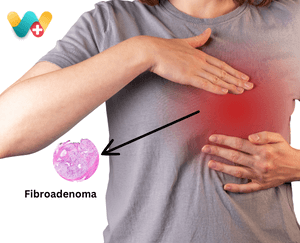
A fibroadenoma is a benign (non-cancerous) breast lump made up of glandular and fibrous tissue. It is one of the most common benign breast conditions, especially in women between 15 and 35 years of age. A fibroadenoma usually feels like a smooth, firm or rubbery lump that moves easily under the skin - often described as feeling like a marble - and it is generally painless, though it can feel tender around the time of a period.
Fibroadenomas are believed to be sensitive to the hormone oestrogen, which is why they can grow larger during pregnancy, while breastfeeding, or with hormone therapy, and tend to shrink after menopause. Having a fibroadenoma does not usually raise your risk of breast cancer, but the diagnosis must always be confirmed by a doctor first. The main types our doctors see are -
- Simple Fibroadenoma - the most common type, uniform in appearance and not linked to increased cancer risk.
- Complex Fibroadenoma - contains cysts, calcifications or other changes; usually larger and seen in older patients.
- Giant Fibroadenoma - a rare, larger type measuring over 5 cm across, sometimes causing visible breast asymmetry and more often needing surgical review.
- Juvenile Fibroadenoma - occurs in adolescent girls and can sometimes grow rapidly during puberty.
| Also known as | Breast mouse, benign breast fibroadenoma, breast lump (when newly found and unconfirmed) |
|---|---|
| Commonly affects | Women and adolescent girls aged 15-35; can also occur later, including during pregnancy or on hormone therapy |
| Main symptoms | Smooth, firm, rubbery, freely movable lump; usually painless; occasional tenderness before periods |
| Common causes | Increased breast-tissue sensitivity to oestrogen; hormonal changes of puberty, pregnancy or breastfeeding; family history |
| Diagnosis | Triple assessment - clinical breast exam, ultrasound or mammogram, and biopsy/FNAC where advised |
| Homeopathic approach | Individualised, constitutional care for confirmed, monitored benign cases, alongside regular medical follow-up |
| Typical treatment duration | Reassessed for change over roughly 3-6 months, with periodic imaging |
| When to seek urgent care | Hard, irregular, fixed or rapidly growing lump; skin dimpling; nipple discharge or retraction; underarm swelling |
Fibroadenoma vs Breast Cancer: How They Differ
A fibroadenoma and a cancerous breast lump differ mainly in texture, mobility and behaviour, though only clinical examination and imaging can confirm which one you have. A fibroadenoma typically feels smooth, round, rubbery and moves freely under the skin, while a cancerous lump more often feels hard, irregular in shape, and fixed in place rather than mobile. Fibroadenomas also rarely cause skin dimpling, nipple retraction or nipple discharge, whereas these signs are more concerning for malignancy and need prompt evaluation.
Because some early cancers - including certain fast-growing subtypes - can occasionally look deceptively smooth and well-defined on a scan, doctors never rely on look or feel alone. This is exactly why a new lump is worked up with a triple assessment: clinical examination, imaging (ultrasound, and mammogram where appropriate), and a tissue sample (biopsy or FNAC) when the picture isn't completely clear. Once this process confirms a benign fibroadenoma, you and your doctor can then discuss whether to monitor it or consider treatment, including complementary homeopathic care.
Common Symptoms We Treat
Patients usually come to us after a fibroadenoma has already been identified on a clinical exam or scan. The typical presentation includes -
- Smooth, movable lump - slides easily under the fingers when examined.
- Firm or rubbery texture - distinct from the surrounding breast tissue.
- Usually painless - though some lumps are mildly tender.
- Tenderness before periods - linked to hormonal fluctuation.
- Well-defined, round or oval shape - with clear borders on imaging.
- Single or multiple lumps - some patients have more than one fibroadenoma at a time.
What Causes Fibroadenomas?
The exact cause of fibroadenoma is not fully understood, but doctors believe it is closely linked to hormonal activity. Commonly recognised contributing factors include -
- Increased sensitivity of breast tissue to oestrogen.
- Reproductive age - most common between 15 and 35 years.
- Hormonal changes during pregnancy or breastfeeding.
- Use of hormone replacement therapy.
- Family history of fibroadenoma.
- Natural hormonal fluctuation around the menstrual cycle.
Fibroadenoma During Pregnancy and Breastfeeding
Fibroadenomas can enlarge during pregnancy and breastfeeding because rising oestrogen and prolactin levels stimulate the glandular tissue they're made of. A fibroadenoma that was barely noticeable before pregnancy may become firmer or more obvious, and in rare cases a lump can develop into a lactating adenoma - a related, harmless growth linked to milk-producing tissue. Any new or fast-changing lump noticed during pregnancy or breastfeeding still needs the same clinical exam and ultrasound evaluation as at any other time, since imaging choices and monitoring plans may be adjusted for safety during this period. Most fibroadenomas that enlarge in pregnancy settle back down after delivery or once breastfeeding ends.
Does a Fibroadenoma Need to Be Removed, or Can It Be Monitored?
Most confirmed, small, stable fibroadenomas do not need to be removed and can instead be safely monitored with a "watch and wait" approach - periodic clinical exams and imaging every few months to a year to confirm the lump isn't changing. Surgical removal is generally reserved for fibroadenomas that are large, rapidly growing, painful, cosmetically bothersome, or where imaging or biopsy findings aren't fully reassuring. Many fibroadenomas stay the same size for years, and some shrink or resolve on their own over time, particularly after menopause.
When Should a Breast Lump Be Checked?
Any new breast lump should always be examined by a doctor promptly - this is true even if the lump feels smooth, soft and painless, which is the typical description of a fibroadenoma. Only a clinical exam and imaging can confirm what a lump actually is, and a proper diagnosis must come before considering any home or complementary approach. See a doctor without delay if you notice -
- A new lump that you haven't had checked before.
- A lump that is growing in size over weeks or months.
- A hard, irregular or fixed lump that doesn't move freely under the skin.
- Skin changes over the lump - dimpling, puckering or redness.
- Nipple discharge or retraction that is new or unexplained.
- Swelling or a lump in the armpit alongside the breast lump.
Important: Please do not assume any breast lump is "just a fibroadenoma" on your own. Book a clinical examination and, if advised, an ultrasound or mammogram, so a doctor can confirm the diagnosis and rule out anything that needs urgent attention. Homeopathic care should only begin after this medical evaluation is complete.
Common Diagnostic Approach
Once you consult a doctor about a breast lump, the typical diagnostic pathway includes -
- Clinical breast examination - the doctor checks the size, shape, texture and mobility of the lump.
- Ultrasound - usually preferred for women under 40, as it clearly shows whether the lump is solid or fluid-filled.
- Mammogram - may be used, particularly in women over 40 or where ultrasound findings need further clarification.
- Biopsy or FNAC - a tissue sample may be taken and tested in a lab to confirm the lump is a benign fibroadenoma and rule out anything of concern.
Note: Not every case needs a biopsy - younger patients with a typical, small, stable lump on ultrasound may only need periodic monitoring. Your doctor will decide what's appropriate based on your individual scan and exam findings.
Care & Monitoring Tips
- Perform a monthly breast self-examination to notice any new or changing lump early.
- Go for an annual clinical breast exam, even if you feel well.
- Keep track of any change in the size, shape or tenderness of a known fibroadenoma.
- Follow your doctor's advice on periodic ultrasound follow-up.
- Maintain a healthy body weight and a balanced, nutrient-rich diet.
- Report any new lump or breast change to your doctor without delay.
How Homeopathy Approaches Fibroadenoma
Allopathy typically manages a fibroadenoma with either watchful monitoring or surgical removal, depending on its size and behaviour. Homeopathy offers a complementary, non-invasive option for patients whose fibroadenoma has already been medically confirmed as benign and is being monitored - it is not a substitute for the diagnostic process itself.
The Homeopathic Approach - Supporting Medically-Confirmed, Monitored Cases
Once your fibroadenoma has been confirmed through a clinical exam and imaging, Dr. Laxmi and the team at WeClinic™ Homeopathy in Kanpur take a detailed case history covering the size, number and duration of your lump(s), your hormonal and menstrual pattern, and your general constitution. Based on this, and on your existing diagnostic reports, an individualised remedy and potency is considered for your case, alongside continued medical monitoring of the lump.
Commonly Referenced Homeopathic Remedies for Fibroadenoma
Classical homeopathic literature references several remedies for glandular breast swellings, each suited to a different type of case, such as -
Often referenced for glandular swelling of the breast with soreness or pain, particularly around the time of menstruation.
Frequently cited for hard, glandular breast lumps that are painful or sensitive to touch.
Considered for nodules that feel very hard, where the tissue tends to form firm, well-defined knots.
Referenced for glandular hardness in patients with a generally chilly constitution and a tendency toward slow tissue changes.
Traditionally used for fibrous, cyst-like glandular growths, particularly where there is a general tendency to overgrowths.
Often referenced for glandular swellings in patients with a chilly, sluggish constitution and a general tendency toward slow-growing lumps.
Considered for hard, slow-developing glandular nodules, particularly in younger patients with a delayed general development pattern.
Important: Homeopathic care described here applies only to fibroadenomas that a qualified doctor has already examined and confirmed, through clinical assessment and imaging (and biopsy, where advised), to be benign. Homeopathy is not a substitute for the medical evaluation of any new breast lump, and self-medication is strongly discouraged. Please do not attempt to self-diagnose or self-treat a breast lump - book a consultation so our doctors can review your reports and guide you safely.
Benefits of Homeopathic Fibroadenoma Care
- Natural treatment with no side effects
- Non-invasive, needle-free approach
- Suitable alongside regular medical monitoring
- No risk of dependency - completely non-addictive
- Personalised to your specific case history
Homeopathy vs Allopathy (Surgery) for Fibroadenoma
Both approaches aim to address a confirmed fibroadenoma, but they work very differently -
Allopathy
- Often recommends observation, or surgical excision for larger/growing lumps
- Surgery physically removes the lump but involves a scar and anaesthesia
- Effective for immediate removal when needed
- Does not address the underlying hormonal tendency
Homeopathy
- Considered for small, confirmed, stable fibroadenomas under medical monitoring
- Non-invasive, with no scarring or anaesthesia
- Aims to support the body's hormonal balance over time
- Requires regular imaging follow-up alongside treatment
Frequently Asked Questions About Fibroadenoma Homeopathy
Can homeopathy shrink a fibroadenoma?
Homeopathy is traditionally used to support the body's response in cases of small, medically-confirmed, benign fibroadenomas, and some patients report a reduction in lump size and tenderness over a course of treatment. However, individual results vary and homeopathy is not a guaranteed way to dissolve a fibroadenoma. Regular monitoring with your doctor is essential throughout treatment to track any change in the lump.
Is a fibroadenoma cancerous?
No. A fibroadenoma is a benign (non-cancerous) breast lump made of glandular and fibrous tissue, and simple fibroadenomas do not increase your risk of breast cancer. Complex fibroadenomas, which contain cysts or calcifications, carry a very slightly higher long-term risk, which is why every new lump should first be evaluated by a doctor to confirm the diagnosis.
Does every fibroadenoma need surgery?
No. Most small, confirmed fibroadenomas that are not growing or causing discomfort can simply be monitored with periodic clinical exams and imaging. Surgical removal is generally considered only when a fibroadenoma is large, rapidly growing, painful, causing visible asymmetry, or when imaging or biopsy results are unclear.
What is the best homeopathic medicine for fibroadenoma?
There is no single best medicine - homeopathy is individualised, and remedies such as Phytolacca Decandra, Conium Maculatum, Calcarea Fluorica, Silicea and Thuja Occidentalis are commonly referenced in classical literature for different fibroadenoma presentations. The right remedy and potency depend entirely on your specific case, so it should only be prescribed after a proper case-history consultation with a qualified homeopathic doctor, once your diagnosis has been medically confirmed.
Can a fibroadenoma come back after treatment?
It's possible to develop new fibroadenomas elsewhere in the breast tissue even after one has resolved or been removed, particularly in women who remain hormonally sensitive. This is usually a new growth rather than a true recurrence of the original lump. Ongoing monitoring and periodic breast checks help catch any new lump early.
Is homeopathic treatment a substitute for medical evaluation of a breast lump?
No, and this is very important - homeopathic care is only appropriate for a lump that a doctor has already examined and confirmed, through clinical examination and imaging, to be a benign fibroadenoma. Homeopathy should never replace the initial medical evaluation, ultrasound or biopsy needed to rule out anything concerning. WeClinic™ doctors will always ask for your diagnostic reports before starting treatment.
How long does homeopathic treatment take to show results for fibroadenoma?
Response time varies with the size, number and duration of the fibroadenoma, but many patients on a monitored homeopathic course are reassessed for change over 3-6 months. Because fibroadenomas grow and shrink slowly, treatment is typically longer-term, with periodic imaging to track progress alongside symptom relief.
When should a breast lump be checked by a doctor?
Any new breast lump should be checked by a doctor promptly, whatever its size. See a doctor without delay if the lump is hard, irregular in shape, rapidly growing, fixed in place, associated with skin dimpling or nipple discharge or retraction, or if there is swelling in the armpit. Even a lump that feels smooth and mobile - the typical description of a fibroadenoma - needs a clinical exam and imaging to confirm what it actually is before any home or complementary approach is considered.
What causes fibroadenoma and who is at risk?
The exact cause isn't fully understood, but fibroadenomas are believed to be linked to increased sensitivity to the hormone oestrogen. They are most common in women between 15 and 35, may grow during pregnancy, breastfeeding or hormone therapy, and can run in families. They tend to shrink after menopause once oestrogen levels drop.
What is the difference between a fibroadenoma and breast cancer?
A fibroadenoma is a benign, smooth, rubbery lump that moves freely under the skin, while a cancerous lump more often feels hard, irregular in shape and fixed in place, and may come with skin dimpling or nipple changes. However, texture alone is not reliable enough to tell them apart, which is why doctors confirm the diagnosis with a triple assessment - clinical exam, imaging and, where needed, a biopsy - before any lump is labelled a fibroadenoma.
What is a giant fibroadenoma?
A giant fibroadenoma is a fibroadenoma that grows larger than about 5 cm across, sometimes causing visible breast asymmetry or discomfort. Giant fibroadenomas are still benign, but because of their size they are more often reviewed for surgical removal after imaging and biopsy confirm the diagnosis, rather than being left for observation alone.
Can a fibroadenoma grow during pregnancy or breastfeeding?
Yes - fibroadenoma can enlarge during pregnancy or breastfeeding because rising oestrogen and prolactin levels stimulate the glandular tissue it's made of. A lump that changes noticeably during this time should still be examined and imaged by a doctor to confirm it remains a benign fibroadenoma, and most such lumps settle back down after delivery or once breastfeeding ends.
How do I check my breasts for a lump like a fibroadenoma at home?
A monthly breast self-exam involves visually checking both breasts for changes in shape or skin, then using the flat pads of your fingers to feel each breast in a systematic pattern (in the shower and lying down), checking for any new lump, thickening or tenderness, and also feeling the armpit area. A self-exam is a useful awareness habit, but it cannot replace a clinical breast exam and imaging - any lump you find, however it feels, still needs to be checked by a doctor.
Is fibroadenoma common in teenagers?
Yes - fibroadenoma is one of the most common breast lumps found in teenage girls and young women, often called a juvenile fibroadenoma when it occurs during adolescence. These can occasionally grow faster during puberty because of the hormonal changes of that stage, but like other fibroadenomas they are benign and are managed with the same clinical exam, imaging and monitoring approach used for adults.
Get Clarity on Your Breast Lump, the Right Way
Book a free consultation with WeClinic™'s experienced homeopathic doctors and get doctor-guided, monitored care for your medically-confirmed fibroadenoma.
Call Now - Book Free Consultation Prefer to visit in person? Book a Clinic Appointment