

 Our specialists are online... Call now...
























Key Takeaways
- What it is: Psoriasis is a chronic, immune-mediated skin disease in which skin cells multiply far faster than normal, forming raised, silvery-scaled plaques that itch, burn or crack.
- Not contagious: Psoriasis cannot be caught or spread from person to person by touch, sharing objects or close contact - it is driven by an overactive immune system, not an infection.
- Who it affects: Psoriasis affects men and women of all ages, most often first appearing between 15 and 35 years, and around one in three cases run in families.
- Common triggers: Flare-ups are commonly triggered by stress, throat infections, cold dry weather, skin injury, smoking, alcohol and certain medicines such as lithium and beta-blockers.
- Homeopathic approach: Homeopathy for psoriasis is individualised and constitutional, aiming to calm the underlying immune imbalance rather than only suppressing the visible patches.
- Treatment timeframe: Many patients report a reduction in redness, scaling and itching within about 6-10 weeks, though psoriasis is chronic and completing the full course is advised for lasting improvement.
- Safety point: Up to around a third of people with psoriasis may develop psoriatic arthritis, so new joint pain, stiffness or swelling should always be evaluated by a doctor.
What Is Psoriasis?
Psoriasis is a chronic, immune-mediated skin disease in which the immune system speeds up the skin cell life cycle, causing cells to build up rapidly on the surface instead of shedding normally. This build-up forms raised, red patches covered with silvery-white scales that can itch, burn or crack. It's a long-term condition that tends to flare up and settle down in cycles, and while it isn't curable in the conventional sense, symptoms can be managed well with the right treatment.
Psoriasis isn't one single presentation - it shows up differently depending on where and how it affects the skin. The most common types we see at WeClinic™ are:
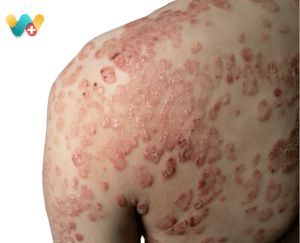
- Plaque Psoriasis - the most common form, raised red patches with silvery-white scales.
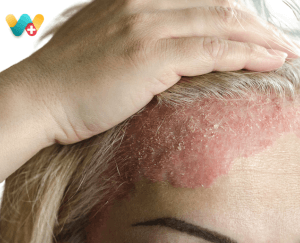
- Scalp Psoriasis - red, scaly patches on and around the scalp, often mistaken for dandruff.
- Guttate Psoriasis - small, drop-shaped spots, often triggered by a throat infection.
- Inverse Psoriasis - smooth, red patches in skin folds like the armpits or groin.
- Nail Psoriasis - pitting, discoloration and thickening of the finger or toenails.
- Pustular Psoriasis - white, pus-filled blisters surrounded by red, inflamed skin.
| Also known as | Psoriasis vulgaris; plaque psoriasis (most common form) |
|---|---|
| Commonly affects | Men and women of all ages, most often first appearing between 15-35 years |
| Main symptoms | Raised red patches with silvery-white scales, itching, burning, dry cracked skin, scalp flaking, nail pitting |
| Common causes | Overactive immune system plus genetic predisposition, set off by triggers like stress, infection, injury or cold weather |
| Diagnosis | Clinical skin, scalp and nail examination; occasionally a skin biopsy; blood tests or joint imaging if psoriatic arthritis is suspected |
| Homeopathic approach | Individualised, constitutional remedies aimed at the underlying immune imbalance rather than only the visible patches |
| Typical treatment duration | Many patients report visible improvement within 6-10 weeks; the full course is advised as psoriasis is chronic |
| When to seek urgent care | Widespread redness with fever or chills, extensive pus-filled blisters, or new joint pain and swelling |
Common Psoriasis Symptoms We Treat
Psoriasis symptoms vary depending on the type and how much of the body is affected. Our doctors regularly treat patients with the following presentations -
- Red/scaly patches - raised plaques covered with silvery-white scales, commonly on elbows, knees & lower back.
- Itching & burning - persistent itch that can range from mild to intense, sometimes with a stinging sensation.
- Dry, cracked skin - skin that may crack and occasionally bleed, especially over joints.
- Scalp scaling - flaking and redness on the scalp that extends to the hairline.
- Nail changes - pitting, thickening or separation of the nail from the nail bed.
- Joint pain - stiffness & swelling in cases linked with psoriatic arthritis.
- Thickened skin - patches that feel leathery or raised in long-standing cases.
What Causes Psoriasis?
The exact cause of psoriasis isn't fully understood, but it's considered an immune-system condition that develops from a mix of genetic and environmental factors. Common causes and triggers include -
- Overactive immune system response.
- Genetics & family history.
- Stress and emotional strain.
- Skin injury such as cuts, burns or sunburn.
- Certain infections, especially strep throat.
- Cold, dry weather.
- Smoking & heavy alcohol use.
- Certain medications, including lithium and antimalarials.
Who Is Most at Risk?
While psoriasis can affect anyone, certain factors make some people more susceptible than others -
- Family history: having a parent or close relative with psoriasis significantly raises your risk.
- Age: psoriasis can appear at any age but most commonly develops between 15-35 years.
- Lifestyle: smoking, heavy alcohol use and obesity are linked with higher risk and more severe flare-ups.
- Other conditions: a weakened immune system or a history of frequent infections can increase susceptibility.
Common Diagnostic Tests
To confirm psoriasis and rule out other skin conditions, doctors typically recommend -
- Physical examination - most cases are diagnosed by a doctor examining the skin, scalp and nails.
- Skin biopsy - a small skin sample may be examined to rule out other conditions in unclear cases.
- Blood tests - to check inflammatory markers and screen for related conditions like psoriatic arthritis.
- Joint examination / imaging - recommended if joint pain suggests psoriatic arthritis.
Note: These tests are usually recommended in more advanced or unclear cases and are not required for every patient.
Prevention & Trigger-Avoidance Tips
- Keep skin well-moisturised, especially in cold weather.
- Manage stress through relaxation techniques & regular exercise.
- Avoid known personal triggers like certain foods or alcohol.
- Protect skin from cuts, burns and excessive sun exposure.
- Treat infections like strep throat promptly.
- Get early treatment for flare-ups instead of ignoring them.
How Homeopathy Treats Psoriasis
Homeopathy treats psoriasis by addressing the underlying immune imbalance through individualised, constitutional remedies chosen to match the whole person, not just the visible skin patches. By contrast, allopathy typically manages psoriasis with topical steroids, vitamin D creams or, in more severe cases, immunosuppressant medication that controls flare-ups temporarily but doesn't address the root cause - and long-term use can bring side effects such as skin thinning, rebound flares or increased infection risk. Homeopathy takes an entirely different approach.
The Homeopathic Approach - Treating the Root Cause, Not Just the Patches
Homeopathy doesn't treat psoriasis as an isolated "skin problem" - it looks at your overall constitution. Our doctors at WeClinic™ Homeopathy in Kanpur, including Dr. Sonali Verma, take a detailed case history: which areas are affected, what makes the itching or scaling better or worse (heat, cold, stress, scratching), the exact nature of the eruption (dry, oozing, cracked), and your general physical and mental makeup. Based on this, an individualised remedy and potency is prescribed for your specific case.
Commonly Referenced Homeopathic Remedies for Psoriasis
Classical homeopathic literature references several homeopathic medicines for skin conditions, each suited to a different psoriasis presentation, such as -
For dry, rough, scaly skin with restlessness, where itching is worse from cold and better from warmth.
Often considered for thick, cracked skin that oozes a sticky, honey-like discharge, particularly at skin folds.
For intense burning and itching that worsens with warmth and scratching, with rough, unhealthy-looking skin.
Considered for thick, deeply fissured skin that cracks and oozes, especially during winter months.
Often referenced for chronic, ring-shaped patches with persistent itching, sometimes linked with hormonal changes.
Associated with thick scaling and dry, rough skin with intense itching that is worse at night.
Commonly referenced where the skin sheds large, dry flakes and scales, leaving raw, red skin underneath.
Often considered for psoriasis along the hairline and in the bends of joints, particularly in reserved patients affected by grief or stress.
Referenced for chronic, dirty-looking, intensely itchy skin where the itching tends to feel worse from warmth and in winter.
Associated with thickened, scaly skin and nail changes, often with itching that worsens from warmth and at night.
Important: This information is for educational purposes only. Please do not self-medicate. WeClinic™ doctors prescribe the right remedy and dosage only after a detailed personal case-history consultation, so book your free consultation before starting any treatment.
Benefits of Homeopathic Psoriasis Treatment
- Natural treatment with no side effects
- No risk of dependency - completely non-addictive
- Treats the root cause, not just the visible patches
- Safe for long-term, chronic use
- Suitable for all age groups
Homeopathy vs Allopathy for Psoriasis
Both approaches aim to relieve psoriasis symptoms, but they work very differently -
Allopathy
- Focuses on quick symptom relief with steroid creams & immunosuppressants
- Flare-ups often return once medicine is stopped
- Long-term use can cause side effects
- Treats the skin patches in isolation
Homeopathy
- Focuses on the root cause of the immune imbalance
- Aims for lasting relief with a complete course
- Natural remedies, safe for long-term use
- Treats the patient's overall constitution
Possible Complications of Untreated Psoriasis
Untreated or poorly controlled psoriasis can lead to complications beyond the skin, because it is a whole-body inflammatory condition rather than a purely cosmetic one. Being aware of these risks is a reason to seek care early rather than wait -
- Psoriatic arthritis: up to around a third of people with psoriasis develop joint pain, stiffness and swelling that can cause lasting joint damage if ignored.
- Skin infection & cracking: deeply fissured or scratched plaques can crack, bleed and become infected.
- Metabolic & heart risks: psoriasis is linked with a higher risk of obesity, type 2 diabetes, high cholesterol and cardiovascular problems.
- Emotional & social impact: visible patches and constant itching can affect confidence, sleep and mood, and stress can in turn trigger more flare-ups.
- Widespread or pustular flares: rarely, psoriasis can become widespread or turn into erythrodermic or generalised pustular psoriasis, which need urgent medical care.
If you develop widespread redness with fever or chills, extensive pus-filled blisters, or new joint pain and swelling, seek medical evaluation promptly - these can signal severe forms of psoriasis or psoriatic arthritis.
Psoriasis Diet: What to Eat and What to Avoid
Diet does not cause psoriasis, but an anti-inflammatory pattern of eating can support treatment and may reduce how often flare-ups occur. Our doctors at WeClinic™ include a free personalised diet chart with every psoriasis treatment plan; the general principles are -
Foods to Favour
- Oily fish and omega-3 sources like flaxseed and walnuts
- Fresh fruit, leafy greens and colourful vegetables
- Whole grains and fibre-rich foods
- Turmeric, ginger and other anti-inflammatory spices
- Plenty of water to keep skin hydrated
Foods to Limit
- Alcohol, a well-recognised psoriasis trigger
- Excess sugar and refined carbohydrates
- Fried, processed and heavily packaged foods
- Red and processed meat in large amounts
- Any personal trigger foods you notice worsen your skin
Frequently Asked Questions About Psoriasis Homeopathy
Can homeopathy cure psoriasis permanently?
Homeopathy treats psoriasis at a constitutional level, working on the underlying immune imbalance rather than only suppressing the visible patches. Many patients experience significant, long-term improvement in skin clarity, scaling and itching when they follow the complete course prescribed by the doctor, though psoriasis is a chronic condition and periodic flare-ups can still occur with triggers like stress or infection.
Is psoriasis contagious?
No. Psoriasis is not contagious and cannot be spread by touch, sharing objects or close contact. It is an immune-system condition in which skin cells are produced much faster than normal, causing them to build up into raised, scaly patches.
What is the difference between psoriasis and eczema?
Psoriasis and eczema can look similar but have different causes. Psoriasis is an immune-mediated condition that speeds up skin cell turnover, producing thick, well-defined, silvery-scaled plaques, often on the elbows, knees and scalp. Eczema (dermatitis) is usually linked to a weakened skin barrier and allergic sensitivity, causing intensely itchy, less defined, sometimes weepy patches. A doctor's examination is the most reliable way to tell them apart.
Which is the best homeopathic medicine for psoriasis?
There is no single best medicine - homeopathy is individualised, and remedies like Arsenicum Album, Graphites, Sulphur, Petroleum, Sepia and Kali Arsenicosum are commonly referenced in classical literature for different psoriasis presentations. The right remedy and potency depend entirely on your specific skin pattern and constitution, so it should only be prescribed after a proper case-history consultation with a qualified homeopathic doctor.
Is scalp psoriasis treated differently from plaque psoriasis on the body?
Scalp psoriasis is still the same underlying condition as plaque psoriasis elsewhere on the body, but our doctors often adjust the remedy selection and guidance around hair-care routines, since scalp patches can be thicker, itchier and more visible. The constitutional homeopathic approach remains the same - treating the root cause rather than just the local scaling.
Can diet affect psoriasis?
Diet does not cause psoriasis, but many patients notice that certain foods - such as excess sugar, fried and processed foods, or alcohol - can worsen inflammation and trigger flare-ups. Our doctors provide a free personalised diet chart alongside treatment to help you identify and manage your individual triggers.
Is psoriasis linked to arthritis?
Yes. Up to around 30% of people with psoriasis may go on to develop psoriatic arthritis, a related condition causing joint pain, stiffness and swelling. If you notice joint symptoms alongside your skin patches, it's important to mention this during your consultation so treatment can address both together.
How long does homeopathic treatment take to show results in psoriasis?
Most patients notice a reduction in redness, scaling and itching within 6-10 weeks of starting treatment, though this varies with the type of psoriasis, how long you've had it, and its severity. Since psoriasis is a chronic condition, doctors usually recommend completing the full course for lasting, root-cause improvement rather than stopping as soon as symptoms ease.
Is psoriasis genetic or hereditary?
Genetics does play a role - having a parent or close relative with psoriasis increases your risk - but not everyone with a family history develops the condition. Psoriasis is thought to result from a combination of genetic predisposition and environmental triggers such as stress, infections or skin injury.
Does homeopathic psoriasis treatment have any side effects?
No. Homeopathic remedies used at WeClinic™ are natural and prescribed in individualised, minimal doses, so they do not carry the side effects commonly associated with long-term steroid creams or immunosuppressant use, such as skin thinning, rebound flares or increased infection risk.
Is psoriasis an autoimmune disease?
Yes - psoriasis is classified as an immune-mediated (autoimmune) condition. In psoriasis the immune system becomes overactive and speeds up the skin cell life cycle from around a month to just a few days, so cells pile up on the surface as thick, scaly plaques instead of shedding normally. This is why psoriasis is chronic and why homeopathy focuses on the underlying immune imbalance rather than only the visible skin.
Does psoriasis spread from one part of the body to another?
Psoriasis does not spread by touch and cannot be passed to other people, but existing patches can enlarge and new patches can appear on other areas during a flare-up. A skin injury such as a cut, scratch or sunburn can also trigger a fresh plaque at that exact spot - a reaction known as the Koebner phenomenon. Managing triggers and starting treatment early helps limit how far it spreads.
What triggers a psoriasis flare-up?
A psoriasis flare-up is most commonly triggered by emotional stress, throat and other infections, cold or dry weather, skin injury, smoking, heavy alcohol use, and certain medicines such as lithium, beta-blockers and antimalarials. Triggers differ from person to person, so identifying your own pattern - and avoiding it - is a key part of keeping psoriasis under control alongside treatment.
What are the warning signs of psoriatic arthritis?
The warning signs of psoriatic arthritis include joint pain, stiffness and swelling, swollen fingers or toes that look sausage-like, morning stiffness that lasts more than 30 minutes, pain at the heel or the back of the ankle, and lower back pain. These symptoms can start years after the skin patches appear, so anyone with psoriasis who develops joint pain should have it evaluated promptly to protect the joints from lasting damage.
How does psoriasis affect mental and emotional health?
Psoriasis can have a significant emotional impact, and many patients experience low self-confidence, social anxiety, sleep disturbance or low mood because of visible patches and persistent itching. Stress can in turn trigger further flare-ups, creating a cycle. At WeClinic™ Homeopathy in Kanpur, the constitutional case history taken by doctors such as Dr. Sonali Verma also considers a patient's mental and emotional state, which is a core part of individualised homeopathic prescribing.
Start Your Journey to Clearer Skin Today
Book a free consultation with WeClinic™'s experienced homeopathic doctors and get a treatment plan made for your specific case.
Call Now - Book Free Consultation Prefer to visit in person? Book a Clinic Appointment