


 Our specialists are online... Call now...

































Key Takeaways
- Not a worm: Ringworm (tinea corporis) is a contagious fungal skin infection caused by dermatophyte fungi, not a parasite or worm, despite its misleading name.
- Who it affects: Ringworm can affect anyone but is especially common in children, athletes, pet owners and people living in hot, humid climates such as much of India.
- How it spreads: Ringworm spreads through skin-to-skin contact, infected pets like cats and dogs, and shared towels, clothing and bedding, which is why it often runs through a whole household.
- Steroid creams worsen it: Applying steroid or steroid-combination creams to ringworm suppresses the skin's defences and produces a widespread, hard-to-recognise infection called tinea incognito.
- What homeopathy does: Homeopathy takes an individualised, constitutional approach that aims to address both the fungal rash and the underlying tendency of the skin to keep developing infections.
- Treatment timeframe: Many patients notice reduced itching and slower spread within a few weeks, though recurring or long-standing ringworm usually needs a longer, complete course.
- Safety point: Ringworm remains contagious during an active infection, so household-wide treatment and washing clothing, towels and bedding in hot water are essential to stop it recurring.
What Is Ringworm?
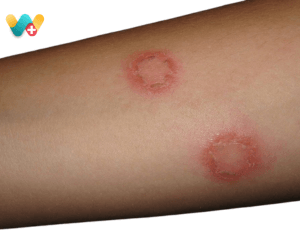
Ringworm is a contagious fungal skin infection that produces a characteristic ring-shaped, red or pink rash with a raised, scaly border and clearer skin in the centre. Despite the name, there is no actual worm involved - the infection is caused by a group of fungi called dermatophytes, which thrive on keratin, the protein found in the outer layer of skin, hair and nails. This "ringworm is not a worm" confusion is one of the most common misconceptions our doctors correct, and it matters because deworming tablets do nothing for it - only antifungal or constitutional treatment does.
Ringworm can affect almost any part of the body, and doctors use different names depending on the location of the infection. The types we most commonly see and treat at WeClinic™ include -
- Tinea Corporis (Body) - the classic ring-shaped rash on the torso, arms & legs; the main focus of this page.
- Tinea Capitis (Scalp) - scaly, itchy patches with hair loss, common in children.
- Tinea Cruris (Groin) - commonly called "jock itch," a red, itchy rash in the groin folds.
- Tinea Pedis (Feet) - commonly called "athlete's foot," itchy, cracked skin between the toes.
- Tinea Unguium (Nails) - thickened, discoloured or crumbly nails.
- Tinea Barbae (Beard area) - itchy, scaly patches in the bearded region of the face and neck.
| Also known as | Tinea corporis, tinea capitis (scalp), dermatophytosis, "dad" (in Hindi) |
|---|---|
| Commonly affects | Children and school-goers, athletes, pet owners, and people in hot, humid climates |
| Main symptoms | Ring-shaped rash with a raised scaly border, intense itching, redness and flaking; hair loss patches on the scalp |
| Common causes | Contagious dermatophyte fungi spread by skin contact, pets, and shared towels, clothing and bedding |
| Diagnosis | Clinical examination, KOH skin scraping under microscope, Wood's lamp and fungal culture in unclear cases |
| Homeopathic approach | Individualised, constitutional remedies aimed at both the rash and the tendency to recur |
| Typical treatment duration | Early relief often within a few weeks; recurring or chronic ringworm needs a longer complete course |
| When to seek urgent care | Widespread or fast-spreading rash, scalp involvement with hair loss, or a rash worsened by steroid creams (possible tinea incognito) |
Common Ringworm Symptoms We Treat
Ringworm symptoms can vary a little depending on the location and how long the infection has been present. Our doctors regularly treat patients with the following presentations -
- Ring-shaped rash - a raised, red or pink ring with clearer skin in the centre.
- Itching - often intense, especially at night or after sweating.
- Scaly, flaky skin - most noticeable along the raised border of the rash.
- Redness & inflammation - around the edge of the ring.
- Multiple or overlapping rings - patches that merge into larger, irregular shapes.
- Blistering or oozing - in more inflamed, neglected or scratched cases.
What Causes Ringworm?
Ringworm is a contagious infection caused by dermatophyte fungi that spread easily under the right conditions. Common causes include -
- Contagious dermatophyte fungi that thrive on the skin's outer layer.
- Direct skin-to-skin contact with an infected person.
- Contact with infected pets or farm animals.
- Sharing towels, clothing, combs or sports gear.
- Warm, humid weather and excessive sweating.
- Walking barefoot in public showers, gyms or locker rooms.
- Tight, non-breathable clothing that traps moisture.
- Weakened immunity or uncontrolled diabetes.
Who Is Most at Risk?
Ringworm most commonly affects children, athletes, pet owners and people living in hot, humid climates, though anyone can catch it. Certain groups are especially prone to catching it or having it recur -
- Children & school-goers: close contact in classrooms and playgrounds spreads scalp and body ringworm easily.
- Athletes & gym-goers: shared mats, showers and sports gear increase exposure.
- Pet owners & farm workers: frequent contact with animals that may carry the fungus.
- People with diabetes or weak immunity: infections tend to be more frequent, severe and harder to clear.
- Those living in hot, humid climates: warm, sweaty skin is an ideal environment for fungal growth.
Common Diagnostic Tests
To confirm ringworm and rule out other skin conditions, doctors typically recommend -
- Physical examination - the doctor examines the size, shape and pattern of the rash.
- KOH microscopy - a skin scraping is examined under a microscope to confirm fungal elements.
- Wood's lamp examination - a special UV light used to detect certain fungal infections, particularly of the scalp.
- Fungal culture - used in resistant or unclear cases to identify the exact fungus involved.
Note: These tests are usually recommended in resistant, recurring or unclear cases and are not required for every patient.
Prevention & Hygiene Tips
- Keep skin clean and thoroughly dry, especially in skin folds.
- Wear loose, breathable cotton clothing.
- Avoid sharing towels, clothing, combs or sports gear.
- Wash hands after touching pets; get pets checked for hair loss or scaly skin.
- Wear slippers in public showers, pools & locker rooms.
- Change out of sweaty clothes promptly.
- Wash bedding, towels & clothing in hot water during an active infection.
- Avoid scratching to prevent spreading the infection to other body parts.
Why Steroid Creams Make Ringworm Worse (Tinea Incognito)
Steroid creams make ringworm worse because they suppress the skin's local immune defence, which lets the fungus spread further and faster while temporarily masking the itching. The result is a condition doctors call tinea incognito - ringworm that has lost its classic ring shape and appears as large, blurred, discoloured patches that are hard to recognise and treat. This is a major, widespread problem in India, where potent steroid and steroid-antifungal-antibiotic combination creams are often sold over the counter and applied to any itchy rash.
- Steroids calm the itch briefly, so people keep applying them while the infection quietly spreads.
- The ring border blurs, patches merge, and the rash can cover large areas of the body.
- Skin may thin, discolour or develop stretch-mark-like lines from prolonged steroid use.
- The infection becomes stubborn, deeper and much slower to clear once treated correctly.
Important: Never apply steroid creams or unlabelled "all-in-one" skin creams to a ring-shaped rash. If you have already used them and the rash has spread, tell your doctor - Dr. Sonali Verma and the team at WeClinic™ Homeopathy in Kanpur regularly manage steroid-modified, hard-to-treat ringworm and will factor this history into your case.
Ringworm vs Eczema vs Granuloma Annulare
Ringworm, eczema and granuloma annulare can all form patches on the skin but are three very different conditions that need different treatment. Telling them apart matters because antifungal treatment only helps true fungal ringworm.
- Ringworm is a contagious fungal infection with a well-defined, ring-shaped, scaly, itchy border and clearer skin in the centre - it spreads and responds to antifungal or constitutional treatment.
- Eczema is a non-contagious inflammatory condition causing dry, itchy, ill-defined patches without a true ring shape, usually linked to allergies or a sensitive skin barrier rather than infection.
- Granuloma annulare is a non-contagious, non-fungal condition that forms smooth, firm, ring-shaped bumps with no scaling and little or no itch, so antifungal treatment does nothing for it.
Because these look alike and are sometimes mistaken for one another, a doctor's examination - and, where needed, a simple skin scraping - helps confirm which condition is present before treatment begins.
How Long Does Ringworm Take to Clear?
Ringworm clearance time depends on where the infection is, how long it has been present, and whether steroid creams have been used. A single fresh patch of body ringworm often improves within a few weeks of correct treatment, whereas scalp ringworm, nail involvement, recurring infections and steroid-modified tinea incognito take considerably longer. Many patients under homeopathic care notice reduced itching and slower spread of the rash early on, but doctors usually advise completing the full course rather than stopping the moment the visible rash fades, because living fungus can remain and trigger a relapse.
How Homeopathy Treats Ringworm
Homeopathy treats ringworm with individualised, constitutional remedies that aim to clear the fungal rash while also addressing the underlying tendency of the skin to keep developing infections. This differs from conventional antifungal creams and tablets, which clear the visible rash but don't always address why the infection keeps returning - and many patients find the rash reappears within weeks of stopping treatment. At WeClinic™ Homeopathy in Kanpur, Dr. Sonali Verma and the team take an entirely different, whole-person approach.
The Homeopathic Approach - Treating the Tendency to Recur, Not Just the Rash
Homeopathy doesn't treat ringworm as an isolated skin patch - it looks at your overall constitution and why your skin is prone to fungal infection in the first place. Our doctors at WeClinic™ take a detailed case history: where the patches appear, what makes the itching better or worse, how the infection has behaved over time, and your general physical and mental makeup. Based on this, an individualised remedy and potency is prescribed for your specific case.
Commonly Referenced Homeopathic Remedies for Ringworm
Classical homeopathic literature references several homeopathic medicines for ringworm and other fungal skin infections, each suited to a different presentation, such as -
Often considered for isolated, well-defined, ring-shaped patches appearing at scattered spots on the skin.
Commonly referenced for chronic or recurring ringworm with intense itching that is worse at night and burning after a hot bath.
Considered when multiple patches merge into large, map-like lesions that may ooze, have an odour, and itch intensely at night.
Often used for a marked tendency toward ringworm infections that keep returning again and again.
Frequently referenced for fungal patches in skin folds - the groin, behind the knees or elbows, behind the ears and between the toes.
Considered in long-standing, chronic skin eruptions with intense itching that worsens with the warmth of the bed.
Commonly referenced for scalp ringworm with thick crusts or scabs, with a sticky discharge beneath that mats the hair.
Often considered where ringworm involves the nails, leaving them thickened, brittle or discoloured, with associated skin scaling.
Frequently referenced for ringworm affecting the beard area and for fungal eruptions on sweaty, oily skin.
Considered where ringworm appears in the bends of joints and along the hairline, with dry, itchy, flaky skin.
Important: This information is for educational purposes only. Please do not self-medicate. WeClinic™ doctors prescribe the right remedy and dosage only after a detailed personal case-history consultation, so book your free consultation before starting any treatment.
Benefits of Homeopathic Ringworm Treatment
- Natural treatment with no side effects
- Addresses the tendency for infections to recur
- Treats the root cause, not just surface symptoms
- Safe for long-term, chronic use
- Suitable for all age groups, including children
Homeopathy vs Allopathy for Ringworm
Both approaches aim to clear ringworm, but they work very differently -
Allopathy
- Focuses on quickly clearing the visible rash with antifungal creams & tablets
- Infection often returns once treatment is stopped
- Long courses of oral antifungals can strain the liver
- Treats the skin patch in isolation
Homeopathy
- Focuses on the root cause and recurring tendency
- Aims for lasting relief with a complete course
- Natural remedies, safe for long-term use
- Treats the patient's overall constitution
Frequently Asked Questions About Ringworm Homeopathy
Can homeopathy cure ringworm permanently?
Homeopathy treats ringworm at a constitutional level, addressing the underlying tendency of the skin to develop fungal infections rather than just clearing the visible rash. Most patients see significant, lasting improvement in itching and rash spread when they complete the full course prescribed by the doctor, and the chances of the infection recurring are lower compared to using antifungal creams alone.
Is ringworm contagious?
Yes, ringworm is highly contagious. It spreads through direct skin-to-skin contact with an infected person or animal, and indirectly through shared towels, clothing, combs, sports gear or contaminated surfaces such as gym mats and locker room floors. Warm, humid conditions make the fungus spread more easily.
Why does ringworm keep recurring?
Ringworm often keeps coming back when the underlying source of infection - an infected pet, family member or contaminated item - isn't treated alongside the patient, or when treatment is stopped as soon as the rash fades instead of completing the full course. A humid environment, excessive sweating, tight clothing and weakened immunity also make some people more prone to repeated fungal infections.
Which homeopathic medicine is best for ringworm?
There is no single best medicine - homeopathy is individualised, and remedies like Sepia, Sulphur, Tellurium, Bacillinum, Graphites and Psorinum are commonly referenced in classical literature for different ringworm presentations. The right remedy and potency depend entirely on your specific symptoms and pattern of infection, so it should only be prescribed after a proper case-history consultation with a qualified homeopathic doctor.
Can pets spread ringworm to humans?
Yes. Cats, dogs and other pets can carry the ringworm fungus, sometimes without showing obvious symptoms, and it can transfer to humans through petting, grooming or contact with bedding. If a family member has recurring ringworm, it's worth getting pets checked by a vet for patches of hair loss or scaly skin.
Is homeopathic treatment safe for children with ringworm?
Yes, homeopathic medicines are prepared from natural sources and, in doctor-prescribed doses, are considered safe and gentle for children, who are commonly affected by scalp and body ringworm through school and playground contact. Our doctors adjust the remedy and potency based on the child's age, symptoms and overall constitution.
How long does homeopathic treatment take to show results in ringworm?
Many patients notice reduced itching and slower spread of the rash within a few weeks of starting treatment, though the exact timeline depends on how long the infection has been present and whether it is recurring. For lasting, root-cause relief, doctors usually recommend completing the full course rather than stopping as soon as the visible rash clears.
What is the difference between ringworm and eczema?
Ringworm is a fungal infection that typically forms a well-defined, ring-shaped rash with a raised, scaly border and clearer skin in the centre, and it is contagious. Eczema is a non-contagious inflammatory skin condition that causes dry, itchy, often ill-defined patches without the characteristic ring shape, and it is usually linked to allergies or a sensitive skin barrier rather than infection. Because the two can look similar, a doctor's examination helps tell them apart.
Does homeopathic ringworm treatment have any side effects?
No. Homeopathic remedies used at WeClinic™ are natural and prescribed in individualised, minimal doses, so they do not carry the side effects sometimes associated with long-term oral antifungal use, such as liver strain or drug interactions.
What causes ringworm?
Ringworm is caused by contagious dermatophyte fungi that thrive on the outer layer of skin, hair and nails. It spreads through direct contact with an infected person or animal, shared personal items, and contact with contaminated surfaces, and it is more likely to take hold on skin that is warm, sweaty or kept covered in tight, non-breathable clothing.
Is ringworm actually caused by a worm?
Ringworm is not caused by a worm at all - it is a fungal skin infection, and the name simply describes the ring-shaped rash it produces. The infection is caused by dermatophyte fungi that feed on keratin in the skin, hair and nails, which is why deworming tablets have no effect on it and antifungal, not anti-parasitic, treatment is needed.
Can steroid creams make ringworm worse?
Steroid creams and over-the-counter combination creams containing steroids can make ringworm significantly worse. Steroids suppress the skin's local immune response, which temporarily calms itching but lets the fungus spread further, blurs the classic ring shape and produces a hard-to-recognise pattern called tinea incognito. This misuse is a common reason ringworm becomes widespread and stubborn in India, so ring-shaped rashes should never be treated with steroid creams.
Should the whole family be treated for ringworm?
When ringworm keeps spreading within a household, treating only one person often fails because the fungus passes back and forth through shared beds, towels, clothing and surfaces. Infected family members and pets should be treated at the same time, and bedding, towels and clothes should be washed in hot water and dried thoroughly, so the whole household clears the infection together rather than reinfecting each other.
Is ringworm still contagious while being treated?
Ringworm remains contagious in the early days of treatment and generally stops spreading once the rash has been treated for a few days and the skin begins to heal. During an active infection it is sensible to avoid sharing towels and clothing, keep the area covered where practical, and continue treatment for the full course, since stopping early allows living fungus to remain and spread again.
What is the difference between ringworm and granuloma annulare?
Ringworm is a contagious fungal infection that produces a scaly, itchy ring with a flaky border, whereas granuloma annulare is a non-contagious, non-fungal skin condition that forms smooth, firm, ring-shaped bumps without scaling or itching. Because granuloma annulare is not caused by fungus, antifungal treatment does not help it, so a rash that looks like a ring but has no scale or itch should be examined by a doctor rather than assumed to be ringworm.
Start Your Journey to Clear, Infection-Free Skin Today
Book a free consultation with WeClinic™'s experienced homeopathic doctors and get a treatment plan made for your specific case.
Call Now - Book Free Consultation Prefer to visit in person? Book a Clinic Appointment