


 Our specialists are online... Call now...



























Key Takeaways
- What it is: Vitiligo (also called leucoderma) is a chronic autoimmune skin condition in which patches of skin lose their natural colour because pigment-producing cells (melanocytes) are destroyed.
- Who it affects: Vitiligo can begin at any age and in any gender, though around half of all cases start before age 20, and it often runs in families with a history of autoimmune conditions.
- Not contagious: Vitiligo cannot spread from person to person through touch or contact - it is an internal autoimmune process, not an infection.
- Main causes: The condition is mainly linked to the immune system attacking melanocytes, with genetics, autoimmune thyroid disease, oxidative stress and skin trauma (Koebner phenomenon) as common contributing factors.
- What homeopathy aims to do: WeClinic™'s individualised homeopathic treatment aims to slow the spread of white patches and support the skin's natural repigmentation process, rather than promising a guaranteed cure.
- Typical timeframe: Because melanocyte regeneration is slow, stabilisation of patches may take a few months, while visible repigmentation, where it occurs, generally takes considerably longer and varies by individual.
- Safety point: Vitiligo patches lack protective melanin and sunburn more easily, so daily sun protection is an essential part of care alongside any treatment.
What Is Vitiligo?
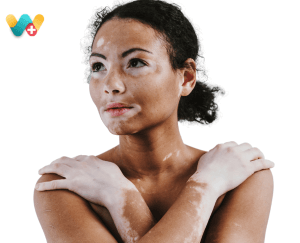
Vitiligo is a chronic autoimmune skin condition in which the body's own immune system attacks and destroys melanocytes, the cells responsible for producing skin pigment, resulting in smooth, flat white patches on the skin. It is also commonly known in India as leucoderma - the two names describe the same condition, with "leucoderma" being the older, more general term still widely used in everyday language, while "vitiligo" is the precise medical term. It is not an infection, and it is not contagious.
At WeClinic™ Homeopathy in Kanpur, our doctors, including Dr. Sonali Verma, regularly see the full range of vitiligo presentations, and treatment is tailored to the specific type our doctors identify in your case. Vitiligo can appear differently from person to person, both in where it affects the body and how it progresses. The main types our doctors evaluate are:
- Segmental Vitiligo - affects one area or one side of the body, often starts young and tends to stabilise after a year or two.
- Non-Segmental (Generalized) Vitiligo - the most common type, with patches appearing in a roughly symmetrical pattern on both sides of the body.
- Focal Vitiligo - one or only a few isolated patches, without a clear symmetrical or segmental pattern.
- Universal Vitiligo - a rare, extensive form affecting nearly all of the skin's surface.
- Acrofacial Vitiligo - patches concentrated on the face, hands, and around body openings like the eyes, nose and ears.
- Mucosal Vitiligo - affects the mucous membranes, such as the lips and the inside of the mouth or nose.
| Also known as | Leucoderma, white patch disease, vitiligo vulgaris |
|---|---|
| Commonly affects | Any age or gender; roughly half of cases begin before age 20 |
| Main symptoms | Flat, milky-white depigmented patches; premature greying of hair; loss of colour inside the mouth or nose |
| Common causes | Autoimmune destruction of melanocytes, genetics, autoimmune thyroid disease, oxidative stress, skin trauma (Koebner phenomenon), significant stress |
| Diagnosis | Physical examination, Wood's lamp test, blood tests for thyroid/autoimmune markers, occasionally a skin biopsy |
| Homeopathic approach | Individualised, constitutional treatment aiming to slow patch spread and support natural repigmentation |
| Typical treatment duration | Several months for stabilisation; visible repigmentation, where it occurs, generally takes considerably longer |
Common Symptoms We Treat
The main symptom of vitiligo is the appearance of flat, milky-white patches on the skin with fairly well-defined borders, most often starting on the hands, face and around body openings. Beyond the patches themselves, our doctors most commonly see patients with the following -
- White / depigmented patches - flat, milky-white patches with fairly well-defined edges.
- Symmetrical patches - patches appearing on corresponding areas on both sides of the body.
- Premature greying - early whitening or greying of scalp hair, eyebrows, eyelashes or beard.
- Mucosal involvement - loss of colour inside the mouth or nose.
- Sun sensitivity - patches that sunburn more easily than surrounding skin.
- Patches at body openings - depigmentation around the eyes, nostrils, navel and genitals.
What Causes Vitiligo?
Vitiligo is most commonly caused by the body's own immune system mistakenly attacking and destroying melanocytes, the pigment-producing cells in the skin, though the exact trigger for this autoimmune reaction is not fully understood. Research points to a combination of the following contributing factors -
- Autoimmune destruction of melanocytes (pigment cells).
- Genetics & family history of vitiligo.
- Association with other autoimmune conditions, especially thyroid disease.
- Oxidative stress within the skin.
- Sunburn or skin trauma at the site of a future patch (Koebner phenomenon).
- Significant emotional stress or major life events.
- Certain chemical exposures affecting pigment cells.
- Neurogenic factors, particularly in segmental vitiligo.
Who Is Most at Risk?
Vitiligo can affect anyone, at any age, but certain factors are associated with a higher likelihood of developing it -
- Family history: having a close relative with vitiligo increases your risk, though most cases occur without any known family history.
- Personal or family history of autoimmune disease: particularly autoimmune thyroid disorders, which are the most commonly seen association.
- Age of onset: around half of all cases begin before the age of 20.
- History of skin trauma or sunburn: injury to the skin can sometimes trigger new patches at that site.
Common Diagnostic Tests
Diagnosing vitiligo usually starts with a visual examination and case history, and may include -
- Physical examination - assessing the pattern, distribution and borders of the patches.
- Wood's lamp examination - a UV light test that makes depigmented vitiligo patches fluoresce brightly, helping distinguish vitiligo from other causes of white patches.
- Blood tests - to check for thyroid dysfunction or other autoimmune markers, given the known association.
- Skin biopsy - occasionally used in unclear cases to confirm the absence of melanocytes.
Note: These tests help confirm the diagnosis and rule out look-alike conditions; not every patient needs every test.
Care & Trigger-Avoidance Tips
- Use sunscreen on patches to prevent sunburn, which can worsen or trigger new patches.
- Avoid unnecessary skin trauma, friction or tattoos where possible.
- Manage stress through regular routine, sleep and relaxation.
- Avoid harsh chemicals and skin-lightening or bleaching products.
- Get thyroid and general health check-ups if you have a family history of autoimmune disease.
- Follow a balanced, nutrient-rich diet as guided by your doctor.
Sun Protection, Skin Care & Camouflage for Vitiligo
Daily broad-spectrum sunscreen (SPF 30 or higher) on and around depigmented patches is the single most important everyday care step for vitiligo, since these areas have lost the melanin that normally protects skin from UV damage. Alongside sunscreen, our doctors generally advise the following -
- Reapply sunscreen every 2-3 hours when outdoors, and cover patches with clothing, caps or scarves where practical.
- Moisturise regularly since depigmented skin can sometimes feel more sensitive or dry than surrounding areas.
- Camouflage or colour-correcting makeup - specially formulated, waterproof camouflage creams can even out the appearance of patches for social or professional occasions; these do not treat vitiligo but are a safe cosmetic option many patients use alongside treatment.
- Remove camouflage products daily to let the skin breathe, inspect for changes, and apply your prescribed treatment or sunscreen.
- Avoid self-tanning products on unaffected skin only, as this can make the contrast between normal and patched skin more visible.
Coping With the Emotional & Social Impact of Vitiligo
Vitiligo itself causes no pain and does not affect general physical health, but the visible change in skin appearance can have a real emotional and social impact, and this is taken seriously as part of care - not dismissed as "just cosmetic." In India in particular, visible white patches are still sometimes met with unfair social stigma, misplaced assumptions about contagiousness, or comments that affect a person's confidence, relationships or even marriage prospects. It is worth repeating clearly: vitiligo is not contagious, not caused by anything "impure," and not a reflection of a person's health or character - it is simply an autoimmune skin condition.
At WeClinic™, our doctors recognise that supporting a patient through vitiligo means addressing both the skin and the person - encouraging open conversation about how the condition is affecting daily life, involving family members where helpful, and setting realistic, honest expectations about treatment timelines rather than adding pressure with unrealistic promises. Support groups, counselling where needed, and simply accurate information about the condition can meaningfully ease the psychological burden alongside medical treatment.
How Homeopathy Treats Vitiligo
Homeopathy treats vitiligo through an individualised, constitutional approach that looks at your overall immune and physical picture rather than treating the visible patches in isolation, with the aim of slowing further spread and supporting the skin's own repigmentation process where possible. Vitiligo is a genuinely difficult, chronic autoimmune condition, and it is important to approach it with realistic expectations, whichever system of medicine you choose - allopathic options such as topical steroids, light therapy or depigmentation therapy also focus mainly on the visible patches, and results vary widely between patients regardless of the approach used.
The Homeopathic Approach - Working With Your Constitution
At WeClinic™, our doctors take a detailed case history before prescribing anything - the size, shape, location and spread pattern of your patches, when they first appeared, any family or personal history of autoimmune conditions like thyroid disease, and your general physical and mental constitution. Based on this complete picture, an individualised remedy and potency is selected for your specific case, and treatment is reviewed periodically since vitiligo tends to respond slowly.
Commonly Referenced Homeopathic Remedies for Vitiligo
Classical homeopathic literature references several remedies for vitiligo and leucoderma, each suited to a different type of case, such as -
Often referenced as a specific remedy for vitiligo, particularly where patches are considered to be spreading relatively quickly.
Considered for cases linked with hormonal imbalance and skin discoloration, particularly in women.
Referenced for cases with weakened immunity, slow skin healing and a generally depleted constitution.
Considered for patients with a chilly, sluggish constitution and a family history of skin or glandular issues.
Referenced for cases where emotional stress or grief appears connected to the onset or spread of patches.
A commonly referenced constitutional remedy in chronic skin conditions with a tendency towards slow resolution.
Often referenced for early-onset cases, including in children, where growth appears slow alongside the skin changes.
Considered where vitiligo occurs alongside a personal or family history of thyroid or glandular imbalance.
Referenced for anxious, restless constitutions with dry skin and a tendency for patches to be associated with underlying unease.
Important: Vitiligo is a genuinely challenging condition to treat, and homeopathy - like every system of medicine - cannot guarantee complete repigmentation in every case. Treatment aims to slow progression and support the skin's natural repigmentation process over a sustained course, and outcomes vary depending on the type, duration and extent of your vitiligo. This information is for educational purposes only; please do not self-medicate. WeClinic™ doctors prescribe the right remedy and dosage only after a detailed personal case-history consultation, so book your free consultation before starting any treatment.
What Homeopathic Vitiligo Treatment Aims to Do
- Natural treatment with no known side effects
- No risk of dependency - completely non-addictive
- Works towards the underlying constitutional picture
- Safe for long-term, sustained use
- Suitable for all age groups, including children
Homeopathy vs Allopathy for Vitiligo
Both approaches aim to help manage vitiligo, but they work quite differently -
Allopathy
- Focuses on the visible patches with topical steroids or light therapy
- Results and side effects vary widely between patients
- Long-term topical steroid use can thin the skin
- Treats the patch in isolation
Homeopathy
- Focuses on the underlying constitutional & immune picture
- Aims for gradual, sustained improvement with a complete course
- Natural remedies, considered safe for long-term use
- Treats the patient's overall constitution, not just the patch
Frequently Asked Questions About Vitiligo Homeopathy
Can homeopathy cure vitiligo permanently?
Vitiligo is a genuinely challenging, chronic autoimmune condition, and no system of medicine - including homeopathy - can promise a guaranteed or permanent cure for every patient. What homeopathy aims to do is work at the constitutional level to help slow down the spreading of patches and encourage the skin's natural repigmentation process over time. Results vary from person to person depending on the type of vitiligo, how long you have had it, and how consistently the treatment is followed, so it's important to have realistic, doctor-guided expectations.
Is vitiligo curable at all?
Vitiligo does not currently have a definitive medical cure in any system of medicine, since it involves the immune system attacking the pigment-producing cells (melanocytes) in the skin. Treatment - whether homeopathic or conventional - generally focuses on stabilising the condition, slowing further spread, and supporting repigmentation in the affected patches rather than promising complete reversal in every case.
Is vitiligo contagious?
No, vitiligo is not contagious in any way. It cannot spread from person to person through touch, sharing personal items, or any other form of contact. It is an autoimmune condition where the body's own immune system affects pigment cells, not an infection.
Is vitiligo hereditary?
Genetics do play a role - having a parent or close family member with vitiligo does increase your risk - but vitiligo does not follow a simple, predictable pattern of inheritance. Many people with vitiligo have no family history of it at all, and many people with a family history never develop it, since environmental triggers and immune factors are also involved.
Does stress trigger vitiligo?
In people who are already genetically predisposed to vitiligo, significant emotional stress, illness, hormonal changes or physical exhaustion are commonly reported to trigger the onset of new patches or a flare-up of existing ones. Physical skin trauma such as sunburn, cuts or friction can also trigger new patches at the injury site, a reaction known as the Koebner phenomenon.
Which homeopathic medicine is best for vitiligo?
There is no single best medicine - homeopathy is individualised, and remedies such as Arsenicum Sulphuratum Flavum, Sepia Officinalis, Silicea, Calcarea Carbonica, Natrum Muriaticum and Sulphur are commonly referenced in classical literature for different vitiligo presentations. The right remedy and potency depend entirely on your specific case, so it should only be prescribed after a detailed case-history consultation with a qualified homeopathic doctor, not self-administered.
How long does homeopathic treatment take to show results in vitiligo?
Vitiligo tends to respond slowly compared to many other skin conditions, since melanocyte regeneration is a gradual biological process. Some patients notice early signs such as stabilisation of existing patches (no further spreading) within a few months, while visible repigmentation, where it occurs, can take considerably longer and varies widely between individuals. Doctors usually recommend a sustained course with periodic review rather than expecting quick results.
Can vitiligo spread to other parts of the body?
Yes, vitiligo can spread over time, particularly in the non-segmental (generalised) type, where new patches may appear in a fairly symmetrical pattern on both sides of the body. Skin trauma, sunburn or friction at a new site can also trigger fresh patches there. Segmental vitiligo, by contrast, tends to affect one area or one side of the body and is less likely to spread widely.
What is the difference between vitiligo and other white patches on the skin?
Vitiligo is a confirmed autoimmune condition where melanocytes are specifically destroyed, producing patches that are usually completely white (depigmented) with well-defined borders. Other causes of white or pale patches - such as fungal infections (tinea versicolor), certain chemical exposures, or post-inflammatory marks after an injury or rash - can look similar but have different underlying causes. A doctor typically uses a physical examination and, where needed, a Wood's lamp test to tell them apart.
Is homeopathic treatment safe for long-term use in vitiligo?
Yes, homeopathic medicines are prepared from natural sources and, when taken in the doctor-prescribed dose, are generally safe for long-term, sustained use with no known dependency. This makes homeopathy a reasonable option for a slow-responding, chronic condition like vitiligo that often requires patience and an extended course of treatment.
Are vitiligo patches more sensitive to the sun?
Yes. Because the affected patches have lost their natural melanin pigment, which normally provides some protection against UV rays, they are more prone to sunburn than the surrounding skin. Sun protection over vitiligo patches is an important part of everyday care, both to prevent sunburn and because sunburn itself can potentially trigger new patches.
Is there a difference between vitiligo and leucoderma?
Vitiligo and leucoderma refer to the same underlying presentation of white, depigmented skin patches - leucoderma is simply an older, more general term (literally meaning "white skin") that is still widely used in India, while vitiligo is the specific medical term used internationally for the autoimmune condition. Doctors today generally use "vitiligo" for the true autoimmune form, though the two names are commonly used interchangeably in everyday conversation.
Does segmental vitiligo have a different outlook than non-segmental vitiligo?
Segmental vitiligo generally has a more predictable course - it tends to appear at a younger age, affects one area or one side of the body, and often stabilises within one to two years without spreading further, which some doctors consider a comparatively better prognosis for limiting new patches. Non-segmental (generalised) vitiligo tends to be more unpredictable, can continue appearing in new symmetrical areas over many years, and typically needs longer, ongoing management.
Can makeup or camouflage products safely cover vitiligo patches?
Yes, specially formulated camouflage creams and colour-correcting makeup are considered a safe, non-medical way to even out the appearance of vitiligo patches for social or professional occasions, and many patients use them alongside their ongoing treatment. These products do not treat the underlying condition, so it's still important to apply sunscreen underneath, remove the makeup daily to let the skin breathe, and continue whatever treatment your doctor has prescribed.
Is there a specific diet for vitiligo patients?
There is no single proven diet that reverses vitiligo, but doctors generally advise a balanced, nutrient-rich diet with adequate vitamin B12, folic acid, zinc, copper and antioxidants, since deficiencies in these have sometimes been associated with pigment changes. Some patients report certain foods seem to affect their patches, though this varies person to person, so it is best to discuss any specific dietary concerns with your treating doctor rather than following generic restrictive diets.
How does vitiligo in children differ from vitiligo in adults?
Vitiligo in children often starts as a single small patch, commonly on the face, hands or around body openings, and childhood-onset cases are more likely to be associated with a family history of vitiligo or autoimmune disease. Because children's skin and immune systems are still developing, doctors typically favour gentler, individualised approaches and closer monitoring, and early attention to the child's emotional wellbeing and confidence is just as important as managing the patches themselves.
Start Your Journey to Healthier, More Even Skin Today
Book a free consultation with WeClinic™'s experienced homeopathic doctors and get a treatment plan made for your specific case.
Call Now - Book Free Consultation Prefer to visit in person? Book a Clinic Appointment