


 Our specialists are online... Call now...

































Key Takeaways
- What it is: Granuloma annulare is a benign, non-contagious inflammatory skin condition that produces small, firm bumps arranged in a ring or circular pattern, most often on the hands, feet, wrists and ankles.
- Not ringworm: Granuloma annulare is frequently mistaken for ringworm, but it is not a fungal infection, so antifungal creams do not help it; a doctor tells them apart by the smooth, non-scaly border of granuloma annulare.
- Who it affects: Granuloma annulare can occur at any age but is most common in children and adults under 30, and is reported about twice as often in women as in men.
- Causes: The exact cause of granuloma annulare is unknown, but it is linked to minor skin injury, insect bites and, in generalized cases, to diabetes, thyroid disorders and high cholesterol.
- Does it clear up: Localized granuloma annulare often fades on its own within about two years, while the generalized type tends to be more persistent and prone to recurrence.
- Homeopathy's role: Homeopathic treatment for granuloma annulare is individualised and constitutional, aiming to address the underlying tendency behind recurring patches rather than only the visible lesions.
- Safety: Granuloma annulare is not dangerous or cancerous, but a persistent or spreading ring-shaped rash should be evaluated by a doctor to confirm the diagnosis and check for associated conditions.
What Is Granuloma Annulare?
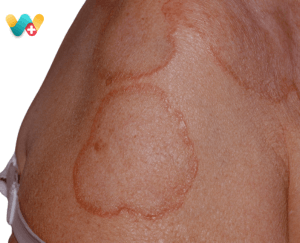
Granuloma annulare is a benign, chronic inflammatory skin condition that causes small, firm bumps to form in a ring or semicircular pattern, usually on the hands, feet, wrists or ankles. It is not contagious and not cancerous, and in most cases it causes no pain, though some patients notice mild itching.
Understanding which type of granuloma annulare you're dealing with is the first step towards effective, individualised homeopathic treatment. The main types we see at WeClinic™ are:
- Localized Granuloma Annulare - ring-shaped patches up to 5cm wide, most common in young adults.
- Generalized Granuloma Annulare - widespread bumps across the trunk, arms & legs in adults.
- Subcutaneous Granuloma Annulare - firm lumps under the skin, mainly seen in children.
- Perforating Granuloma Annulare - umbilicated bumps that may ooze a thick discharge.
| Also known as | Granuloma annulare (GA); often confused with ringworm because both form ring-shaped patches |
|---|---|
| Commonly affects | Children and adults under 30; reported about twice as often in women as in men |
| Main symptoms | Firm, ring-shaped bumps or patches on the hands, feet, wrists and ankles; usually painless, sometimes mildly itchy |
| Common causes | Cause unknown; linked to minor skin injury, insect bites, and (in generalized cases) diabetes, thyroid disorders and high cholesterol |
| Diagnosis | Clinical examination; skin biopsy in unclear cases; blood sugar and thyroid tests in generalized or recurring cases |
| Homeopathic approach | Individualised, constitutional treatment aimed at the underlying tendency behind recurring ring-shaped patches |
| Typical treatment duration | Visible change is often seen within 8-12 weeks; a full course spans several months depending on type and duration |
| When to seek care | If patches spread, persist beyond two years, or a ring-shaped rash is uncertain, see a doctor to confirm the diagnosis |
Common Symptoms We Treat
Common granuloma annulare symptoms are firm, ring-shaped bumps or patches on the skin, and they vary depending on the type and how widespread it is. Our doctors regularly treat patients with the following presentations -
- Ring-shaped patches - circular or semicircular patches, most common on the hands, feet, wrists & ankles.
- Small firm bumps (papules) - skin-coloured, pink or reddish bumps arranged in a ring.
- Widespread bumps - papules across the trunk, arms & legs in the generalized type.
- Firm lumps under the skin - common in children with the subcutaneous type.
- Discharging bumps - umbilicated lesions seen in the perforating type.
- Occasional itching - most patches are painless, though some mild itching can occur.
- Recurring patches - patches that fade in one area and reappear elsewhere over time.
What Causes Granuloma Annulare?
The exact cause of granuloma annulare is not fully understood, but it is thought to involve an inflammatory reaction that damages small areas of collagen in the skin. Possible triggers and associations include -
- The precise underlying cause remains unknown.
- Minor skin injury or trauma.
- Insect bites or stings.
- Excess sun exposure.
- Certain viral infections.
- Diabetes mellitus, especially Type 1.
- Thyroid disorders.
- High cholesterol (dyslipidemia).
Who Is Most at Risk?
Granuloma annulare most commonly affects children and young adults and is seen more often in women, though certain factors make some people more susceptible than others -
- Age: localized granuloma annulare is most common in children and young adults, while the generalized type usually appears in adults.
- Gender: the condition is reported more frequently in women than in men.
- Family history: a family history of granuloma annulare or autoimmune-type conditions may increase risk.
- Underlying conditions: diabetes and thyroid disorders are seen more often in patients with generalized or recurring granuloma annulare.
Common Diagnostic Tests
To confirm granuloma annulare and rule out other skin conditions, doctors typically recommend -
- Clinical examination - most cases are diagnosed simply from the characteristic ring-shaped appearance of the patches.
- Skin biopsy - a small skin sample examined under the microscope confirms the diagnosis in unclear cases.
- Blood sugar / HbA1c test - to check for underlying diabetes, especially in generalized or recurring cases.
- Thyroid function test - to rule out an associated thyroid disorder.
Note: These tests are usually recommended only in unclear, generalized or recurring cases and are not required for every patient.
Granuloma Annulare vs Ringworm: How to Tell Them Apart
Granuloma annulare and ringworm both form ring-shaped patches, but granuloma annulare is a non-infectious inflammatory condition while ringworm is a contagious fungal infection - which is why antifungal creams clear ringworm but do nothing for granuloma annulare. Mistaking one for the other is one of the most common reasons treatment fails, so the distinction matters before starting any cream.
Ringworm (Tinea)
- Caused by a fungus and is contagious through skin contact, animals or shared surfaces
- Border is usually scaly, flaky and raised, often clearing in the centre
- Frequently itchy and can spread quickly
- Responds to antifungal creams or tablets
Granuloma Annulare
- Not an infection and not contagious - it cannot spread to others
- Border is smooth, firm and non-scaly, made of small bumps
- Usually painless, with only occasional mild itching
- Does not respond to antifungal creams; a biopsy confirms it if unclear
If a ring-shaped patch does not improve with antifungal cream, it may be granuloma annulare rather than ringworm. A short consultation with a doctor - or a skin biopsy in unclear cases - can confirm which condition you have.
Is Granuloma Annulare Dangerous? Possible Complications
Granuloma annulare is not dangerous, not cancerous and does not damage internal organs, so in itself it is a harmless condition. The concerns it raises are mostly cosmetic and diagnostic rather than medical emergencies -
- Long-lasting patches can leave temporary discolouration, especially on darker skin.
- Persistent or widespread patches can cause self-consciousness and distress.
- Generalized granuloma annulare may point to underlying diabetes, thyroid or cholesterol issues that need checking.
- A ring-shaped rash can be mistaken for ringworm, eczema or other conditions, delaying correct care.
- Patches often recur even after clearing, which can be frustrating without a root-cause plan.
Prevention & Care Tips
- Protect your skin from cuts, scrapes and insect bites.
- Use sun protection on exposed skin.
- Keep skin well-moisturised to support healing.
- Avoid scratching the patches, even if they itch.
- Get blood sugar and thyroid levels checked periodically.
- Track any new or spreading patches and consult a doctor early.
How Homeopathy Treats Granuloma Annulare
Homeopathy treats granuloma annulare with individualised, constitutional remedies chosen to address the underlying tendency behind the ring-shaped patches rather than only the visible lesions. By contrast, allopathy typically manages granuloma annulare with topical steroids, steroid injections or, in some cases, oral medication to calm the visible patches - but these approaches don't address why the patches formed in the first place, and long-term steroid use can bring side effects such as skin thinning. At WeClinic™ Homeopathy in Kanpur, Dr. Sonali Verma and our team take an entirely different, whole-person approach.
The Homeopathic Approach - Treating the Root Cause, Not Just the Patches
Homeopathy doesn't treat granuloma annulare as an isolated "skin problem" - it looks at your overall constitution. Our doctors at WeClinic™ take a detailed case history: where the patches appear, how long you've had them, whether they itch, any family history of skin or metabolic conditions, and your general physical and mental makeup. Based on this, an individualised remedy and potency is prescribed for your specific case.
Commonly Referenced Homeopathic Remedies for Granuloma Annulare
Classical homeopathic literature references several medicines for skin nodules and ring-shaped eruptions, each suited to a different presentation, such as -
Often considered for slow-healing skin nodules and a tendency towards indurated or discharging lesions in a generally depleted constitution.
Commonly referenced for patients with a chilly, flabby constitution and a tendency towards glandular swellings and recurring skin nodules.
Traditionally considered for skin complaints that worsen in damp weather, along with an underlying tendency towards metabolic imbalance.
A classical remedy for chronic, unhealthy skin conditions with itching that is worse from heat or scratching and eruptions that heal slowly.
Frequently referenced for wart-like or nodular skin growths and ring-shaped or clustered eruptions in classical homeopathic literature.
Often considered where ring-shaped, itchy eruptions are worse in damp or cold weather and where symptoms ease with warmth and gentle movement.
Commonly referenced for skin eruptions that flare in cold, damp conditions and in patients whose complaints worsen with weather changes.
Traditionally considered for thickened, rough or nodular skin with a tendency towards slow-healing eruptions and cracked, dry patches.
Important: This information is for educational purposes only. Please do not self-medicate. WeClinic™ doctors prescribe the right remedy and dosage only after a detailed personal case-history consultation, so book your free consultation before starting any treatment.
Benefits of Homeopathic Granuloma Annulare Treatment
- Natural treatment with no side effects
- No risk of dependency - completely non-addictive
- Treats the root cause, not just the symptoms
- Safe for long-term, chronic use
- Suitable for all age groups
Homeopathy vs Allopathy for Granuloma Annulare
Both approaches aim to address granuloma annulare, but they work very differently -
Allopathy
- Focuses on topical steroids or steroid injections for visible patches
- Patches often persist or return once treatment is stopped
- Long-term steroid use can thin the skin
- Treats the visible lesion in isolation
Homeopathy
- Focuses on the underlying constitutional tendency
- Aims for lasting improvement with a complete course
- Natural remedies, safe for long-term use
- Treats the patient's overall constitution
Frequently Asked Questions About Granuloma Annulare Homeopathy
Can homeopathy cure granuloma annulare permanently?
Homeopathy treats granuloma annulare at a constitutional level, working on the underlying triggers rather than only addressing the visible ring-shaped patches. Many patients see the patches fade and new-lesion formation slow down when they complete the full course prescribed by the doctor, though - as with any chronic skin condition - results and recurrence risk vary from person to person.
Is granuloma annulare linked to diabetes?
Some studies have found granuloma annulare, especially the generalized type, occurring more often in people with diabetes mellitus (particularly Type 1), thyroid disorders and high cholesterol. This does not mean everyone with granuloma annulare has diabetes, but our doctors do check for related conditions as part of a thorough case history, especially in generalized or recurring cases.
Does granuloma annulare go away on its own?
In many cases, especially the localized type, granuloma annulare patches fade on their own within a year or two without any treatment, though this varies from patient to patient. Generalized granuloma annulare tends to be more persistent and is less likely to clear up by itself, which is when patients typically look for supportive treatment such as homeopathy.
Is granuloma annulare contagious?
No, granuloma annulare is not contagious. It cannot spread from person to person through touch or close contact, and it is not caused by any infection that can be transmitted to others.
Which homeopathic medicine is best for granuloma annulare?
There is no single best medicine for every patient - homeopathy is individualised, and remedies such as Silicea, Calcarea Carbonica, Natrum Sulphuricum, Sulphur and Thuja Occidentalis are commonly referenced in classical literature for different skin nodule and ring-eruption presentations. The right remedy and potency depend on your specific case, so it should only be prescribed after a proper consultation with a qualified homeopathic doctor.
How long does homeopathic treatment take to show results in granuloma annulare?
Most patients begin to notice a visible change in their patches, such as reduced size, colour or new-lesion formation, within 8-12 weeks of starting treatment, though this can vary with how long the condition has been present and whether it is localized or generalized. Doctors usually recommend completing the full course for the best long-term outcome rather than stopping as soon as visible improvement begins.
Does granuloma annulare come back after treatment?
Granuloma annulare can recur in the same spot or elsewhere on the body, even after the original patches have cleared, regardless of the type of treatment used. Homeopathy's constitutional approach aims to address the underlying tendency behind flare-ups, which may help reduce how often the condition returns, though no treatment can guarantee it will never recur.
Is granuloma annulare painful or itchy?
Granuloma annulare is usually painless. Some patients experience mild itching, particularly with the generalized type, but the patches are not typically tender to the touch unless there is associated skin irritation.
What causes granuloma annulare?
The exact cause of granuloma annulare is not fully understood. It is believed to involve an inflammatory reaction that damages small areas of collagen in the skin, sometimes triggered by minor skin injury, insect bites, sun exposure or viral infections. It has also been associated with diabetes, thyroid disorders and high cholesterol in some patients, though many cases occur without any identifiable trigger.
Is granuloma annulare ringworm, and will antifungal cream treat it?
Granuloma annulare is not ringworm and antifungal creams do not treat it. Although both form ring-shaped patches, granuloma annulare is a non-infectious inflammatory condition while ringworm is a contagious fungal infection. A doctor can usually tell them apart because granuloma annulare has a smooth, firm, non-scaly border, whereas ringworm is scaly and flaky - and if a ring-shaped patch does not clear with antifungal cream, it may well be granuloma annulare.
Is granuloma annulare dangerous or serious?
Granuloma annulare is not dangerous, not cancerous and does not harm internal organs, so it is considered a harmless skin condition. Its main effects are cosmetic and it can cause distress when patches persist, but generalized or recurring granuloma annulare is worth evaluating because it is sometimes linked to diabetes, thyroid or cholesterol problems that may need attention.
Can children get granuloma annulare?
Granuloma annulare is common in children, and the subcutaneous type - which forms firm, painless lumps under the skin, often on the scalp, shins or fingertips - is seen mainly in young children. It is harmless and frequently clears on its own over time, though the ring-shaped patches can understandably worry parents and are worth having checked to confirm the diagnosis.
Why does granuloma annulare keep coming back?
Granuloma annulare tends to recur because it reflects an underlying inflammatory tendency in the skin rather than a one-time infection, so patches can return in the same spot or elsewhere even after clearing. This is more common with the generalized type and in people with associated conditions such as diabetes or thyroid disorders, which is why a root-cause approach that looks beyond the visible patches is often preferred.
Start Your Journey to Clear, Healthy Skin Today
Book a free consultation with WeClinic™'s experienced homeopathic doctors and get a treatment plan made for your specific case.
Call Now - Book Free Consultation Prefer to visit in person? Book a Clinic Appointment